SPECIAL REPORT DAY 4: Is austerity working - the European perspective
THE entire eurozone was having one long, giant party all the way from the turn of the millennium until 2008.
It had to end in tears — and that is how we have the longest recession in modern history — or so the story goes.
But that is not what was being said during those years when day after day in Brussels, the message from politicians and businesses alike was that the EU was a basket case, and that it must try harder to catch up with the US, where true nirvana had been reached.
Little wonder, then, that the news of the sub-prime collapse in the US was met with a mixture of surprise and detachment during an informal meeting of EU finance ministers in Portugal on Sept 7, 2007. Bankers, finance ministers and journalists alike mused over what this strange American product was, never imagining its effects would reach all the way across the Atlantic.
But it did — finding its way a year later via Ireland’s banking system which was already poised ready to burst at the first little prick — and on into the rest of the EU’s banks that had, to the dismay of finance ministers, been playing around with derivatives and other products unknown to the public and their leaders at the time.
It found a Europe and a currency ill prepared for a shock, either politically or economically. And it took a long time for anyone to understand or admit to the scale of the tsunami engulfing the 27 EU states.
So when the crash came, it unfolded in completely unpredictable ways, splintering the EU socially, politically and economically.
It shattered illusions, reinventing stereotypes that many believed the enlarged EU had abolished making of us all one happy family. Lazy southerners, fascist northerners, stupid Irish — the pictures could be picked off EU souvenir tea-towels.
It began here in Sept 2008 and that amazing announcement that the State was guaranteeing every loan and deposit in every bank.
It assumed EU-wide significance when Angela Merkel announced that each country would look after its own banks — affirming that the currency union was just a mish-mash of countries sharing similar looking notes and coins.
And it brought the globe’s second biggest reserve currency to the brink of annihilation with the desire to punish the Greeks — and it has been tottering on the edge ever since.
The truth is even seedier. When compromise is the decision, you need a very kind hand of fate to ensure it produces the right answer. So the euro was born handicapped, a currency without a framework; it had a troubled adolescence when Germany and France insisted on breaking its only rule book — the Stability and Growth Pact — with impunity; and it has been in psychiatric care ever since with a dubious future.
When Ireland and the other periphery countries were booming thanks to the single market and the euro, they needed high interest rates. But Germany, trying to balance its books after the cost of reunification, needed them low.
The opposite is becoming true now but so far the ECB is holding steady. However that great liberator of indebted countries — inflation — is also at an all time low offering no respite and threatening to tip into deflation, exacerbating indebted countries.
So, more than four years after the EU adopted the Milton Friedman Chicago school of hard knocks and insisted austerity was the answer, how has it worked out?
Unemployment has increased to record levels; government debt has increased in most countries; incomes have dropped and the IMF says they must drop by 5% to 15% in periphery countries like Ireland, where they have already fallen to 1999 levels.
Banking, too, is still part of the problem, with the IMF warning that the link between banks and sovereigns still exists. It took the politicians some years to admit that what the eurozone was experiencing was a banking problem that went on to cannibalise the sovereigns. But the crisis has destabilised the banking balance in the eurozone, with German banks being owed huge sums as deposits flow from the poorer, indebted countries, increasing German hysteria.
Gradually the steps that should have been taken at the outset are being taken — but too slowly for those losing jobs, savings and even hoping that the EU would be a match to defend itself in an increasingly non-western world. Steps towards a banking union are continually faltering but have evolved from refusing to allow Ireland to burn bondholders to, in Cyprus’ case, having account holders forfeit their savings. But it is uncertain whether what emerges from this laboratory will ever be a genuine joined up banking union, or just a collection of loosely co-ordinated national measures.
The IMF commented on this in its latest staff report. Germany insists that treaty change is needed to create a central system to wind up or rescue banks and to guarantee deposits. But treaty change would take a long time and the proposed interim measures sees national regulators and funds coordinated by the centre is too weak, warns the IMF.
While banks may have been bailed out by taxpayers, both are now left struggling since the financial institutions are setting aside assets to meet the requirements of new banking rules so that if they go belly up, everybody’s money does not go along with them.
This feeds into the ongoing vicious cycle between the real economy and the banks as they fail to lend to the growth and job generating small and medium-sized enterprises, creating an ever widening circle of stagnation and worse.
Proposals such as shifting to a more US banking model away from the EU one, where the majority of the economy goes through banks, require time. Involving the private sector rather than banks in funding infrastructure shifts more power to the markets.
Changing mindsets away from punishment of the poor and rewarding the rich is difficult as it is inbuilt in many institutions. This is seen in the design of the European Investment Bank, which one would think would be ideally placed to deal with the catastrophe the EU finds itself in. Instead workarounds are being devised to loosen the purse strings of the world’s wealthiest bank jointly owned by the EU states but they also need to find private investors confident enough to plough money into infrastructure and other projects.
Contagion was the big threat the entire early eurozone response was designed to prevent. Germany had massive exposure, having lent an estimated €550bn — more than they were worth themselves — to the so-called PIGS (Portugal, Ireland, Greece, and Spain). The EU/IMF bailouts to these countries drastically reduced the German exposure and Germany itself bailed out some of its own dodgy banks.
But contagion has not gone away as other countries, including France, are still exposed as is the euro generally. None of the measures has put a floor under the Greek problem that has continued to worsen as each step appears to move the Greeks further into the quicksand. The massive haircut on their bonds devised by the world banking representatives, the Institute of International Finance, with the EU last year will end up costing the Greeks.
But the failure to take sufficient steps in time is now increasingly likely to end up costing the EU taxpayer. Even German politicians are now accepting that another haircut is needed — this time with the EU’s bailout fund and the ECB taking a hit. Christiane Krajewski, economic advisor to Socialist leader Peet Steinbruck and contender to be Germany’s next chancellor, said she saw no alternative. “It’s necessary to make this second cut”.
Most are agreed that at 160% of GDP, with household income falling by more than 6% in the past three months on top of a drop of more than 8% last year, an 11% fall in wages, and a 12% drop in social benefits, recovery is not part of the Greek scenario anytime soon.
UP TO now, the money from the EU’s funds has been lent at a reasonable rate of interest to countries including Ireland. But this is the first time the money is in danger of becoming a grant — and the political fallout could be interesting.
Cyprus was brought down to a large extent by the Greek bank haircut since their banks were reluctant to pull out their money in time, and their government was slow to react for a variety of political reasons.
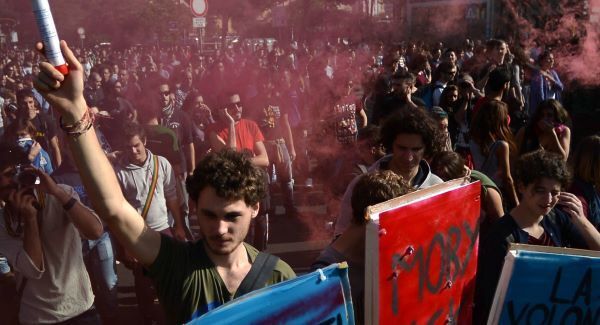
Commentator Kyriakos Pierides says they have been suffering for the past three years, a series of cuts in salaries and jobs have split society in two as the private sector has lost its dynamism, there is no work for young people and anybody with experience who can, is emigrating.
The division of the island after the Turkish invasion of 1974 left the Greek Cypriot part largely unsustainable, he believes, and a poor political system completed the damage. The credibility of the president leading the most moderate government of the past decade was severely damaged by the way he was forced to accept the troika’s terms within days of assuming office, he believes.
The only hope now is for a grand plan for the whole island designed to heal political and economic problems with help from the huge natural gas deposits found offshore. But this is a dream, he fears.
But despite being small Cyprus has the power to create a massive tidal wave. Capital controls are still in force preventing whatever money has not been already seized from leaving their depleted and struggling banks.
“When they lift the capital controls you cannot exclude anything happening — the rest of the banks could collapse as well as the Cypriot system”, warns Dimitris Katsikas, the head of the Greek Crisis Observatory.
That could see Cyprus becoming the first to leave the eurozone, and that could trigger upheavals in other countries too small to withstand, such as the tiny island of Malta, and smelling blood, the markets and the politicians could quickly change the existence of the European Monetary Union.
Even with German legislation in place that would permit them to leave the euro without leaving the EU, the cost of a break up is still massive. But according to Eurofound, even Germany is suffering the consequences of a floundering eurozone. The country suffered the largest single recent job loss with Siemens laying off 2,900 in its industry divisions due to falling demand.
Even if the euro survives and Greece remains a member putting in place the much needed reforms such as collecting taxes, the scars will be long term. There is a lot of despair with the best educated leaving but the cost is not just in jobs — it is also to the fabric of democracy with a fascist right wing group attracting support.
“They are showing their face and what is behind their face, but still people vote for them, and they have put down strong roots in parts of Athens — this will not change even if the economy changes,” warns Janis Emmanouilidis, senior analyst at the European Policy Centre in Brussels.
The IMF may be the ones that call the shots ultimately. They have already warned that if someone does not plug the hole of up to €5bn in Greece, they under their statutes cannot continue to be involved in funding them.
In the meantime their reports are becoming increasingly nervous with the latest Article IV health check on the eurozone listing every stumbling block the region faces, and leaving a large question mark over the future of the euro area itself.
With banks worse, debt worse, employment worse, growth worse, fragmentation worse and political will stretched to breaking point, the euro area is facing into a torrid autumn.


CONNECT WITH US TODAY



Be the first to know the latest news and updates