Wrong-way motorway technology could be 15 years away, Oireachtas committee told
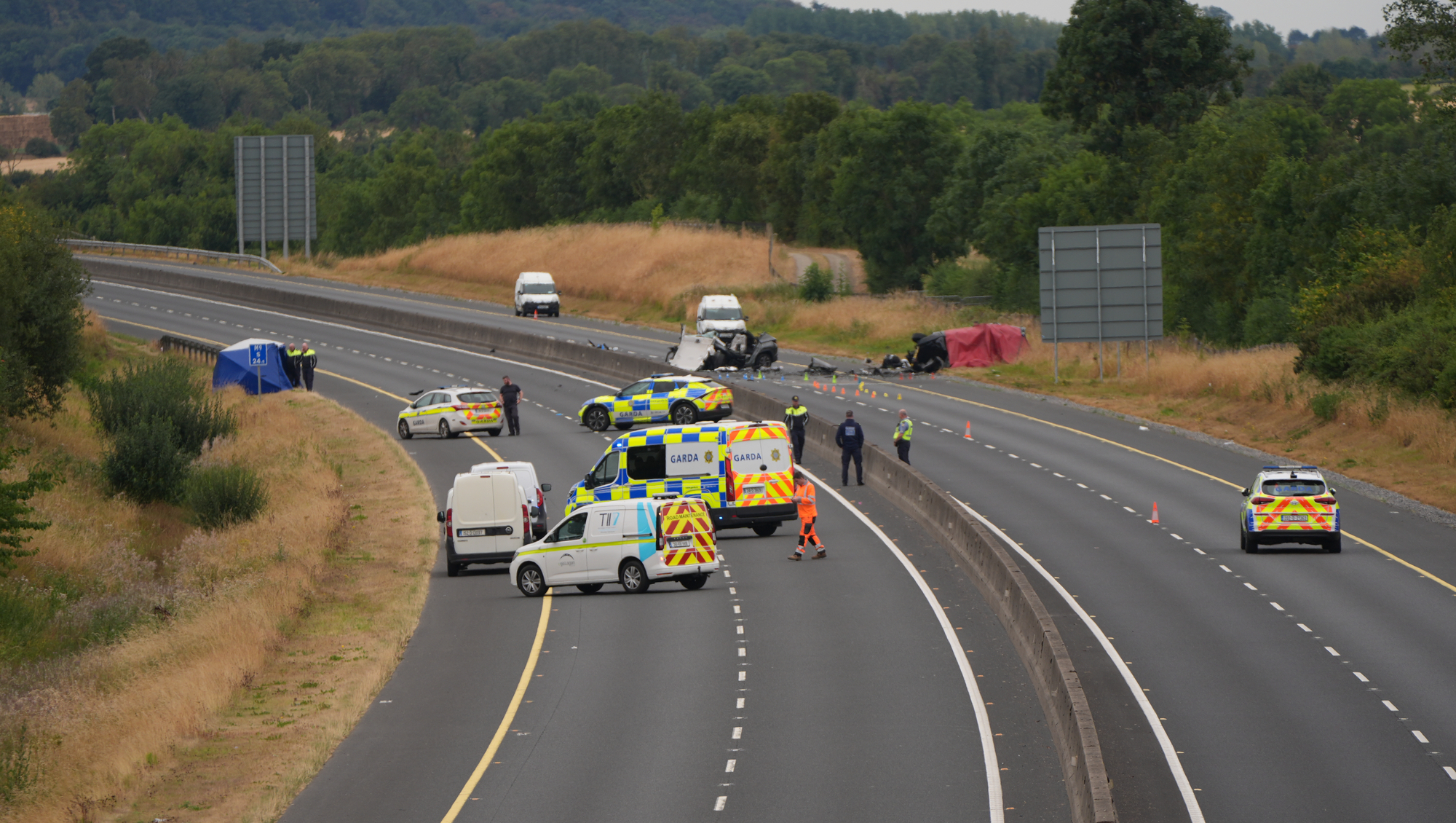
The scene on the M9 northbound at Junction 3 in Co Kildare where five people died and four were seriously injured after a head-on collision between two cars. Picture: PA
There is currently no “silver bullet” to alert drivers to wrong-way motorway driving and the technology is 10 to 15 years away, politicians have been warned.
The Road Safety Authority (RSA) has said it is “deeply concerned” about the increase in the number of people who have died or have been seriously injured so far this year, including recent high-profile motorway incidents involving vehicles driving the wrong way.
Three-quarters of the 139 people who have been killed in road crashes so far this year were men, with young people far more at risk.
Pat Maher of Transport Infrastructure Ireland (TII) said that in the future, technology “through the use of connected vehicles” will “allow communication between drivers and control centres”, but he said this will take time as only 5% of cars currently have the required technology.
He said it will be “perhaps 10, perhaps 15 years hence” before the “broader development within the fleet of these communications technologies will allow immediate transmission of messages and alerts to drivers”.
Asked by Fine Gael's Emer Currie whether mobile phone alerts have been considered, he said warnings on overhead signs have been used around the M50, but added that mobile alerts could “potentially” be part of the solution.
Read More
Members of the transport committee have also been told that motorway driving “must be part” of the driving test and is now expected to be among the Road Safety Authority's recommendations for an updated curriculum.
The RSA's chief operations officer Brendan Walsh said the authority is now working “closely” with the Department of Transport on changing the curriculum of the driver test, and officials are due to meet researchers from Queensland University who carried out work on designing a new test.
"I lived in Germany, before you do your test in Germany, you drive for four hours on the motorway under guidance. I believe we need to look at something like that," he said.
Mr Walsh added: “We will make recommendations to our colleagues in the department of transport, and then I believe we will be pushing an open door in relation to those changes.”
He was questioned by Sinn Féin Senator Joanne Collins, who said that many people do not know the rules around driving on motorways, with many people using the slow lane to pass out.
"I often drive on motorways, and I often see people driving slower in the outside lane than they're supposed to be.
"I know frustration can lead to accidents, because if you are stuck behind someone doing 50 [km] for an hour, all you want to do is put your foot to the floor to catch up, which is wrong," she said.
Junior transport minister Sean Canney previously told the Irish Examiner that he believes the driving test should be changed to include an assessment of a person's competency on motorways, and simulators could potentially be used to ensure driving on such stretches is up to scratch.
In areas where a motorway is not close to a test centre, Mr Canney suggested a simulator could be used.
RSA chief executive Sam Waide warned politicians that young drivers continue to be a “particularly high risk group”, with under-25s accounting for almost one-third of deaths.
Almost half of people who have been killed this year, 44%, were “vulnerable road users”, Mr Waide said, detailing 24 pedestrians, 21 motorcyclists, 10 cyclists and four e-scooter users who have died.
Dublin, Cork, Donegal and Kildare have seen the highest numbers of fatalities this year to date.
Appearing before the Oireachtas transport committee, Mr Waide said: “National and international evidence indicated that while this behaviour is rare compared to other dangerous driving behaviours, it poses a significant risk of fatal or serious injuries when it occurs, as this may result in head-on collisions at high speed.
“Between 2023 and 2025, there were three fatal and serious injury collisions on motorways in Ireland, where one of the vehicles was recorded as driving in the wrong direction. Two of these collisions were fatal and the third resulted in serious injuries.”

CONNECT WITH US TODAY



Be the first to know the latest news and updates