Government still aims to cut worker taxes in budget despite Iran crisis

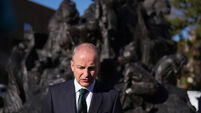
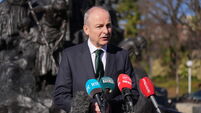
Tanaiste Simon Harris (centre) during the St Patrick's Day parade in central London. Picture: Lucy North/PA
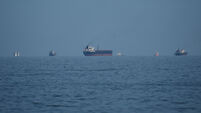
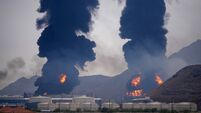
The Government is still hoping to cut workers’ taxes in the budget despite fears that the war in the Middle East will lead to spiralling prices, Tánaiste and finance minister Simon Harris has said.
Speaking to the in London, Mr Harris confirmed that the Government should know by the end of the month whether it needs to deploy any assistance following rising prices caused by the US strike on Iran and the retaliatory measures that have been seen across the Middle East.
However, he ruled out the prospect of a mini emergency budget, saying that the priority will be helping those “most in need” and then examining the “broader impact on energy”.
Petrol and diesel prices have spiralled in recent weeks, with the cost of home heating oil also rising dramatically.
In Philadelphia on Saturday, Taoiseach Micheál Martin hinted at excise cuts for fuel, as well as targeted supports for those struggling with rising energy prices.
Mr Harris told the that the Government is examining a range of options that could be unveiled if the situation deteriorates. However, the Government has still not committed to introducing any cost-of-living measures.
“Obviously, we are considering — and it would be really imprudent of us not to consider — what measures we could deploy to assist the Irish economy and therefore people and businesses, should this situation in the Gulf go on to be a protracted conflict,” the Tánaiste said.
“We are now preparing a range of possible measures that could be deployed — could — in a variety of alternative scenarios.
“The best thing to happen is for the conflict to end. Obviously, that's the best thing from a humanitarian point of view, but also from an economic point of view."
He echoed the European Commission view that a short-term conflict would have a relatively small economic impact.
"A long one will have a very different one," he said. "We are preparing a range of measures. The Taoiseach spoke to some of them [in Philadelphia].
“If this situation continues, how can you target measures? We look at a variety of other tools we've deployed in the past.
“But we need to consider all of them, and then we need to consider what is required, depending on where that scenario is at."
The Tánaiste said he is very concerned about inflation.
“The broader concern I truthfully, honestly, have, and I have to have as finance minister, is if this goes on for a long period of time, the inflationary impact," he said.
“At the moment, the focus is on energy. I get that. But if this goes on for a longer period of time, the impact of growth and inflation in the eurozone, and therefore in Ireland, is real.
“I have to make sure anything we do as a Government, we do with our eyes wide open, and it's not something that just looks like a good decision today, but actually stands the test of time.”
Mr Harris said that by the end of the month, the Government will have “a lot more clarity as to what may be required”.
However, he once again ruled out postponing the carbon tax increase that will come in at the end of April.
In an interview with the before Christmas, Mr Harris said that “barring an unforeseen shock”, he believed that the Government would be able to “get back to normal tax packages next year”, including the entry point for the higher rate of tax increasing.
When asked if the conflict in the Middle East could be that shock, the Tánaiste said, “not as yet”, and that the conflict has only been ongoing for the last two weeks.
“At the moment, I remain confident that the Irish economy is robust and strong enough to deliver a regular budget package, the rhythm that we had been in in previous years.
“Sensible, targeted investment in public services and ways of making the tax system work for working people — they’re the two pillars with which I approach this.
“I think what people are saying to me is, what do we do in the here and now between now and a budget if the energy situation continues to go in one direction, and that's why we're exploring what measures can be deployed, should they be required.”
However, Mr Harris ruled out the prospect of a mini or emergency budget in advance of the Budget 2027 announcement in October.
Speaking to reporters at Trafalgar Square, Mr Harris confirmed that the Government will fast-track plans to give the Competition and Consumer Protection Commission (CCPC) additional powers.
The plans were expected to be progressed in the autumn, but the Tánaiste said that there needs to be “greater transparency provision”.
“People right across the country now are seeing with their own eyes what's happening at petrol stations,” he said.
“Your eyes can't unsee what they've seen.”
He said that petrol stations’ prices are differing "significantly”, and he would like to see the CCPC have more powers to examine this.


CONNECT WITH US TODAY



Be the first to know the latest news and updates