Evacuation flights for Irish in the Middle East under consideration
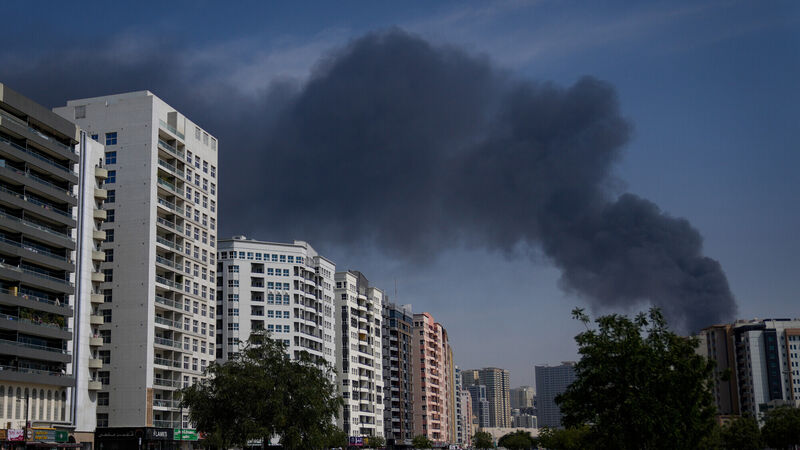
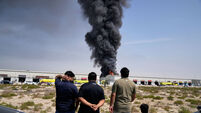
A cyclist rides past as black plume of smoke is seen rising from a warehouse at the industrial area of Sharjah City in the United Arab Emirates following reports of Iranian strikes in Dubai. Picture: AP Photo/Altaf Qadri)
The Government is raising the possibility of chartered flights to evacuate Irish citizens from the Middle East, as foreign affairs minister Helen McEntee says contingency planning is ongoing around the “fast-evolving situation”.
There are an estimated 22,000 Irish citizens living across the Middle East. The Department of Foreign Affairs is urging them to take shelter amid escalating conflict in the region. The Israeli-US war with Iran has widened in recent hours, with Iranian-backed militias firing rockets at Israel and other Arab states.
Read More
Asked about the prospect of Irish citizens being evacuated from the region, Ms McEntee said Ireland had an understanding with the UK for both states to “support each other” in situations like this.
Ms McEntee said EU foreign ministers had agreed on Sunday that there should be “close coordination” between member states in case any find themselves able to evacuate citizens.
“It is a fast-evolving situation. What we are trying to assess is what is safe, what routes are open, what are the possible options here,” Ms McEntee said.
“Of course, that contingency planning, that work is being done and has been done over the weekend.
“Where we can and where we have in the past chartered flights ourselves. That, of course, is an option that we would prefer and we’re looking at as well. We’ll have everything now in place should that possibility arise.”
Ms McEntee said she understood that many Irish citizens want to leave the region.
“We are doing everything that we can with our teams on the ground and with our teams working here, 24/7 in Ireland, to make sure those options are available to Irish citizens,” Ms McEntee said.
The foreign affairs minister said she understood some Irish citizens wished to travel by land to countries like Oman, saying the safety of this is currently being assessed.
“It is very difficult to encourage people to travel, what may be an eight or nine-hour journey, where things are evolving so quickly. But of course, we are keeping all of this under consideration,” Ms McEntee said.
She said Ireland is engaging with the EU and UK to see if this is an option for Irish citizens to evacuate, adding that the Government is talking directly to airlines to see how best to assist individuals in the Gulf.
Ms McEntee said it is “not possible” as of yet to provide evacuation plans to people, while saying it is “logistically challenging” for Ireland due to the high number of civilians in the region.
“Our focus and priority has to be to de-escalate, to call on all of those involved to show restraint and to not respond to the escalating violence and to try and bring everyone back to the table.” Ms McEntee said.
On Irish troops stationed in Lebanon, Ms McEntee said all Irish troops are safe and that any decision to withdraw troops would be taken in cooperation with UNIFIL.
“I've spoken to our Chief of Staff this morning a number of times, and I'm speaking to them quite regularly," Ms McEntee said.
“All of our troops are safe. We know that the situation overnight has escalated in Lebanon. We know that there have been significant strikes, both by Hezbollah, but also Israel.
“What I'm informed of is that our troops will be staying there for the moment.
“We don't want our troops to be put in more danger, potentially by moving from where they are."
Meanwhile, Tánaiste Simon Harris said he was concerned about the price of oil and gas increasing due to the war with Iran if there is a “supply shock”.
Mr Harris said the Government would be monitoring the situation closely, saying there were a lot of unknowns at present.
“Does this situation de-escalate relatively quickly? Is this something that goes on for a prolonged period of time? The difference between those two things economically could be very significant,” Mr Harris said.
Asked why the Government had not condemned the US attacks against Iran, when it had condemned the Russian invasion of Ukraine, Mr Harris said there is “complexity” there.
He said there was no comparison between the Ukrainian government and the “brutal, despotic regime” in Iran, saying it had no respect for human rights, women and protest.
Mr Harris said the Government’s priority needed to be on protecting Irish citizens and working at an EU level to monitor possible impacts of the war.
“Of course, there’ll be plenty of time for examination and consideration of the rights and wrongs of certain actions. But right now, the priority has to be on de-escalation,” Mr Harris said.
“De-escalation isn’t some sort of woolly term. De-escalation means saving lives, and means preventing injuries and means trying to restore some degree of economic stability.”
CONNECT WITH US TODAY



Be the first to know the latest news and updates