Why does the Government want to help build four new flour mills?
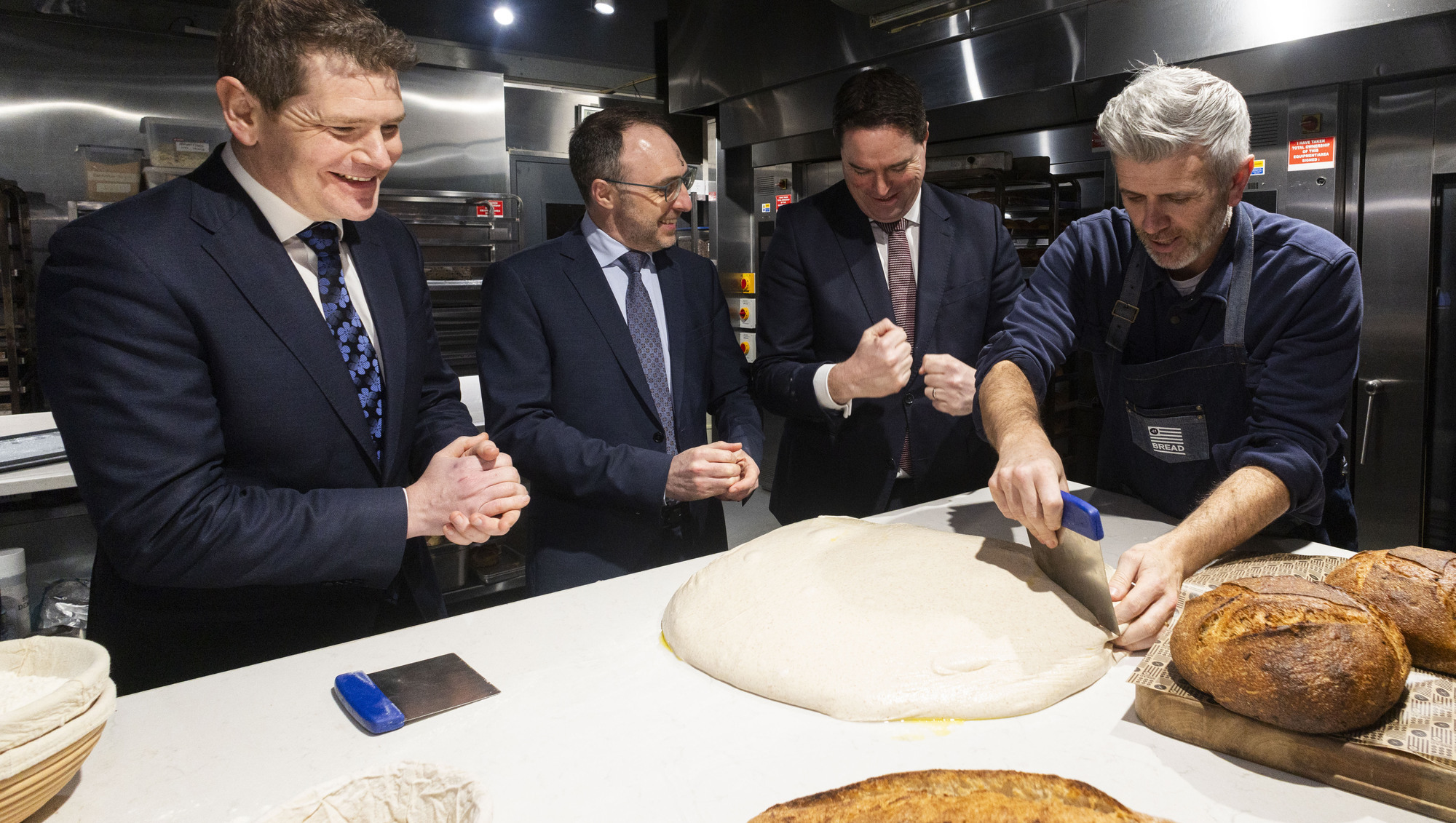
Enterprise minister Peter Burke, minister of state Robert Troy, agriculture minister Martin Heydon, and Bread 41 CEO Eoin Clunky making bread in Bread 41. Picture: Sam Boal/Collins photos
In an economy where artificial intelligence and technology are seen as the future, a Government announcement around something as simple as flour might seem a little odd.
Today, agriculture minister Martin Heydon, enterprise minister Peter Burke, and junior finance minister Robert Troy gathered at a Dublin city centre bakery to launch a brand new strategy.
Here's what you need to know about Ireland's plan for more flour mills.
I did. The Government on Monday announced an initiative to financially support up to four new flour mills in Ireland. At present, Ireland has only one industrial‑scale flour mill, and this initiative "aims to strengthen the competitiveness, sustainability, and resilience of the bakery value chain". Ireland has only one industrial‑scale flour mill, located in Portarlington, run by Odlums. There are two in the North — James Neill's Flour Ltd and Andrews Flour.
Simply put, cost. From January 2015 to December 2024, Ireland imported 2,253,871 tonnes of flour at a cost of over €1bn. The vast majority of this comes through the UK, with costs having risen considerably since Brexit. The bakery industry in Ireland has around 600 companies in operation with about 8,000 employees.
The initiative will create a capacity of between 60,000 and 80,000 tons per annum for new flour mills. Mr Burke said that "if we get three or four flour mills nationally, that will be a huge achievement". The rising costs of flour have hit the bakery sector, where Ireland imports about 240,000 tons. The scheme aims to address the cost and import questions, with an eye on sustainability. Mr Burke said that the recent years had seen costs rise "between transport costs and associated paperwork" which he estimated cost the sector €10m annually.
"This will really give us a chance to assist businesses," he said.
The Government hopes that the subvention will help to cut costs for businesses and build up the indigenous bakery sector.
The Government hopes to establish up to four mills at a cost of up to €5m each. Mr Burke said that the money is "a very significant commercial incentive to get the sector back up and running again", and which will underwrite the growth of the thousands of jobs in the area.
Mr Heydon is hopeful that it will assist tillage farmers, who he said have been at the mercy of world grain prices and would be able to sell more of their products here. He said that the outworkings of Brexit has made the Government "realise the importance of diversification" and that his department is "diversifying our dependency on the UK market through a range of different agricultural products, finding our routes to market across the EU and in third countries, but also identifying the things that we can do more more activity on here in Ireland ourselves".
An analysis this week of 2024 figures by Teagasc showed that 37% of farmers growing winter wheat achieved net profit margins of more than €750 per hectare, whereas 13% suffered a loss.
Nearly one in five (19%) had a margin of less than €250; 13% had a margin of €250 to €500; and 18% had a margin of between €500 and €750.


CONNECT WITH US TODAY



Be the first to know the latest news and updates