Flour power: Welcome revival for Ireland’s mills
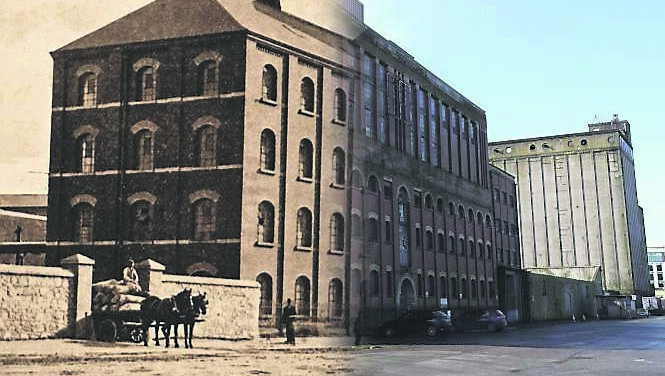
Cork National Flour Mills, pictured in the Cork City Reflections book by Kieran McCarthy and Daniel Breen. Two centuries ago, it is estimated that as many as 7,000 mills operated across the country. Today, the remains of just 660 survive — picturesque relics of what was once a thriving rural industry.
For an island once dotted with mills, Ireland’s relationship with flour has become strangely distant.
Two centuries ago, it is estimated that as many as 7,000 mills operated across the country. Today, the remains of just 660 survive — picturesque relics of what was once a thriving rural industry. In modern Ireland, in 2026, we are left with just one industrial-scale flour mill.
That stark contraction is more than a footnote in economic history. It reflects a broader drift away from local processing and self-sufficiency — an erosion that feels deeply uncomfortable in an era of fragile global supply chains.
That is why news that the Government is to financially back new flour mills in Ireland marks a welcome change of direction.
Enterprise minister Peter Burke and agriculture minister Martin Heydon have announced an initiative aimed at strengthening the competitiveness, sustainability and resilience of the bakery value chain. The scheme, to be overseen by Enterprise Ireland, will engage directly with firms considering new or expanded milling operations of scale.
Minister Burke described the move as “a powerful display of our intent to become more self-sustaining as an economy”. He pointed to the scale of the bakery sector — worth an estimated €995m annually, with exports exceeding €200m and employing more than 7,000 people across 600 businesses. Reducing input costs for these SMEs, he said, has been a priority.
Minister Heydon highlighted the opportunity for tillage farmers. Growing and developing the tillage sector is stated Government policy, and the prospect of a viable domestic market for milling wheat could provide a new value-added outlet for Irish grain.
All of that is sound reasoning. Domestic milling offers the potential to create jobs, add value to what is often an underpriced primary product, shorten supply chains and produce food to high Irish standards.
It speaks to sustainability and competitiveness — but also to something less easily quantified: food security.
None of this suggests that every loaf baked in an Irish kitchen will, or even could, be made entirely from home-grown grain. Ireland will remain a trading nation, reliant on imports for certain varieties and volumes.
But recent years have exposed how vulnerable global supply chains can be. A container ship wedged in the Suez Canal, a factory fire, a drought in a major grain-producing region — each can ripple quickly onto supermarket shelves thousands of miles away.
Here is hoping the project will be the first of many, with future applications to revive other once domestic industries. Many Farm Exam readers will remember the closure of Ireland’s last sugar beet factory and the devastating impact on growers.
In 2005, farmers protested outside the former plant in Mallow, Co Cork, warning that EU reforms would threaten the livelihoods of 3,700 tillage farmers. Just a year later, following the factory’s closure, sugar beet production had effectively disappeared.
Once infrastructure is dismantled, rebuilding it is neither quick nor cheap, and 20 years on the effects of that industry’s demise are still felt today.
It would be easy to romanticise the return of the mill — to picture restored stone buildings and waterwheels turning again. The reality, of course, will be modern, efficient processing facilities designed to compete in a global market.
But the principle is the same as it was 200 years ago: adding value close to where food is grown strengthens rural economies and reduces exposure to shocks beyond our control.
It is not about turning back the clock. It is about ensuring that, when the next disruption comes, we are better prepared — and that more of the value in our food chain is captured at home.
After all, resilience, like good bread, requires the right ingredients — and the willingness to let something rise again.