Tánaiste: We took case against UK's Troubles law over worries about human rights
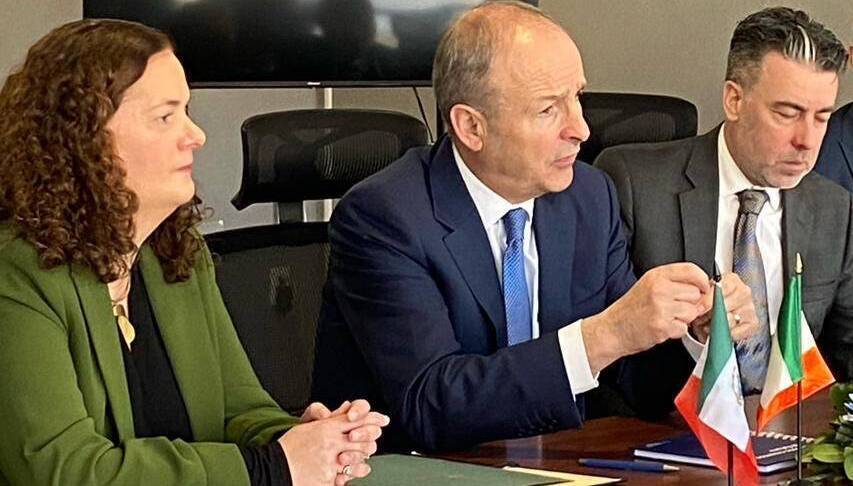
Tánaiste Micheál Martin (centre) confirmed he received the letter from the UK Secretary of State early this morning while travelling in Mexico.
Tánaiste Micheál Martin has criticised the UK Government for taking “unilateral action” through their controversial legacy legislation, after the Northern Ireland Secretary formally expressed regret for the legal challenge.
The Northern Ireland Troubles (Legacy and Reconciliation) Act has faced widespread criticism, from political parties, victims groups and the Irish Government.
The bill itself can provide limited amnesties for people who engage in a new body, known as the Independent Commission for Reconciliation and Information Recovery (ICRIR), and will stop existing criminal, civil and inquest inquiries into acts committed during the Troubles.
Late last year, Ireland officially launched an inter-State legal case against the UK over the controversial legislation.
Mr Martin confirmed he received the letter from the UK Secretary of State early this morning while travelling in Mexico.
"What I would say is I think from our perspective, the Irish government's perspective, we had an agreement with the British government and with all of the political parties in the North, the Stormont House agreement," Mr Martin said.
“It had been an internationally recognized agreement, we were proceeding along those lines, but the British government decided after the last general election in the UK to take a different tack on its own and to go in a unilateral direction.
"We are where we are now and we've reluctantly taken this inter-State case because human rights and the compliance with the European Convention on Human Rights is a fundamental pillar of the Good Friday Agreement."
Mr Martin said that the Government had sought a pause on the legislation being passed to work “collectively” with the UK Government to reach an agreement on legacy matters.
“It is understood that [Northern Ireland secretary] Mr Chris Heaton-Harris expressed concerns that the case against the UK Government could lead to destabilisation as efforts continue to restore the Northern Ireland Executive and Assembly."
Asked if he was concerned about the potential impact on Ireland-UK relations following the case, Mr Martin said that it is important for the two Governments to work together “in harmony”.
“I’m very much up for that and very much focused on building and strengthening the relationship. We’ve been very positive and constructive over the last three years in respect to the European-UK relationship and the Windsor Agreement,” Mr Martin said.
“I think that has been acknowledged by the UK Government. We’re hoping again to facilitate and work towards the restoration of the Executive in Northern Ireland and I think we’ve shown significant patience in that regard.”
Ireland previously took a case against the UK in 1971 over its methods of interrogation used by the British Army in Northern Ireland. The case saw 14 people, known as the Hooded Men, interrogated for seven days using what had been known as the “five techniques”.
The European Court of Human Rights found that the techniques were inhuman and degrading treatment, but did not constitute torture. The Government previously sought to revise this decision but was dismissed in March 2018.


CONNECT WITH US TODAY



Be the first to know the latest news and updates