Decapitated skeletons in Limerick point to society where life was 'fraught with risk'
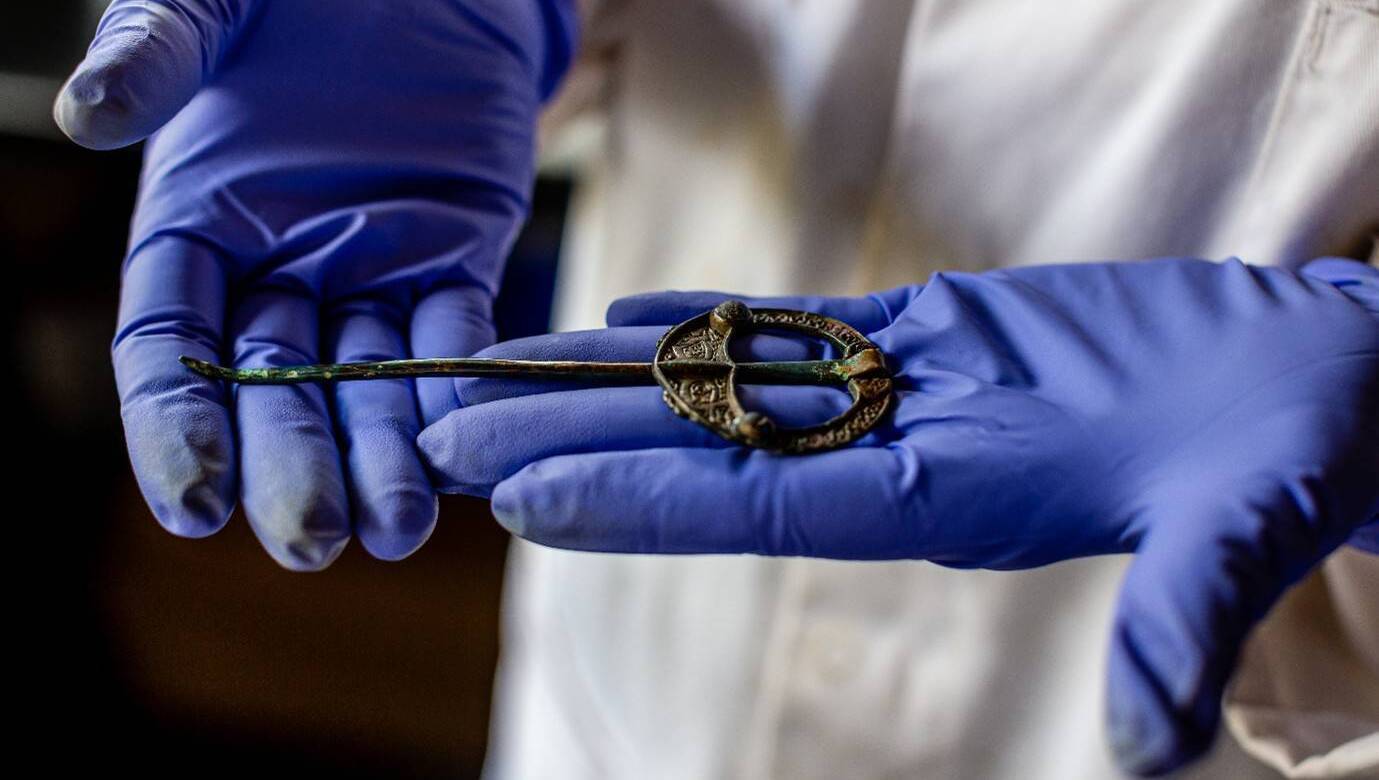
Early medieval metalwork in the form of a small, but carefully crafted buckle, found in Croagh, Co Limerick.
Archaeologists have described as “fascinating”, the discovery of a number of skeletal remains in Croagh, Co Limerick.
The recent excavations of a circular ditched enclosure along the route of the Foynes to Limerick (including Adare Bypass) Road Project, have revealed evidence of a society where life was “fraught with the risk of an early death”.

Initial examination of skeletal remains have revealed multiple traces of wounds on some of the individuals, suggesting a number of them were decapitated.
Excavation director, Seán Tiffin from Archaeological Management Solutions (AMS), who led the excavations at Croagh, was fascinated by what one local told him about the field in which he was digging.
"Even before we had fully exposed the site here, we were told that the field was known as 'the field of blood', and so we were on high alert even before the first human bones were encountered."
HISTORY HUB
If you are interested in this article then no doubt you will enjoy exploring the various history collections and content in our history hub. Check it out HERE and happy reading
Subsequently, dozens of burials, laid out in a Christian style, were discovered, one of which was adorned with the example of early medieval metalwork — a crafted buckle.
Initial examination of the skeletal remains by project osteoarchaeologist, Dr Mara Tesorieri, revealed multiple traces of wounds on some of the individuals, suggesting that quite a number of those laid to rest here had met violent ends, including by decapitation.
The analysis of the skeletal remains is ongoing and is expected to reveal more insights about the people who made their homes in Croagh in early medieval times.
Excavation manager for AMS, Fintan Walsh, said: “This was only one of the 150 sites found on the project, all of which were fascinating in their own right.
"These sites included prehistoric settlements, cooking sites and burials; medieval forts and burial grounds; as well as lime and brick making kilns of our more recent past, and World War II (‘Emergency’) era concrete pillboxes.
"Built heritage surveys recorded vernacular houses, a quay keeper’s cottage, railway structures and historic farm buildings too.”
Keeper of Irish antiquities at the National Museum of Ireland, Maeve Sikora, said: “Many of the finds are hugely significant, not just because they are rare, but because they were found in dateable contexts and can be used as reference points by researchers for many years to come.
"The exemplary finds retrieval strategies employed on these excavations have ensured that as much information as possible has been gleaned, enabling a deeper understanding of our past, preserved for all to access and enjoy."
Throughout the project, local schools and historical societies were invited to visit the sites to get a sense of how an archaeological dig takes place, and to get up close with the finds.
The Second World War pillboxes have been the subject of numerous talks around the country, and a site tour was given as part of Heritage Week 2025.
Fieldwork on the project is now coming to a close, with all excavations completed in advance of construction, including those on the Adare Bypass section which were prioritised to facilitate the speedy development of the bypass in time for the Ryder Cup in 2027.
The team at AMS are now writing up their reports, all of which will be made available online through Transport Infrastructure Ireland’s (TII) Digital Heritage Collections which forms part of the Digital Repository of Ireland.
In the meantime, to showcase their discoveries, AMS has launched an online StoryMap where you can explore all of the discoveries for yourself, complete with interactive maps, 3D models and details of the amazing artefacts.
The StoryMap can be accessed through the TII website.