Possible avian flu concern after 11 dead swans discovered at Loughaderra lake in east Cork
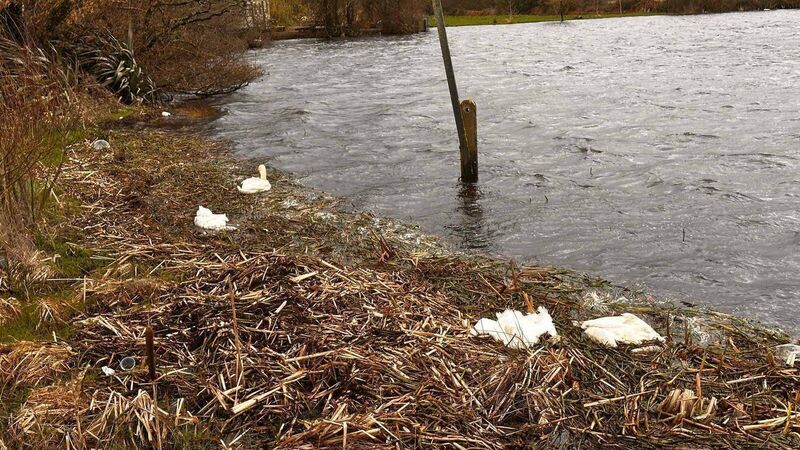
Dead swans at Loughaderra, east Cork today. 'I watched a hooded crow land on one of the carcasses. That is how this [avian flu] is spreading,' said Proinsias Ó Tuama.
Eleven dead swans reported as potentially infected with bird flu in east Cork on Thursday morning had not been moved hours later, it has been claimed, prompting fears that a possible biohazard was left at the lake to spread the potentially deadly virus unchecked.
Six dead swans were found at about 9am at Loughaderra, a lake outside Castlemartyr, Co Cork, and another two swans were seen “struggling”.
After 2pm, another five dead swans were seen there and the carcasses of the earlier reported six dead swans were still there. All were reported to the Department of Agriculture through its Avian Check app.
“This is a biohazard,” Proinsias Ó Tuama, who reported the dead birds to the Department of Agriculture, told the Irish Examiner.
Mr Ó Tuama said that when he reported the dead birds to the Department of Agriculture today, one person there told him to report it to Cork City Council instead.
“But the reporting mechanism for avian flu is through the Department of Agriculture,” said Mr Ó Tuama, who is the founder of Clean Coasts Ballynamona, a community group working to protect and clean Ireland’s coasts.
Read More
A spokesperson from the Department of Agriculture said it "is unable to collect, remove or provide treatment to sick wild birds".
"Where they are not needed for surveillance, the routine collection of dead birds rests with the landowner. It is the responsibility of the local authority to safely dispose of carcasses where they are on public land," the spokesperson said.
The department's role is to conduct avian influenza surveillance, which forms part of its Early Warning System for the detection of circulating avian influenza viruses, "thereby informing our assessment as to the level of risk the disease poses to Ireland’s poultry sector," the spokesperson said.
"The Department carries out avian influenza surveillance testing throughout the year in targeted dead wild birds to understand if avian influenza is circulating in the wild bird population and then provides this information to the poultry industry to inform them of risk."
Bird flu has been a serious concern in the east Cork area since an outbreak of the highly pathogenic avian influenza (HPAI) H5N1 virus closed Fota Wildlife Park, also in east Cork, in October.
The outbreak in Fota, which has since reopened, was in the Greylag goose population.
The east Cork wildlife park confirmed 12 cases of bird flu and had to euthanise 73 birds from the park due to the outbreak.
Five commercial poultry sites across Ireland suffered HPAI outbreaks over the winter.
In January, Ireland was declared free of HPAI avian flu.
The World Organisation for Animal Health published Ireland’s self-declaration of freedom from HPAI in poultry on its website, with an effective date of January 1, 2026.
But in March, a bird flu outbreak was reported in the north, in a poultry farm near Omagh, Co Tyrone.
It is now feared that there has been another outbreak in wild birds in east Cork.
A precautionary compulsory housing order on all poultry and captive birds in Ireland remains in place this year, despite Ireland’s declaration of HPAI-free status in January, according to the website of the Department of Agriculture.
This required flock keepers to keep all birds under their care in a secure building.
Flock owners are advised to exercise strict biosecurity measures to protect their birds.
The main clinical signs of the virus in birds are depression or lethargy, loss of appetite and excessive thirst, swollen head, blue discolouration of areas of exposed skin, respiratory distress, diarrhoea, reduced or no eggs laid, and sudden death.
The public is advised not to approach sick, dead or dying wild birds, not to touch wild bird feathers or droppings, and avoid surfaces that may be contaminated with them.


CONNECT WITH US TODAY



Be the first to know the latest news and updates