'It has nowhere to go': More floods expected as heavy rain falls on saturated ground
More flooding is expected as heavy rain continues to fall on saturated ground throughout the south and east of Ireland, Met Eireann has said.
The forecastor warned that high river levels and tides are likely to lead to localised flooding, river flooding and difficult travel conditions.
High tide on Tuesday morning caused spot flooding in parts of Cork City and elsewhere nationwide, as eight counties remain under flood warnings.
A number of areas of the country have already experienced flooding caused by storms and heavy rain over the last few weeks.
It is understood that on Tuesday the cabinet approved opening the Emergency Humanitarian Flooding Scheme to help small businesses and community, voluntary and sports organisations that have suffered damage.
The Irish Red Cross administers the scheme which provides help for those who have been unable to obtain flood insurance.
Read More
Qualifying organisations will be able to access initial funding of up to €5,000, and following that additional funding of up to €20,000.
Ministers and the National Emergency Coordination Group are expected to meet on Tuesday evening to discuss the ongoing issues caused by storms and heavy rainfall over the last few weeks.
A status yellow rain warning is in place for Dublin, Louth and Wicklow until 9pm on Tuesday.
Louth County Council has said a number of parts of Drogheda close to the Boyne are flooded and should be avoided.
Sandbags were deployed in Newbridge, Co Kildare overnight as the river Liffey rose to a high level.
Carlow County Council has said the state of roads there are now “of serious concern” with a number “significantly damaged” and “impassable”.
It has told motorists not to pass “road closed” signs, to report any issues and travel with care.
Met Eireann said spells of heavy and persistent rainfall will continue through the week, particularly in southern and eastern coastal counties.
"Rain will fall on saturated ground where river levels are high, with high tides expected this week. This will lead to further flooding along rivers and in coastal areas," the forecaster said.
Meteorologist Holly O'Neill said: "On a normal day, if we hadn't had rain for the last few weeks, it's a normal January wet week. It's a wet day, it is a lot of rain.
"But given the fact that we've had such a consistent period of rain over the last week, any extra accumulations of rainfall that we get today, particularly over the South East, whether it's 10 mm or up to 30 mm, it will have a more significant impact," she told RTÉ's on Tuesday.
"So the most likely impacts are going to be for those in the South East, unfortunately, because they've already borne the brunt of that rain for such a prolonged period,” she added.
Ms O'Neill added that “higher than normal high tides,” combined with strong winds along the south-east and east coasts, mean that “rivers can't discharge.”
"[It] then means that rather than the levels gradually falling, the rainfall is actually just exaggerating the risk of river flooding. So it's really a combination of the worst-case scenario," she told
Micheal Martin said the country’s flood warning systems need to change.
The Taoiseach told Newstalk’s programme that development of a text-based system “is under way” but “will take a lot of work”.
Such an alert system is where “emergency planning is heading”, he said but it is “some distance” away.
On Monday, Mr Martin visited areas badly hit by flooding in recent weeks including Aughrim, Co Wicklow, and on Tuesday he described what had happened as “quite frightening”.
“This was literally water flowing down the mountains with nowhere else to go,” he said, adding that it took “roads with it” and damaged “a lot of houses and businesses in the process”.
Mr Martin said “funding allocations” need to be planned as flooding events become more likely.
He added that “prevention” is key but said flooding schemes are “complex and they do take time”.
More “short-term work” is needed to tackle flooding, he said, adding that more “nature-based solutions” are needed.
In Cork City, surface water was expected on Wandesford Quay, Union Quay, and Kyrl's Quay at around 6.29am.
Further surface water is expected in those areas at 6.46pm on Tuesday evening, according to Cork City Council.
Cork City Council said it will deploy crews in the city centre to respond as required.
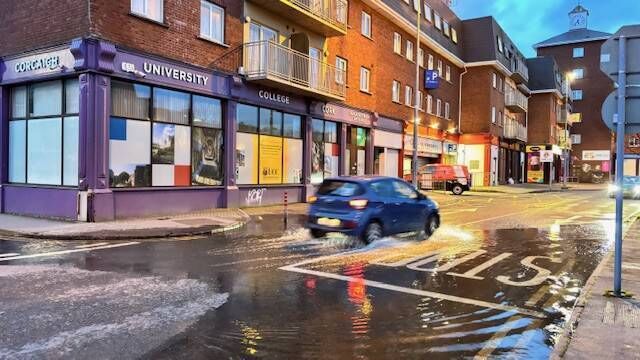
Authorities are advising pedestrians to exercise caution in affected areas during high tide, while motorists are advised not to park in flood-prone locations and to allow time for possible diversions or delays.
Chairperson of the National Emergency Coordination Group Keith Leonard said local authorities across the eastern regions remain on high alert, with engineers monitoring water levels in real time across many catchments.
"Certainly, in some pinch points, there's no doubt there may have to be people who are moved from their homes. We'd hope those would be very limited operations," Mr Leonard told Newstalk Breakfast on Tuesday mornig.
"Generally speaking, local authorities try to do small engineering works or to put in temporary flood defences and temporary flooding operations to try and mitigate the worst impacts of flooding. But there's a point beyond where that does, so that just isn't feasible."
Mr Leonard added that the Government has committed funding to the response for as long as required.
“I suppose the key piece with all these things is crews, and you know crews have been working on this now for over a week and probably are starting to get fatigued.
"So there is mutual support across the local authority system to try and again support outdoor staff, engineering staff and other people who are on the front line of this response," he added.
Looking ahead, Wednesday will bring further outbreaks of rain, though brighter spells will develop, particularly in the midlands and western counties. Temperatures will range from 5C to 10C.
Wednesday night will remain cloudy in the south, with rain spreading from southern counties, while drier conditions and some clear spells develop further north.
Met Éireann said Thursday’s forecast remains uncertain, though current indications point to a wet and windy day, with widespread rain becoming heavy and persistent at times.
Rain and drizzle will continue overnight, gradually becoming patchier and largely confined to the south and east by Friday morning.
Friday will remain wet and windy, with further heavy and persistent rainfall affecting the south and east.
Check out the Irish Examiner's WEATHER CENTRE for regularly updated short and long range forecasts wherever you are.
CONNECT WITH US TODAY



Be the first to know the latest news and updates