Less than a quarter of journeys into Cork City made via sustainable methods
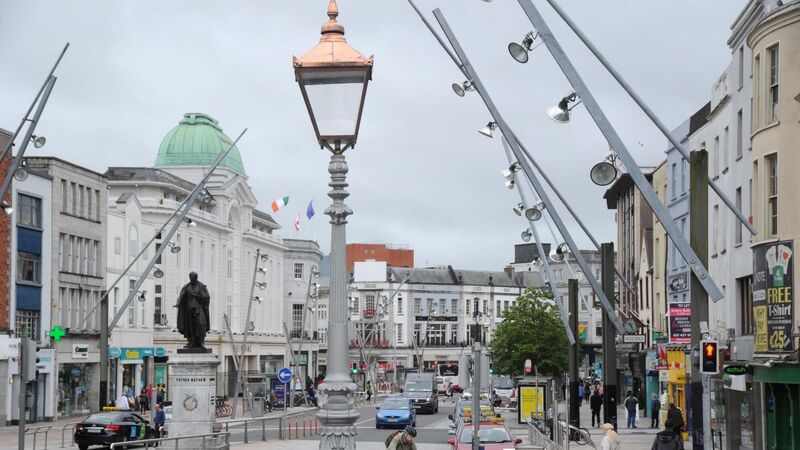
Surveys conducted by the National Transport Authority in 2024 show that just 23% of journeys into the city were made via sustainable transport. Picture: Denis Minihane
The use of green transport in Cork continues to lag significantly behind other cities in the country, with less than a quarter of journeys into the city made via sustainable methods such as cycling or public transport.
Surveys conducted by the National Transport Authority in 2024 across Ireland’s five major urban centres show that the three Munster cities —Cork, Waterford, and Limerick — are a lot further behind Galway and Dublin in terms of embracing green transport methods.

Waterford showed the lowest level of sustainable adaptation, with trips into the city via green modes of transport accounting for just 16% of overall journeys — albeit 2024 saw a 38% increase in bus passengers across its city centre.
In Cork meanwhile, 75% of journeys made into the city were by car, with just 23% of the total being made via sustainable transport.
The statistics were delivered to the Public Accounts Committee, with National Transport Authority (NTA) chief executive Anne Shaw saying public transport use across the country “continues to grow at exceptional levels”.
She noted that in Dublin, more than 74% of journeys into the city in 2024 were made by sustainable means — the highest in the near-50 years that the survey has been conducted.
Separately, the committee heard discussions around a number of financial issues regarding ongoing projects within the purview of the NTA.
Comptroller and auditor general Seamus McCarthy told the committee that a new traffic management system for Ireland’s train network, first approved in 2019, will not now go live before November 2028, placing the project more than 3.5 years behind schedule with cost overruns of some €41m.
The overall project — which was to see the construction of a new central train control building at Heuston Station in Dublin, a building completed in 2022, along with the development of the new system and an associated backup — was initially budgeted at €148m, with the NTA currently estimating final costs to total €189m.

Addressing the committee, Hugh Creegan — the authority’s director of transport, planning and investment — said there is “still uncertainty” as to whether or not the final system will indeed be in place by the end of 2028.
He said that the software required and the overall transition to the new control system are “taking longer than expected”.
“The development and testing of the software is taking longer. It was initially intended that it would be done in one singlular implementation; that the whole country would move onto the new system on one particular day,” he said, adding that the decision has since been taken to instead process the move in eight separate phases “to reduce the amount of risk”.
"While we’ve given the date of 2028 we can only firm up that date when we see how the first phase has gone, take the lessons from it, and apply it to the others,” Mr Creegan said.
Asked by Labour TD for Cork Eoghan Kenny how the NTA had not been able to see the need for multiple phases in advance, Mr Creegan responded that the implementation of a new train control system is a “once-in-a-generation event”.
He added that the decision to move to multiple phases is “absolutely a significant part” of the €41m cost overrun seen to date. He firmly denied that Mr Kenny’s speculation that the project could amount to “another children’s hospital”.