Young Scientist: Kerry student wins top prize for 'extraordinary' brain cancer diagnostic tool
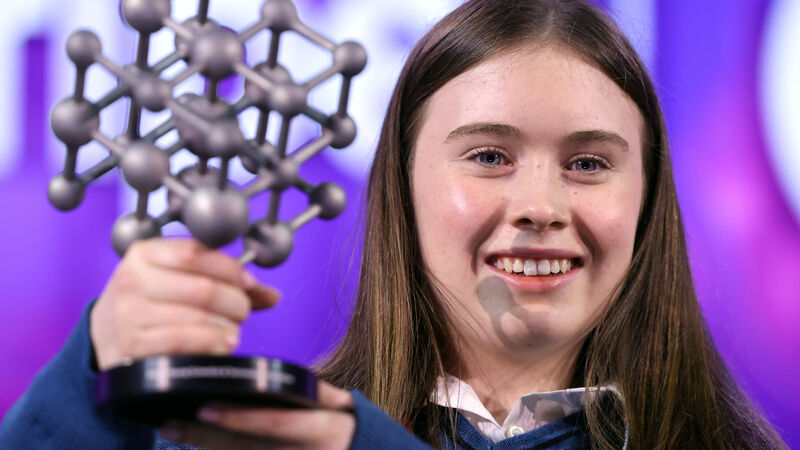
Aoibheann Daly from Mercy Mounthawk Secondary School with the trophy for her brain cancer diagnosis tool at the Stripe Young Scientist Exhibition in the RDS. Picture: Leah Farrell/RollingNews
A 15-year-old from Kerry has scooped the top prize at the Stripe Young Scientist and Technology Exhibition for an "extraordinary achievement" that helps doctors improve the treatment of brain cancer.
Aoibheann Daly, a fourth-year student at Mercy Secondary School Mounthawk in Kerry, won the 2026 competition with her project, .
Glioscope helps doctors to predict what genetic mutation is likely to be present from a simple MRI brain scan, in order to make quicker treatment decisions and reduce risk for the cancer patient.
As there are no good methods currently to identify such mutations, doctors must rely on samples of brain tissue, which carries a high risk of bleeding in the brain for patients, as well as being slow and expensive.

Her project triumphed over 550 projects that made the final round of the prestigious competition, out of more than 2,000 entries overall this year.
As well as taking home €7,500, Aoibheann will represent Ireland at the EU Contest for Young Scientists in Germany later this year.
Head judge for the Health and Wellbeing category, Professor Catherine Darker, said: “Brain cancer is a devastating condition for people. Glioscope, developed by a 15-year-old student, is an extraordinary achievement.
"She is a worthy winner of the Stripe Young Scientist & Technologist 2026.”
Co-founder of payment giant Stripe, Patrick Collison, was the winner of the competition 21 years ago that his company now sponsors. His co-founder and brother John took home a category award at the same event in 2005.
Chief revenue officer at Stripe, Eileen O’Mara, said:
Joshua Corbett, a sixth-year student from St Mary's CBS in Laois, won the individual runner-up, also for a project related to brain cancer.
His project identifies tiny nanocarriers for drug delivery administered through the nose to treat brain cancer.
Head judge for the Chemical, Physical & Mathematical Sciences category, Rachel Quinlan, said: “This expansive project used machine learning to identify the best designs of tiny nanocarriers, approximately one thousandth of the width of a human hair, to act as miniature submarines.

"By navigating the space of a hundred million billion possible nanoparticle designs, this method can guide the next practical steps in the development of treatments leading to better outcomes.”