Catherine Conlon: As a former winner of the Young Scientist, it still gives me hope in a troubled and unstable world
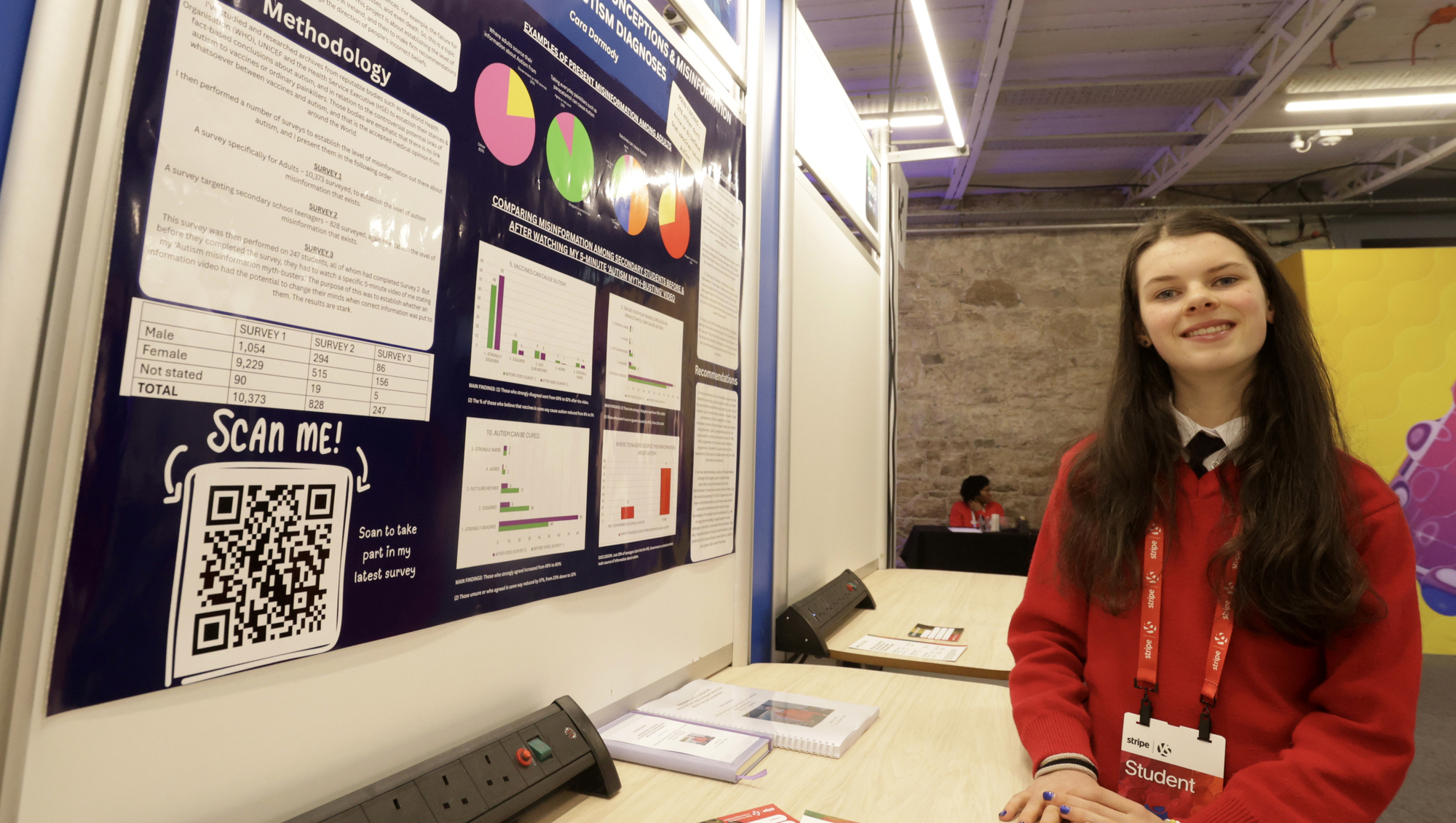
Student and campaigner Cara Darmody with her project about addressing and combating misconceptions and misinformation about autism diagnoses at this year's Stripe Young Scientist Exhibition in the RDS. Pictures: Leah Farrell/ RollingNews.ie
The Stripe Young Scientist & Technology Exhibition, which begins on Thursday, is much more than a competition. It is an unforgettable lifetime experience that was one of the formative events of my adolescence, when I won the overall prize in 1981 at the age of 17.
The competition is the complete antithesis of the society we live in today. In a world that fosters greed, individualism and fake news, the Young Scientist fosters curiosity and collaboration underpinned by robust evidence, dump-loads of diligence, a large dollop of creativity, a dash of questioning and lashings of entertainment.
I first visited the exhibition in the RDS when I was about 12 with my father and my three older brothers. There was something about it — an intoxicating mix of fun and adventure and curiosity — that got into my system. I recall the winners, corralled in the centre with bright lights, and lots of curious people asking questions, and I thought: that could be me.
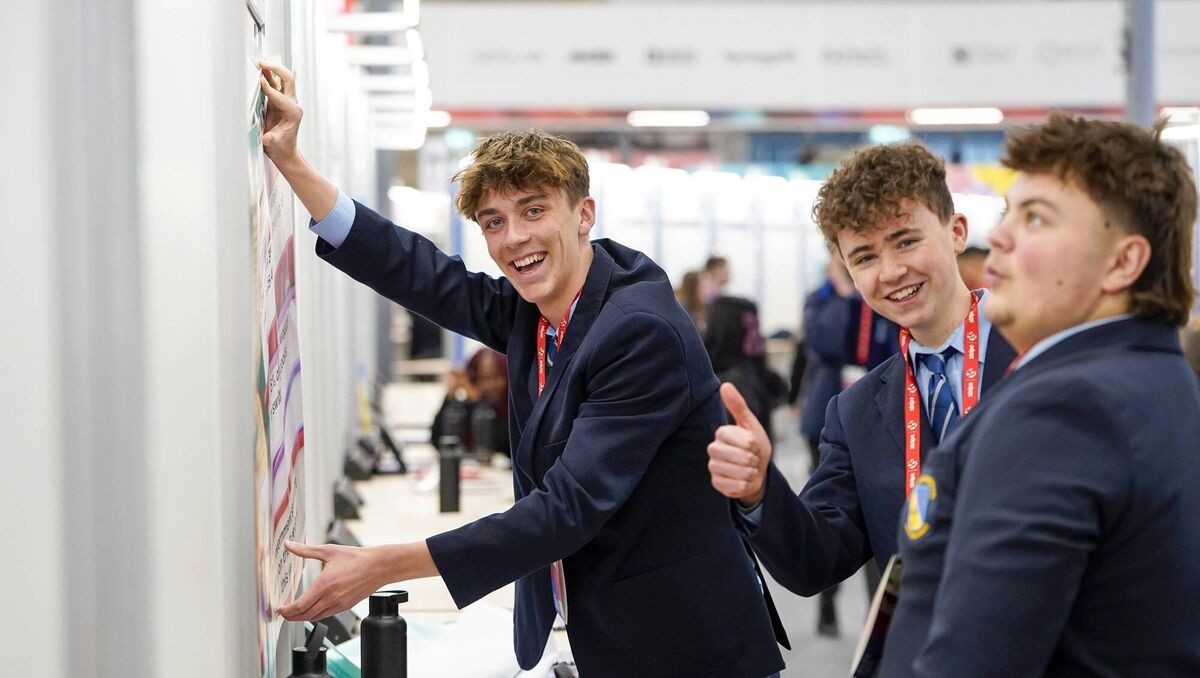
Four years later, I was back with my older brother and a project on spiders. We discovered spider’s webs were uniquely structured to match prevailing climate conditions — more robust on wet and windy days then they needed to be on fine days. We won the overall group award.
My brother — now consultant nephrologist in Beaumont Hospital — was the chief scientist and I was the administrative assistant. He was the spokesperson, and I was the back-up. That all changed the following year when Peter left school and I entered an individual project. I was chief scientist and chief communicator.
The project looked at the spider’s web from every angle. I went to the physics department in UCD and asked them how I could devise an instrument and what scientific formulae I could use to measure the strength and elasticity of the fibres in the spider’s web.
It subsequently emerged the tensile strength of the scaffolding fibres was stronger than steel and the radial fibres were highly elastic to prevent the wind tearing the web apart.
I went to the electron microscopy unit in Trinity and asked could they put the different web fibres under a microscope to look at how their structure was adapted to their function. The images were fascinating. The radial fibres showed fibres plaited together and the interconnecting fibres between radii had a wavy structure with the intervening gaps filled with glue — so that prey would stick and get caught in the web.
High-resolution images of the spider’s legs showed them to be fitted with six different types of claws to allow them speed and support as they danced across the web. One was a comb-like structure to help them climbing. Another was a hook to allow balance as they dangled on the web.
I used data supplied by Met Éireann in Glasnevin to show how the web structure adapted to changes in climate over a two-year period. I borrowed a cine camera to photograph the complex manoeuvres that spiders used to entice, entrap, store, liquidate and digest their prey.

The reason the project won the overall award in 1981 was a combination of constantly asking questions, then trying to answer them by whatever means possible — the more innovative and creative the better, supported by the best available evidence for what was already known in the field.
At 17, I did not have all the answers, but I was not afraid to ask the experts how to go about answering a question. Without exception, those experts were all delighted to be asked and spent hours supporting me in devising instruments, teaching me about scientific formulae or facilitating the use of their complex technological equipment to help me find the answers.
The biggest learning came at the time of the judging. In those days, there was a day and a half where judges would grill you for about 20 minutes on your topic.
That enthusiastic grilling from the top science minds in the country was the foundation for oral exams, presentations and media communications for decades to come. If you can get through those judging sessions, you can get through anything.
The Friday afternoon of the prize-giving was nerve-racking but very exciting. The then taoiseach, Charles Haughey, visited my stand and RTÉ filmed a piece for the evening news, so I knew I was in for a big prize, but not sure which one.
When the time came and my name was called out, I remember being in the middle of a crowd of people and knowing I had to push my way up to the front. But I could not feel my feet. At the last minute, I pushed forward and made it to the podium. A sea of flashing lights and cameras. It was all a bit surreal.
My parents were not there — my dad had an evening surgery. But my six brothers and sisters were — jumping up and down in the distance. Nobody really believed it.
Later that evening, my dad drove over to the RDS and picked me up with my bike and put it in the boot. That night, he had decided I deserved a lift home. That’s how it was in those days.
The following May, in Brussels, I won the overall European prize. Again, I could not believe it — all the other projects looked so much more elaborate and technical than mine.
That’s when I learned about perspective. When you are close to something, it looks easier than it is and when you view something from a distance, it can look more daunting than it is.
Over the years, I have remained in contact with the Young Scientist competition — as a judge and in other years as mentor and supporter of many projects — some of whom have done really well.
For me, the competition encompasses what science is all about. Asking a good question and thinking of ways to answer it. Discipline. Hard work. Innovation and creativity. Learning to communicate to an audience — not just a scientific one but to anyone who is interested.
Throughout his time as president, Michael D Higgins was an ardent supporter of the Young Scientist. Last January, in a world fraught with distrust and upheaval, his words were particularly apt.
“The future of humanity requires a science without borders built on co-operation in the interest of humanity, accepted as a shared responsibility. I have faith in the ability of our young Irish scientists to locate their gifts, their brilliance, in a moral and ethical context.”
Little did he know how relevant these words would be in the weeks and months that quickly followed.
The Stripe Young Scientist & Technology Exhibition continues to be world class and a vital cog in the global evidence-based science machine. In a world of greed and self-interest, with planetary boundaries being overshot and loud-mouthed buffoons attempting to drown the evidence, the Young Scientist gives me hope the world of scientific rigour will prevail.
- Dr Catherine Conlon is a public health doctor with the HSE in Cork
CONNECT WITH US TODAY



Be the first to know the latest news and updates