Ireland has small earthquakes 'all the time'; seismic station installed at Mitchelstown Cave

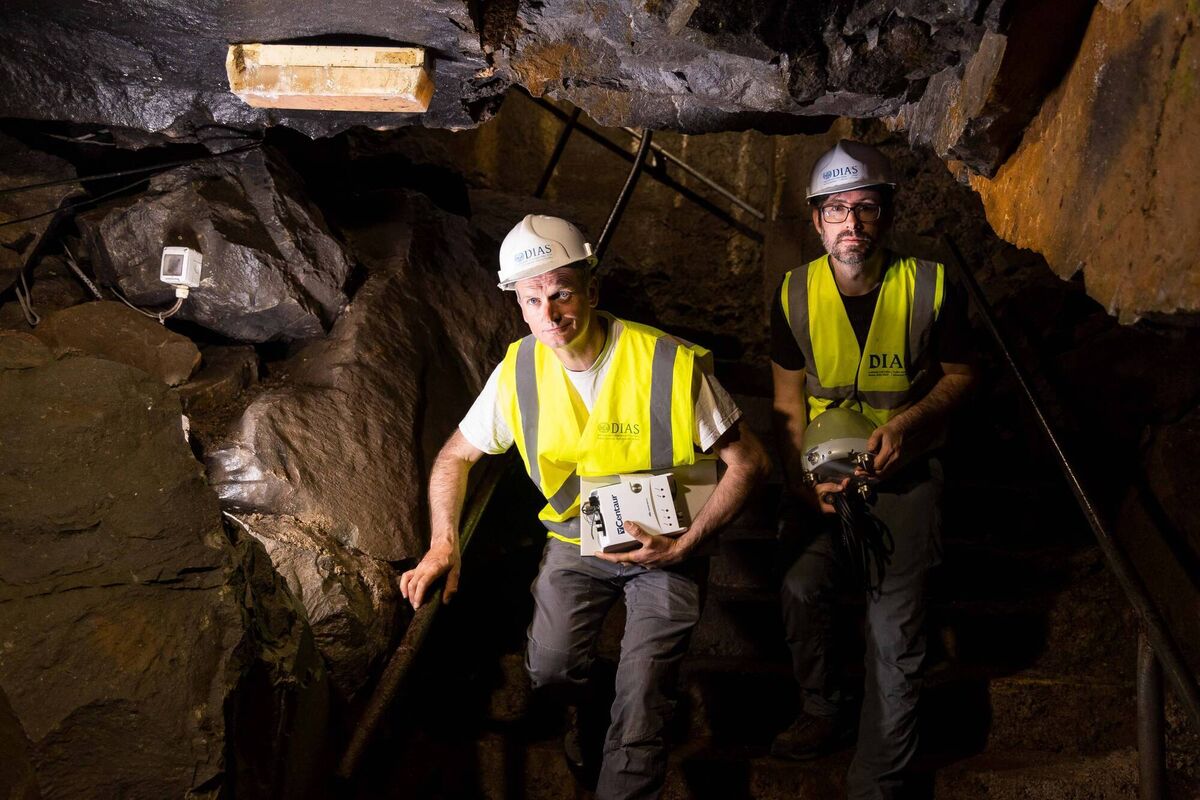
(Left to right) Dr David Craig, technical officer for the Irish National Seismic Network, John English, owner of Mitchelstown Cave, and James Grannell, data analyst for the Irish National Seismic Network, at the newly installed seismic station in Mitchelstown Cave. The station is one of nine seismic stations in Ireland. Picture: Michael O'Sullivan
Small earthquakes are happening in Ireland “all the time”, according to one of Ireland's top geophysicists.
Dr Martin Möllhoff says that although we might not actually feel any of them in Ireland - deemed one of the countries in the world least at risk of a devastating earthquake - the world is constantly moving beneath our feet.
The Director of Seismic Networks at the Dublin Institute for Advanced Studies (DIAS) was speaking at the installation of Ireland’s first underground seismic station.
The installation means earthquakes around the world will now be detected 60 metres underground by DIAS’ Irish National Seismic Network (INSN) staff members.
Set up under a joint agreement with Geological Survey Ireland, a division of the Department of the Environment, Climate and Communications, the station at Mitchelstown Cave, Co. Tipperary, is one of nine seismic stations in Ireland.
It is the first to be installed underground and was chosen as a site for installing a permanent seismic station due to its location within the quiet Galtee-Vee valley. There the station is protected from seismic noise sources such as wind, rain and heavy road traffic.
Since its installation in May, the station has already detected earthquakes as far away as southern Peru and the Fiji Islands.
Dr Möllhoff said: “The addition of the new seismic station at Mitchelstown Cave will contribute greatly to our understanding of what lies beneath Ireland and the structure of the Earth as a whole.
“All of this information is fed back to our data centre at DIAS allowing us to understand the world beneath us.
“Most people think there are no earthquakes in Ireland but there are actually smaller earthquakes happening all the time.
“It is important that we are aware that, even though we may not feel it, the world is moving slowly beneath us all the time.”
Professor Chris Bean, Head of Geophysics at DIAS, said: “Having a seismic station located deep underground within the quiet Galtee-Vee valley provides us with a unique opportunity to collect high quality data that is not adversely affected by human activity such as building sites and road and rail traffic.
“This allows us to detect Ireland’s smallest earthquakes on our seismic network, and to better understand the forces at play beneath our feet.”
As reported in the Irish Examiner in May, a recent assessment of earthquakes and their potential devastation across Europe found Ireland is one of the safest places to be.
The assessment ranked the country the lowest when it comes to both "hazard" and "risk". Hazard describes the potential for ground shaking due to earthquakes, while risk describes the impact that can be expected in the aftermath in Europe.
While Ireland can be prone to major storms and flooding in many townlands, the most terrifying of all natural disasters is something we need not worry about, the EFEHR modelling suggests.
CONNECT WITH US TODAY



Be the first to know the latest news and updates