€20m settlement will help Cork boy to 'lead as normal a life for as long as possible'
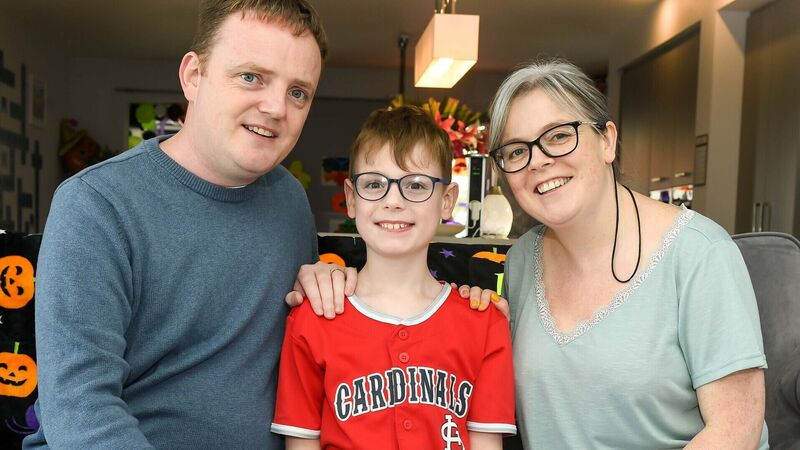
Alex Foley, 11, with his parents Patrick and Laurane, at their home in Midleton, Co Cork. Picture: David Keane
Alex Foley's devoted and determined parents, Laurane and Patrick, left the High Court for the final time on Tuesday with a sense of relief that whatever happens now, their 11-year-old son’s future is secure.
Moments after the High Court approved a €20m damages payment, the couple called for a change in maternity hospital policy to scan for undiagnosed vasa praevia, a rare condition during pregnancy which left Alex fighting for his life in the moments after his birth at Cork University Maternity Hospital (CUMH) in 2010, and with cerebral palsy.
And Laurane said they planned to use what they’ve learned during their fight against the might of the HSE and the State to help the parents of other children with special needs.
But there was a strong sense of disappointment too that the HSE did not admit liability in Alex’s case, and that the maternity hospital did not offer an apology.
“This is something that has added greatly to our pain and our struggle,” the couple said.
And while the payout means Alex can lead a normal life, the couple said they'd give it all back in a heartbeat if it meant Alex didn't have to face the challenges he has to overcome every single day.
The award will help pay for a range of occupational, speech and physiotherapies, for specialist wheelchair and gym equipment he needs to maintain his strength and conditioning, as well as fund his attendance at other specialists, including education psychologists, neurologists and dieticians.
“Alex was done so wrong and to think that they can’t say ‘we’re sorry, we should have seen it’, I think there will always be a part of me that will find it difficult to accept that," Laurane said.
"It makes you feel mad and angry but at least now we can say goodbye to the legal process."
The couple, who sued over the circumstances of Alex’s birth at CUMH in 2010, received an interim payout of €1.98m in 2016, which they used to move to a purpose-built home which was specially adapted and equipped for Alex’s needs. They were back in the High Court yesterday for a full and final assessment of damages.
Speaking afterwards, Laurane said: “There is a real sense of relief for myself and Patrick now because we know that if anything happened to us in the morning, the burden of looking after Alex would fall on his siblings.
“We lost my mum three years ago and so there is nobody else.
In 2016, the High Court was told that Ms Foley was pregnant with twins and had a scan in June 2010 which showed a low-lying placenta.

There was another scan in September 2010 and her counsel said a low-lying placenta meant there was a real risk of the rare condition vasa praevia.
Her legal team contended there should have been another more specific scan at that stage and if there had been it would have identified the risk.
On October 4, 2010, Ms Foley began to suffer pains at home and went to the hospital where a CTG trace showed the foetal hearts to be normal.
After midnight, her waters were artificially broken and she suffered heavy bleeding.
Alex’s heartbeat started to drop and it was decided to deliver the twins by emergency Caesarean section.
Alex was in poor condition when born but his brother Jacob was fine.
Jacob was allowed home after a few days, and Laurane recalled the day they left the hospital with Jacob while Alex was still in the neonatal unit.
“It was torture really, leaving one of the twins behind in hospital,” she said.
Alex was later diagnosed with spastic diplegic cerebral palsy. He also has epilepsy.
The family has been engaged in the legal process for over a decade.
The HSE denied the claims and contended it was not normal practice to carry out the second scan.
But Ms Foley said she believed medics should have scanned her for vasa praevia because she fitted the criteria: she was pregnant with twins, she was a smoker at the time, she had experienced bleeds during this and previous pregnancies, and she had a low-lying placenta early in her pregnancy, but it had come up to safe distance later.
“All these should have set alarm bells ringing but it just never came into their heads,” she said.
“Early detection of vasa praevia is the key to saving lives and preventing harm.
"If correctly diagnosed by a colour doppler scan, and if delivery is managed via a planned C-section, vasa praevia should not have a detrimental effect on a newborn and has a survival rate of 97%.

"We don’t blame the midwife who delivered the boys. It wasn’t her fault.
“But for those first eight days, it was a nightmare, we didn’t know if Alex would survive.
“The care they got in the neonatal unit afterwards was just out of this world. If it wasn’t for them, Alex just wouldn’t have survived.”
She praised their legal team, Grace, Jessica and Ralph from McMahon Goldrick Solicitors in Dublin, their senior counsel Liam Reidy and junior counsel Doireann O’Mahony, for guiding them through the daunting process with respect and dignity, and she thanked Alex’s therapy team who have continued to help him “reach great heights”.
The couple also thanked all those who helped fundraise for Alex’s SDR surgery in the US, and those who fundraised and donated to help them buy two wheelchairs, neither of which the HSE would provide.
They paid special tribute to their other children Lauren, 19, Harry, 16, Ryan, 12, and Alex’s twin, Jacob, whose lives have also been hugely impacted, and to Laurane’s mum, who died three years ago but who she said has passed on the fighting spirit that helped get them to this ending.
“Notwithstanding the many opportunities Alex has lost, he never fails to amaze us as he continues with his big smile, positive outlook and bucketloads of empathy, while inspiring all those he meets. He has given us, and continues to give us, so much joy,” she said.

Laurane, a former creche manager, said the legal battle and the last two years during Covid in particular, encouraged her to look at her own outlook on life.
“I now know that I would like to help other parents at the start of this process – like, from a case manager perspective,” she said.
“There are so many families with kids with special needs out there who have no idea where to turn or where to start – like where to find a physio, how to start adapting the house, where to find the right car – all those practical things,” she said.
“We would like to use our experience to try and help people like that, to guide them, to show them that there are ways and means of doing things, that there are services that can be accessed.
“You see, parents of kids with special needs, they don’t have many people advocating for them."
Alex, who is a student of the Divine Child in Ballintemple, is also a sports-mad member of the Rebel Wheelers group in Cork.
“You will not meet a child with a more positive outlook in life. He has so much empathy. He’s a miracle really,” his mum said.