Kilworth camp escape remembered 100 years on
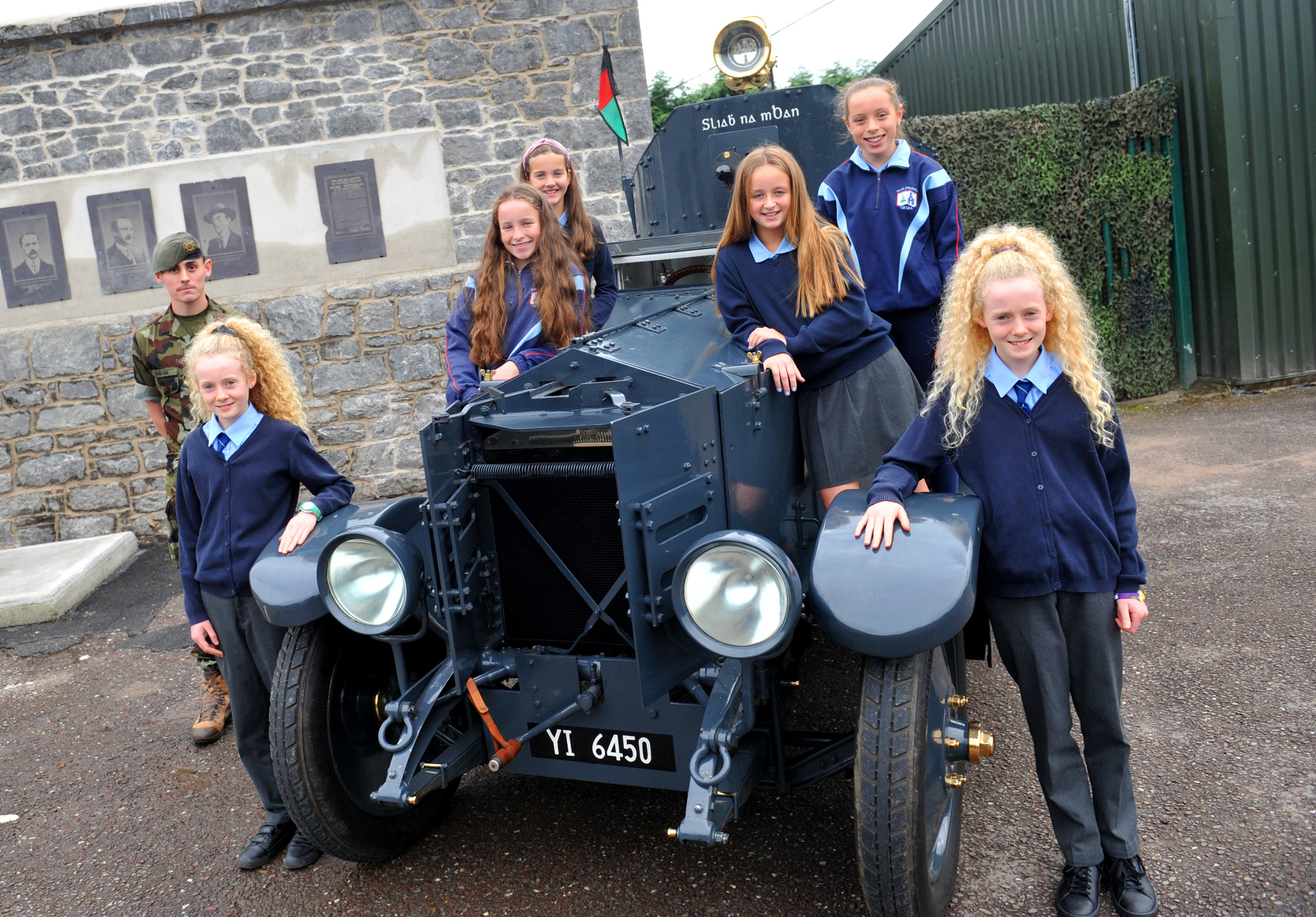
Lt Jordan Corrigan with sixth class pupils from Scoil Mhairtin, Kilworth, (front) twins Ailbhe Brett, and Claudine Brett (middle) Jane Linehan and Casey Lane and (back) Lucy Beecher and Meadbh Riordan, with the 1920 Slieve na mBan Rolls Royce armoured car which led the convoy ambushed at Beal na Blath when General Michael Collins was killed. Photo: Larry Cummins
Descendants of some of the men involved in the biggest War of Independence jail break of IRA volunteers in Munster were invited to commemorate their feat exactly 100 years on at the army camp where it occurred.
Up to 25 volunteers escaped by tunneling more than 100 yards from their hut and under the perimeter wire. Unfortunately one of them was left behind – he was too stout to fit into the hole. None of them were ever recaptured by the British.
They'd no proper tools for the job and had to improvise. Marianne Kelly and her brother, Matt, brought along a mess spoon provided to their granduncle Matthew Kelly by his British captors, which he could have well used to tunnel out.

The pair travelled from Enniscorthy, Co. Wexford, to attend the army camp in Kilworth, Co. Cork, for yesterday's event. Like many other escapees Matthew was put up in safe houses for several weeks.
“He didn't return home until that Christmas,” Marianne said. Matt pointed out that Matthew was a rates collector who was arrested by the British on suspicion of being an IRA intelligence officer.
After hostilities ceased he married, had 11 children and worked as an ambulance driver before turning to farming. He died aged 74 in 1974.

Jim Linehan, 94, from Ballyhooly, Co Cork came along with members of his family to honour the memory of his uncle, Simon Linehan.
After the war Simon went to Boston, later returning to live in Kilworth. “It's a proud day for us to be able to remember him in this way,” John said.
After the British left and handed over the camp to the fledgling Irish Army it was renamed Lynch Camp after General Liam Lynch, who joined the Anti-Treaty side in the Civil War. He was shot dead by Free State Forces and is buried in the nearby town of Fermoy.
Two of Lynch's grandnieces, Bernadette O Laitháin and Paula Noonan, were given the honour of placing a wreath at the base of the camp's flagpole as a piper played a lament and the National Anthem.

Paula's daughter, Ciara Molan, a teacher at the national school in Kilworth, brought along some of her students who'd also been invited to the event by the army.
It was organised by the camp's Commandant Tadhg O'Donoghue who spent many hours on the phone trying to track down the men's descendants.
Noted historian Tom O'Neill, who is deputy general manager of Spike Island, gave a lecture on the escape. He said the men who tunneled out were lucky as they were the last of three batches of detainees due to be transferred to the more secure Spike facility.

The other two batches were transferred, but the third batch got out just before their turn.
He said the men held in Kilworth came from all the counties of Munster and from Wexford and Kilkenny.
“They were not charged or convicted, they were interned on suspicion of IRA involvement. Kilworth was a staging camp until they were moved on to prisons at Spike Island and Bere Island,” Tom said.
“We need to celebrate the bravery and exploits of the gentlemen and ladies who fought for our independence,” said Colonel Ray O'Lehane, the most senior officer to attend the event.