Tidal barrier 'won't save Cork and lives could be lost,' says minister
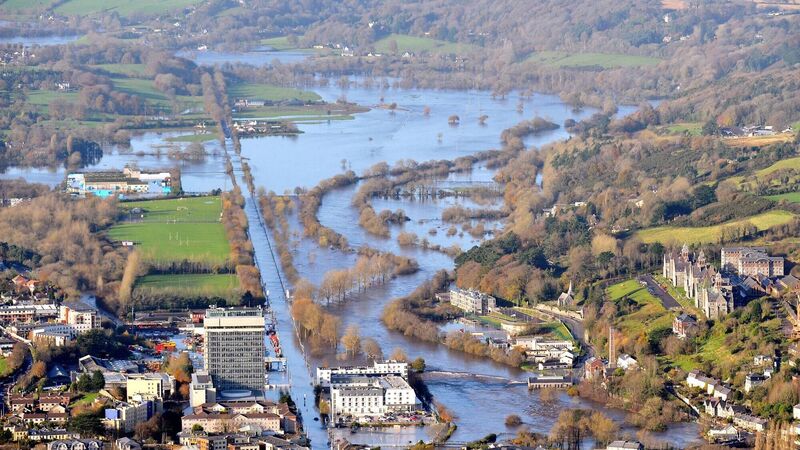
People could end up dead in Cork city if a major flood similar to the devastating 2009 event is to reoccur, warned OPW Minister Patrick O’Donovan Picture: Denis Minihane.
A tidal barrier will not save Cork City and its communities from major damage, is too costly, and could take 50 years to come to fruition, the minister in charge of the flood plan for the region has insisted.
People could end up dead in Cork City if a major flood along the devastating 2009 event is to reoccur, which is not beyond the realm of possibility with climate change, Office of Public Works (OPW) minister Patrick O’Donovan when asked to update the progress on the Lower Lee Flood Relief Scheme.
In reply to Cork senator Jerry Buttimer, who asked for a progress report on implementing the scheme, Mr O’Donovan could barely hide his frustration at what he called the “snail’s pace” of major flood relief works for Cork since 2006.
In a thinly-veiled barb at opponents of the OPW’s flood defence plan for Cork city, Mr O’Donovan said “nobody has a monopoly” on strategies on how to save the region from future catastrophic events.
“The OPW is not above criticism, we are not one bit precious. If things can be made better by engagement, we are all for that. One of the most contentious issues raised is whether a tidal barrier is a solution to the problem of Cork city.
“One of the many options considered was a tidal barrier, and a detailed report was prepared, as one of the many reports prepared for the scheme. The conclusion is that while a correctly sited and designed barrier may — and I repeat, may — resolve the tidal problem, it would not solve the more destructive fluvial, that’s the river flooding problem in Cork.
“I know having lived there for a period of time, and all the traders will tell you, is one of their biggest concerns.” Four locations were considered and ruled out for various reasons, he said.
“They include environmental impacts, technical difficulties, impact on the navigation of the harbour which is one of the busiest in the country, limited upstream storage capacity for flows coming down the river, inadequacy in terms of climate change in terms of adaptatibilty.
“This was actually televised on (RTÉ programme). Estimated costs are between €1bn and €2bn, these are massive variations, and would be prohibitive at this point. Any such project would not be cost beneficial when all the financials are taken into account.
“The report concluded that a tidal barrier is not currently viable for Cork city and would not become viable for at least the next 50 years. I don’t believe that the people of Cork city are prepared to wait that long.” The delays are “not for want of money”, Mr O’Donovan claimed, adding that human habitat was his priority.
Save Cork City has taken a complaint against Mr O’Donovan to the European Commission over the OPW’s plan.
The lobby group has insisted that a tidal barrier would protect the city from a major flooding threat.
It says that a barrier would have a navigation gate that can be closed as necessary to protect the city from tidal surge for generations, allows for required water storage to separate upstream water from the tide and the protection of and development of the city and docklands.
A tidal barrier would cause no disturbance to the current river landscape in the city or to the city economy during construction, the group claims, and would work in combination with other flood relief methods which may all react together.
SCC has described the Lower Lee Flood Relief Scheme as “damaging to property, the economy, heritage, nature, and the environment generally”.


CONNECT WITH US TODAY



Be the first to know the latest news and updates