Enoch Burke was moved from Mountjoy for his own safety, High Court hears
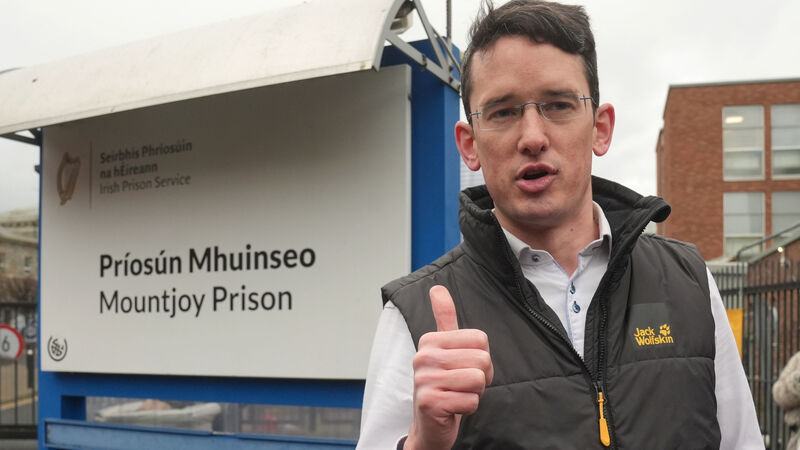
Enoch Burke was transferred after he was stripped of his 'enhanced' prison status due to his behaviour during an escort to a recent court hearing.
Jailed teacher Enoch Burke was transferred to Castlerea Prison after prison authorities decided housing him within Mountjoy Prison’s general inmate population would pose a risk to his safety, the High Court has heard.
Lawyers for the prisons’ governors told Mr Justice Brian Cregan on Thursday that the transfer occurred in circumstances where, in light of Mr Burke’s conduct during an escort to a recent court hearing, he was no longer deemed eligible for “enhanced” privileges under the Irish Prison Service’s (IPS) “incentivised regimes” policy. This policy incentivises good behaviour among prisoners.
Previously, as a prisoner with “enhanced” status, the teacher had been housed in a single cell at Mountjoy’s West section, separate from the prison’s general population. Prison authorities’ stripping of Mr Burke’s “enhanced” status necessitated him being housed elsewhere, the court heard.
Enoch Burke is in jail for breaching a court order banning him from Wilson’s Hospital School, Co Westmeath, where he previously taught German and history.
He has spent more than 600 days in prison in separate spells for his contempt of the court order. His imprisonment was most recently ordered in January.
On March 1, Enoch Burke was transferred by the IPS from Mountjoy Prison in Dublin — where he had been detained during his various periods of incarceration — to Castlerea Prison in Co Roscommon.
He is challenging this transfer. He contends that the transfer had “no legal basis”, arguing that the court had ordered his detention be at Mountjoy. Lawyers for the prisons’ governors maintain that they had a legal right to transfer Mr Burke under the Criminal Justice (Administration) Act 1914.
Enoch Burke was banned from the school when the High Court ruled in May 2023 that Wilson’s Hospital School had validly suspended Mr Burke from his teaching position. Judge Alexander Owens ordered that he be restrained from attending at the school premises.
The school suspended — and later dismissed — Mr Burke over his conduct towards the then-principal Niamh McShane at a school religious event in June 2022.
The confrontation arose in circumstances where the principal had earlier requested teachers to address a student by a new name, and with the pronouns “they” and “them”. Mr Burke, an evangelical Christian, has maintained that this request went against his religious beliefs.
He has repeatedly claimed he has been jailed over his religious beliefs and views on transgender issues, a claim rejected by several High Court judges.
At Thursday’s hearing, David Perry, barrister for the governors of Mountjoy and Castlerea, opened to the court a sworn statement of Don Cullinton, director of operations at the Irish Prison Service.
In the statement, Mr Cullinton outlined how Mr Burke’s behaviour during an escort to court failed to meet the standard of behaviour required for an “enhanced” privileges status. This left him ineligible for housing in Mountjoy’s West section.
Housing Enoch Burke in Mountjoy’s general population would pose a risk to his safety, Mr Cullinton said. To ensure his safety, he required a single occupancy cell, but providing this was not possible due overcrowding in the prison, Mr Cullinton said.
In those circumstances, Enoch Burke was transferred to Castlerea Prison, where it was possible to place the teacher in a single cell.
Counsel submitted that the legislation, in its “ordinary and natural” meaning, defines a prisoner as a person held in a prison. He submitted that all prisoners — including those who are detained for contempt of civil orders — are subject to powers that allow for the transfer of inmates between prisons.
In response, Mr Burke, appearing in court via videolink, said the 1914 Act deals with criminal matters, and should not apply to his case. He said the prison governors’ reliance on the act was “unfounded and misconceived”.
Responding to Mr Cullinton’s sworn statement, he said he had always conducted himself well in prison. “I challenge any averment to the contrary,” he said. Mr Burke said the removal of his enhanced status was a punishment for “being vocal in court”.
Following the parties’ submissions, the judge asked Enoch Burke if he was willing to purge his contempt, and give an undertaking not to trespass at the Wilson’s Hospital School.
Mr Burke declined. He said he should not be in prison, and repeated his claim that the reason for his imprisonment was his refusal to address a pupil by “they” and “them” pronouns. “I have no intention of compromising my Christian belief,” he said.
“From my perspective it is a tragedy that you are wasting your life like this,” the judge replied. He said had no interest in asking Mr Burke to change his religious beliefs, and said he was in prison for his breach of a court order.
The judge reserved his judgment on the prison transfer matter to next week.
CONNECT WITH US TODAY



Be the first to know the latest news and updates