'We must match drone and robot tech that criminals and terrorists are using' – Europol
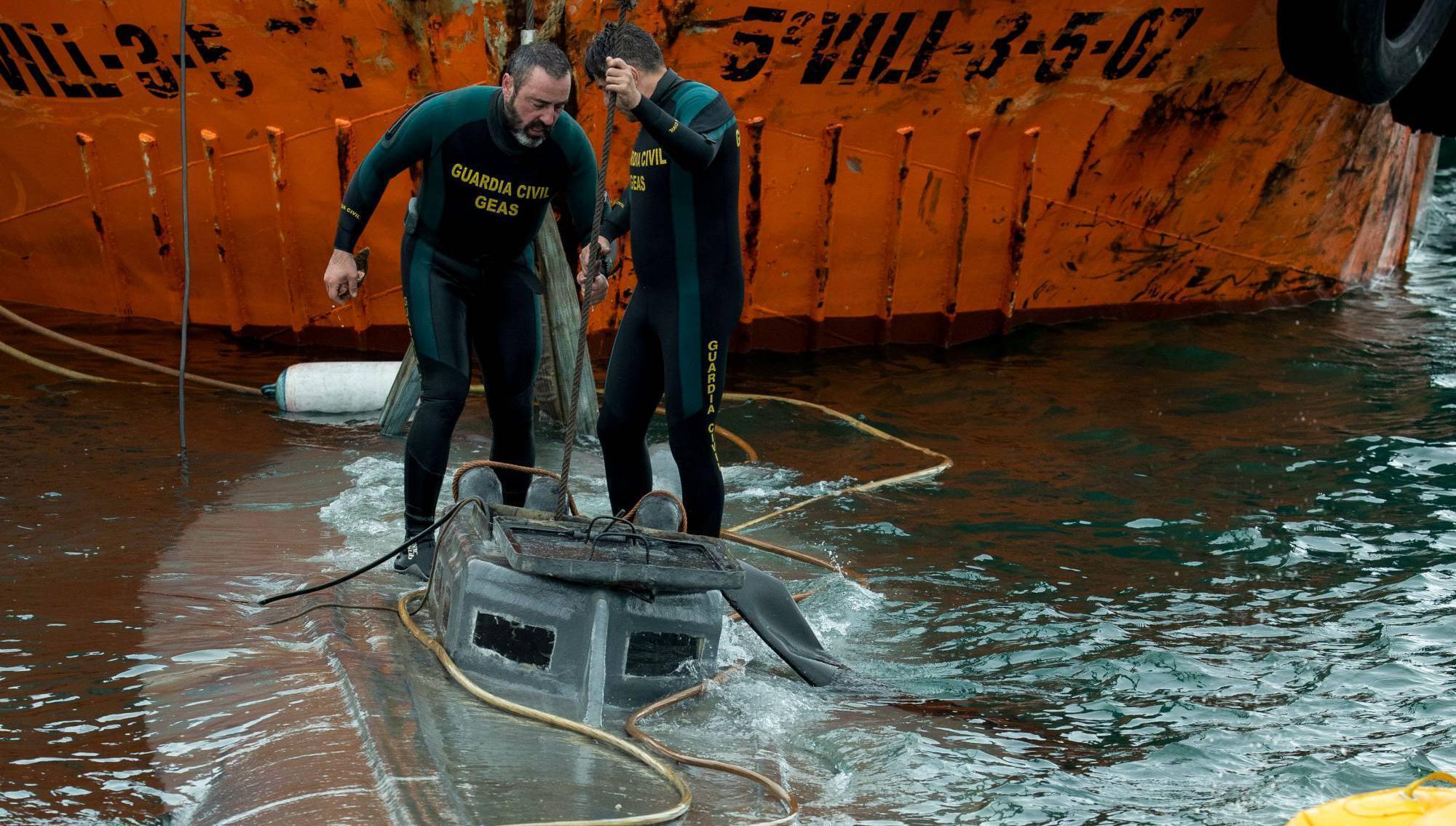
Spanish police divers on a drone submarine they intercepted in Aldan, north western Spain, in November 2019: An early instance of illegal drone technology, increasingly being used by criminal gangs. For more, see the links at the foot of this article. Picture: Lalo R Villar/AFP/Getty
Drones and robots are increasingly being used by criminals — and police forces must adapt, potentially developing ‘robocops’ to fight technology-enabled crime, a new report by the EU’s law enforcement agency has found.
Recent wars including Russia’s invasion of Ukraine sparked innovation in unmanned systems such as drones, advances which are now being capitalised on by criminal organisations and terrorists. Such advances have been further supported by developments in supporting technology like 3D printing for the modifications, cryptocurrency for anonymous trade, and encrypted communications to evade law enforcement detection.
There has been a reported increase in drone use around European infrastructure, especially airports, and there are examples of drone pilots selling their services online, Europol’s ‘Unmanned Future(s)’ report found.
The launch of suspicious drones as Ukrainian president Volodymyr Zelenskyy arrived in Ireland recently prompted concerns about the State’s ability to counter possible foreign interference.
Euronews’ fact-checking unit, The Cube, found that drone-related disruptions at European airports quadrupled between January 2024 and November 2025.

Drones and robots are already being used by law enforcement for surveillance; to access dangerous areas in search and rescue; to map crime scenes; and for bomb disposal and the handling of hazardous material. But the adoption of unmanned technologies in law enforcement is being hampered by limited suppliers in the US and Asia.
“Without European alternatives, there is a significant risk of being vulnerable to dependencies, cybersecurity and data protection vulnerabilities,” the report warned.
Because the development of most unmanned systems is focused on either purely civilian or military applications, the report found “a critical gap in the development of law enforcement specific capabilities, especially at a systemic, interoperable level”.
Criminals are increasingly using drone and robotic technology to smuggle drugs and other contraband in unmanned submarine-type boats and in aerial drones.
Drones may also be used increasingly by criminals and terrorists to gather vital intelligence undetected.
As AI and sensor technology develops, their integration will enable robots to navigate and interact with their environment more effectively, with some amphibious drones being able to move from the water to the air seamlessly.
“The criminal use of drones has been reported since around 2010, making 2025 a 15-year learning process for criminal innovators and early adopters,” the report said.
“Organised crime actors are now capable of producing professional and advanced drones in an artisanal way, and in 2022, the first known instances of unmanned underwater drones, deployed for nefarious purposes, were discovered.”
Drones also distance criminals from the crime.
Several technologies are available and being developed to counteract unauthorised drones.
“Electronic countermeasures like RF jamming and GPS spoofing can disrupt a drone’s communication links, causing it to land or return to its operator. However, if drones are controlled via fibre optic cable, some of these mitigation mechanisms are ineffective,” the report said.
"Kinetic solutions involve physically intercepting drones using nets fired from specialised guns or deploying interceptor drones designed to capture or collide with the target."
High-powered microwaves and lasers are being developed to disable drones by damaging their electronic components or airframes.
However, disabling drones is a more complicated operation for police than it is for the military, with an onus on stopping the threat with minimal damage to the source of the threat, public safety concerns, and a need to preserve evidence.
The advent of robotics is now extending the world's digital transformation into the physical space, where mechanical entities interpreting digital data will interact with humans and animals, the report said.
Police forces will likely see a shift from monitoring two-dimensional to three-dimensional spheres, as criminal activities migrate across air, sea, and underground, traditional perimeter-based policing may become obsolete, the report said.
"This multi-dimensional criminality will require a multi-dimensional law enforcement response.
"With an increase in unmanned systems, underwater and in the air, the planes in which humans operate will become increasingly multi-dimensional. For law enforcement, unmanned systems not moving along the paths that are currently being policed will bring new challenges in terms of monitoring and enforcement."