Hospital apologises for ‘shortcomings’ during delivery of baby who later died
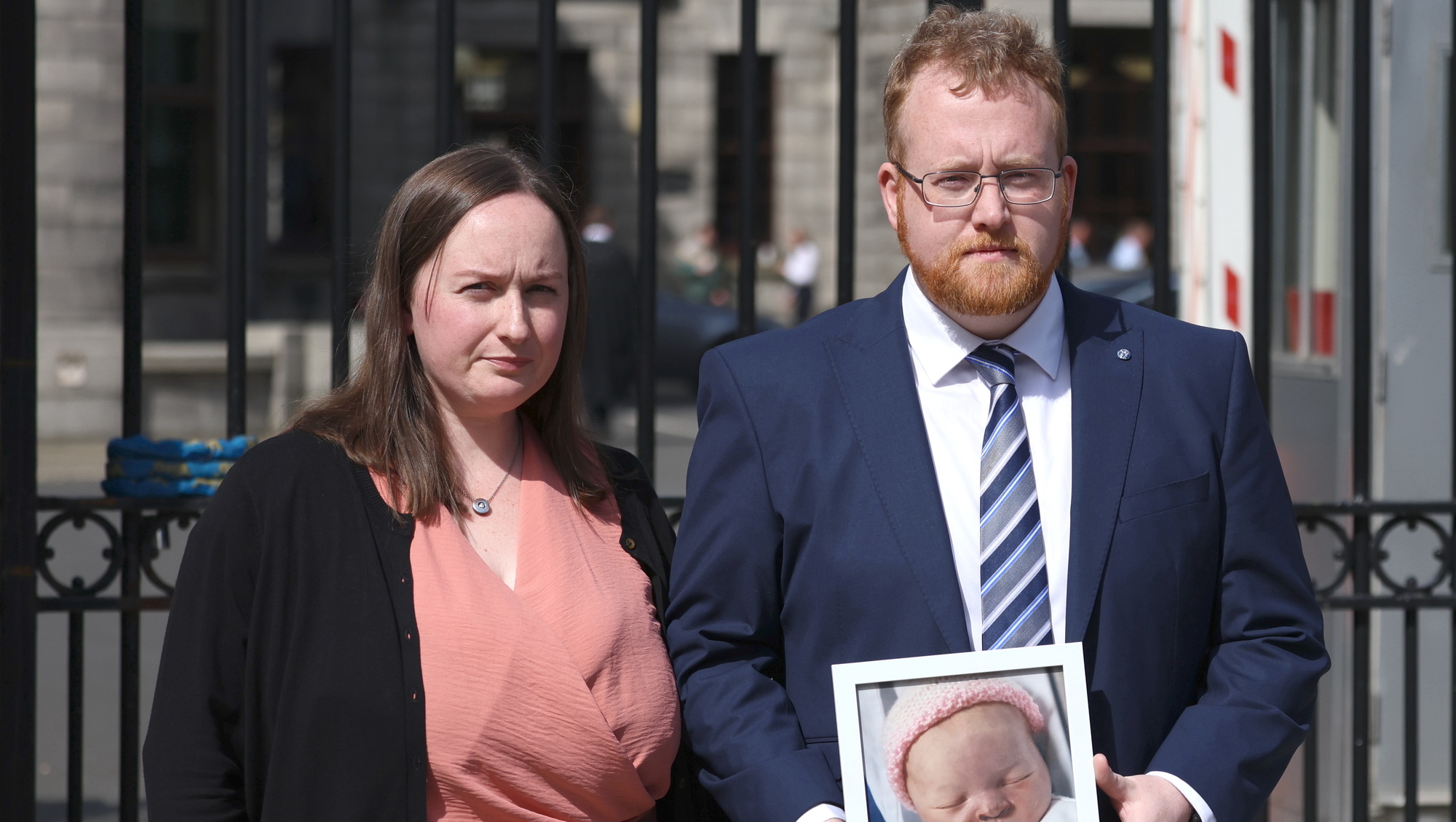
Anna and Gerard Gilligan from Oranmore, Co Galway, who settled an action over the death of their baby daughter Ailbhe at University Hospital Galway. Picture: Collins Courts

University Hospital Galway has apologised for “shortcomings in the obstetric care” provided during the delivery of a baby girl who died just one hour after her birth.
The High Court heard that the loss of Ailbhe Gilligan five years ago has left a deep gap in the Gilligan household.
Her parents, Anna and Gerard Gilligan, of Oranmore, Co Galway, had sued the HSE over the death of their baby girl on October 27, 2020.
The family’s counsel, Doireann O’Mahony Bl, with John O’Mahony SC, told the court that it was a very tragic and devastating case.
Counsel said it was their case that CTG monitoring of the baby’s heart rate was deficient, and at times there was no monitoring of the baby’s heart rate.
The little girl allegedly suffered a hypoxic-ischaemic insult, which is a brain injury caused by a lack of oxygen.
Baby Ailbhe, counsel said, died an hour after her birth when attempts to resuscitate her failed.
A letter from the hospital was read out as the Gilligan family settled their action against the HSE over the death. In the letter, the general manager of the hospital, Chris Kane, expressed sincere condolences to the Gilligan family, on his behalf and on that of the hospital, over the death of Ailbhe.
The hospital acknowledges the shortcomings in the obstetric care provided during Ailbhe’s delivery, and we sincerely apologise in this regard.
It added: “We understand that this statement cannot change or negate your loss, but wish to convey our deepest sympathies to you and to Ailbhe’s extended family.”
In the proceedings, it was claimed that the CTG monitoring was allegedly grossly inadequate and it was alleged that, at times, there was no monitoring of the fetal heart.
It was further claimed that as a result of the alleged delay in reacting to ongoing abnormal CTG readings and an alleged failure to properly monitor CTG, the baby suffered a hypoxic-ischaemic insult.
It was contended that if she had been delivered earlier, resuscitation would have been successful, and she would have survived.
It was claimed there was an alleged failure to have in place proper continuous CTG monitoring and that lapses in the CTG monitoring had been allegedly caused so that at times there was no fetal heart monitoring. Alleged early warning signs of fetal distress had been overlooked, it was also claimed.
The HSE admitted a breach of duty in the management of the mother’s labour and delivery of Ailbhe in failing to repeat a fetal scalp blood sample on three occasions or to expedite delivery based on the CTG tracing.
However, the HSE denied that the death was caused solely and entirely by the admitted breach of duty.
Approving the settlement, Mr Justice Paul Coffey said it was very sad and tragic case, and he conveyed his deepest sympathy to the family.
CONNECT WITH US TODAY
Be the first to know the latest news and updates