Man who murdered wife and children forced them to deny he hit them in video recording
Inquest into the deaths of Seema Banu and her two children heard accused had disguised himself in women's clothing to take a bus to their house on day they were last seen alive
Man who murdered wife and children forced them to deny he hit them in video recording

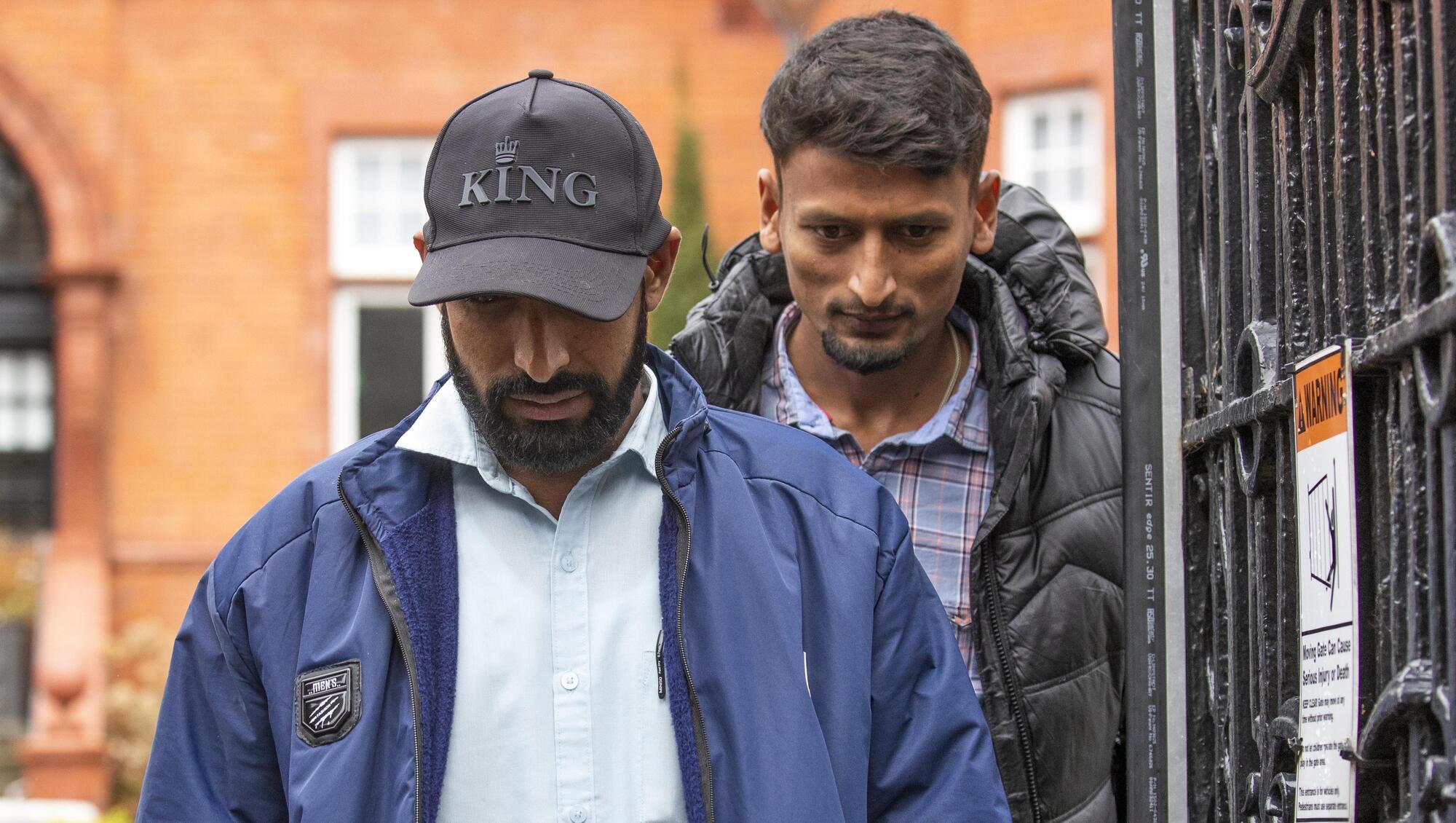
Kashief Ahmed, left and Syed Suhan, nephew and cousin of Seema Banu at the inquest into her death at Dublin District Coroner's Court on Friday. Picture: Colin Keegan/ Collins

A man who was arrested for the murder of his wife and two children at their home in south Dublin disguised himself in women’s clothing to take a bus to their house on the day they were last seen alive on October 22, 2020, an inquest has heard.

Evidence also emerged that the accused, Sameer Syed, was in the family home on 29 days in the two months before their deaths in breach of bail conditions imposed after he had physically assaulted his wife, Seema Banu, earlier that year.

Syed also appeared to coerce his wife and children into recording a video on October 22, 2020, in which they claimed he had never hit Ms Banu and that any marks on her body from the time of the assault were self-inflicted.

The bodies of Ms Banu, 37, and her daughter, Asfira, 11, and son, Faizan, 6, were discovered in their home at Llewellyn Court, Ballinteer, Co Dublin on October 28, 2020.

Detective Inspector Vivian Rock said Syed had admitted to gardaĂ­ following his arrest that he had killed his wife after sneaking into the house but had blamed the deaths of their two children 'on another party'. Picture Colin Keegan/ Collins

A sitting of Dublin District Coroner’s Court heard Syed was arrested and charged with their three murders a month later.

Syed, a 38-year-old IT expert with Eir, took his own life in his cell at the Midlands Prison in Portlaoise last June, just a week before he was due to go on trial at the Central Criminal Court.

He had appeared in court a few days before the discovery of the bodies of his wife and children on a charge of assault causing harm to Ms Banu on May 16, 2020.

The lead investigator into the three murders, Detective Inspector Vivian Rock, said Syed had admitted to gardaí following his arrest that he had killed his wife after sneaking into the house but had blamed the deaths of their two children “on another party”. 

However, Det Insp Rock said it was “proven not so” and explained  Syed’s fingerprints were discovered on a plastic bag found under his daughter’s head.

State pathologist's evidence

State pathologist Heidi Okkers told the second day of the inquest on Friday that autopsies on the three victims revealed they had all died by asphyxia due to strangulation which was consistent with scarves found around the necks of the three bodies.

Evidence on the time of death provided by Dr Okkers indicated Ms Banu had died before her two children — a finding which refuted Syed’s claims that she had killed them.

Dr Okkers said there was evidence that external force by another party was used in the deaths of the two children.

While Ms Banu’s body gave the appearance of self-strangulation, Dr Okkers said she believed that explanation was “highly unlikely” given the circumstances of the case.

A jury of six women and two men returned a verdict of unlawful killing in all three cases.

The inquest was shown CCTV footage of an individual dressed as a woman with a coat, full-length dress, hat and dark glasses boarding a 14 bus at 8.05pm on October 22, 2020, in Rathmines, where Syed had been living since he was restricted from living in the family home as part of his bail conditions.

Det Insp Rock said Syed had admitted the figure in the footage, who was traced to getting off at a bus stop on Stonemason’s Way in Ballinteer, was him.

He remarked Syed’s clothing was “not a cultural dress”, while other CCTV footage showed he had changed back into his normal clothes as he got near his home.

The inquest heard gardaĂ­ were called to the house in Llewellyn Court on October 28, 2020, after a Tusla social worker, Holly Nuzum, became concerned that Ms Banu was not at home for an appointment which was unusual, while all the blinds were shut.

Garda evidence

Detective Garda Brian O’Neill said he arrived at the house at 11.40 am and spoke to a neighbour, Vivian Balwalya, who also said she had not seen Ms Banu or her two children for a number of days.

Det Garda O’Neill said he sought support from the Garda Armed Support Unit because of concern for the welfare of its occupants.

GardaĂ­ described forcing entry into the property by breaking a window on a rear patio door.

They immediately noticed water flowing through a damaged ceiling of the kitchen, while the kitchen floor was very wet.

Det Garda O’Neill described going upstairs and finding Asfira and Faizan lying face down side-by-side on a bed.

He then discovered their mother lying face up on a bed in another bedroom.

The inquest heard a tap in the bath was running and it had overflowed.

Det Garda O’Neill said all three victims had scarves around their necks which were knotted at the back with the two children and at the front with Ms Banu.

He told coroner Clare Keane he knew both children were dead, while he was certain Ms Banu was also deceased after touching her leg and finding it was “ice cold.” 

Video recording

The inquest also heard evidence that Syed was in the house in Llewellyn Court on October 22, 2020, when Ms Banu recorded a video in which she claimed her husband had never assaulted her and that marks on her body were self-inflicted.

The video, which was recorded by Ms Banu’s daughter, showed her mother claiming she had repeatedly explained to gardaí what had happened and had written a letter containing the same claims of her own free will.

In the recording, Asfira also said her father had not hit her mother, before adding: “Dad loves us a lot. No matter how we explain to [social workers] they don’t understand.” 

Detective Garda Ciaran Byrne told the inquest an examination of a wi-fi router in the house in Llewellyn Court had established that Syed’s phone was in the property on 29 days between August 20 and October 23, 2020. Picture Colin Keegan/ Collins

Det Insp Rock said the letter, which he described as Ms Banu’s “final statement”, was “a proclamation of no wrong-doing by Syed and that they should be together.” 

Detective Garda Ciaran Byrne of the Garda National Cybercrime Bureau told the inquest an examination of a wi-fi router in the house in Llewellyn Court had established that Syed’s phone was in the property on 29 days between August 20 and October 23, 2020.

The coroner and jury of six women and two men were shown a number of video calls retrieved from Ms Banu’s mobile phone in which she was crying as she spoke to family members back in India about her husband beating her.

“When I went to the police, he got a certificate to say I was mad,” she told one relative in a call in May 2019.

In another video call on May 15, 2020 — a day before she was physically assaulted by her husband — Ms Banu said her body “can’t take it anymore” and expressed concern because her son was “so scared”. 

'I’ll be killed'

“I’ll be killed. I can’t talk to the children,” she added.

Ms Banu claimed her husband was “high on his money and wants to do whatever he wants”. 

In the same call, she warned that if anything happened to her or if she died, Syed would be responsible.

However, there was another video call recorded on August 9, 2020, which Dr Keane said was “completely different” and showed Ms Banu declaring she loved her husband very much and how people did not understand how much he also loved her.

She claimed they were unable to live together because of the “misunderstanding” by gardaí about the report of domestic violence.

In another video on October 3, 2020, Ms Banu said she was making it to show how she inflicted marks on herself as gardaĂ­ had not wanted to understand how they had happened.

The inquest heard the Garda inquiry had involved thousands of man hours with hundreds of lines of investigation being followed.

Det Insp Rock said gardaĂ­ were aware Ms Banu and her children had been brought to a shelter for victims of domestic violence in Dublin on Christmas Eve in 2018.

Evidence was heard on Thursday that staff at the Dunnes Stores supermarket in the Beacon Centre in Sandyford had called gardaĂ­ after Ms Banu and her children were crying and distressed after Syed was seen pulling and forcibly grabbing his wife and daughter outside the store.

Det Insp Rock said there was also the Garda’s own file on Syed being arrested on May 16, 2020, at the family home after Ms Banu was found unconscious.

Although no formal complaint was made against Syed, Det Insp Rock said gardaĂ­ were satisfied they had enough evidence to prosecute the case.

The witness said gardaĂ­ also knew Ms Banu had been treated in hospital in India in May 2019 after being assaulted just a few days after she had returned home for a period with her husband and children.

The inquest was told Syed had flown back to Ireland before he could face a charge for assaulting his wife.

Det Insp Rock noted a neighbour at the family’s previous home in Sandyford had also made them aware of an incident in March 2019 during which the inquest heard Ms Banu was crying and appeared fearful of her husband.

A number of Tusla social workers gave evidence of the challenge of trying to assist the family and ensuring the protection of the two children as Ms Banu was claiming that gardaĂ­ and Tusla misunderstood their domestic situation.

Jury recommendations

At the conclusion of the inquest, the jury issued a number of recommendations including that there should be a shorter period between the first referral of child protection concerns to Tusla and the holding of a case conference as well as the provision of support workers catering for mothers only in cases of domestic violence.

The foreman of the jury said supervised visits should also be provided by professional support workers, with a translator if necessary.

Dr Keane said she would bring the jury’s recommendations to the attention of the relevant authorities.

Addressing two of Ms Banu’s nephews who had travelled from India for the inquest, the coroner expressed regret that their first visit to Ireland was in such tragic circumstances.

Dr Keane said for all the trauma and anguish she and her children had suffered their voices were “but a whisper and they had no chance to explore their full potential”. 

The coroner observed they had died “in a way that is unimaginable to most of us”.

More in this section

Lunchtime News

Newsletter

Keep up with stories of the day with our lunchtime news wrap and important breaking news alerts.

Cookie Policy Privacy Policy Brand Safety FAQ Help Contact Us Terms and Conditions

© Examiner Echo Group Limited