Hutch fails in bid to have taped conversations with Jonathan Dowdall in North ruled inadmissible
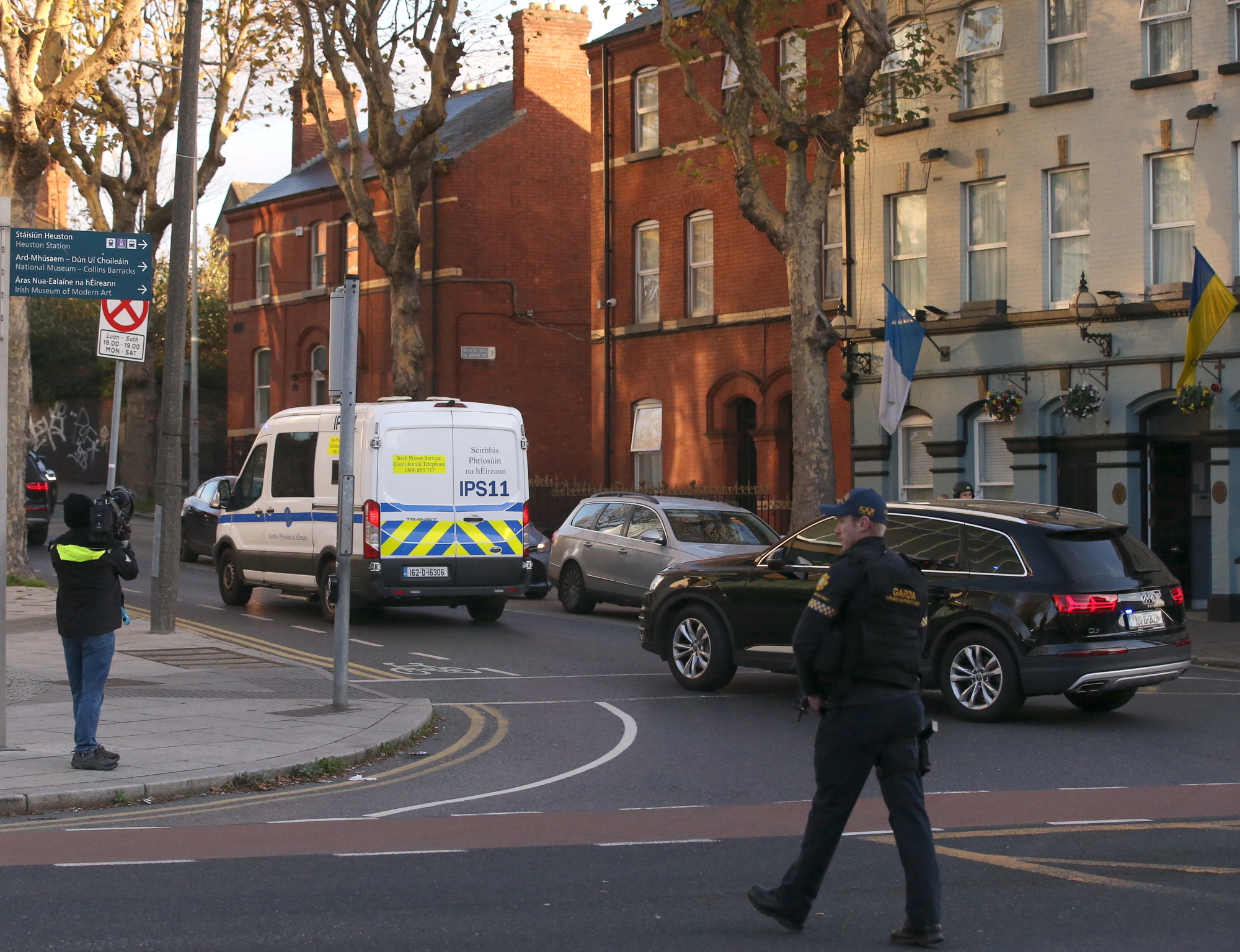
A prison van under Garda escort arriving to the Special Criminal Court on Friday morning, where the trial of Gerry Hutch for the murder of David Byrne, continues. Picture: Collins Courts
Gerry 'The Monk' Hutch has failed in his bid to have the taped recordings of his conversations with former Sinn Féin councillor Jonathan Dowdall in Northern Ireland ruled inadmissible.
This is despite the three-judge court ruling the evidence of these recordings while the pair were in Northern Ireland were unlawfully obtained.
Mr Hutch is before the Special Criminal Court accused of the murder of David Byrne in the Regency Hotel on February 5, 2016. He has pleaded not guilty.
His defence team had sought to have the recordings of his conversations with Mr Dowdall while they were travelling to Northern Ireland on March 7, 2016, ruled inadmissible.
Gardaí had received a warrant to place the bug on the car in the weeks following the Regency shooting.
On March 7, Mr Hutch and Mr Dowdall embarked on a 10-hour journey from Dublin, taking in Lisburn, Belfast and Strabane. It is the prosecution’s case they met with republicans in a bid to have them broker a peace amid the escalating Hutch-Kinahan feud.
The trial has heard Dowdall’s jeep crossed the border at the Carrickdale Hotel in Dundalk, Co Louth, at 3.12pm on March 7, crossing back into the Republic at 10.50pm that night at Aughnacloy in Co Monaghan.
Earlier this week, both the State and the defence for Mr Hutch made their legal arguments as to the admissibility of the evidence.
Prosecution counsel has agreed with the presiding judge it was the State's case that, once a surveillance device is placed and retrieved lawfully on a car within this jurisdiction, "then it does not matter a damn where the vehicle was in the meantime".
Sean Gillane SC argued an audio surveillance device was "simply an inanimate movable item" which had been "applied, sought, deployed, initiated and retrieved within the State" and that the data was recovered within the State. He stated: "No question of extraterritoriality in truth arises''.
Last Friday, Brendan Grehan SC, for Mr Hutch, set out his stall, telling the non-jury court that "on its face" there had been an illegal operation of the Surveillance Act in this case and that the prosecution was seeking to "wheel the evidence in" which "extended beyond the territorial boundaries" and say "none of that matters".
He said an audio surveillance device being deployed on a vehicle gathering intelligence whilst operating outside of the jurisdiction was in "contravention" of the terms of the act.
The three-judge court delivered its ruling in this matter this morning before the court.
Ms Justice Tara Burns said that the authorisation given by a district judge to place the tracker on Dowdall’s car was only valid within the State. Therefore, only the portions of audio that were captured while the car was in this jurisdiction were lawfully gathered.
She said that the gardaí and officers from the National Surveillance Unit acted “in good faith” and any illegality of this evidence gathering was unknown to them.
During the conversations, Ms Justice Burns said that criminality was discussed and the pair were “clearly discussing criminal behaviour”. She also made reference to a “combative strategy” being discussed on behalf of the Hutch family.
Nevertheless, she said the court is satisfied that the conversation ought to be admitted in the interest of justice.
Mr Grehan, for Mr Hutch, said he accepted the court ruling, adding: “As I must”.
“The court has ruled the surveillance in Northern Ireland was unlawfully obtained but has nonetheless decided to admit it into evidence,” he said.