Jury fails to reach verdict in garda murder trial
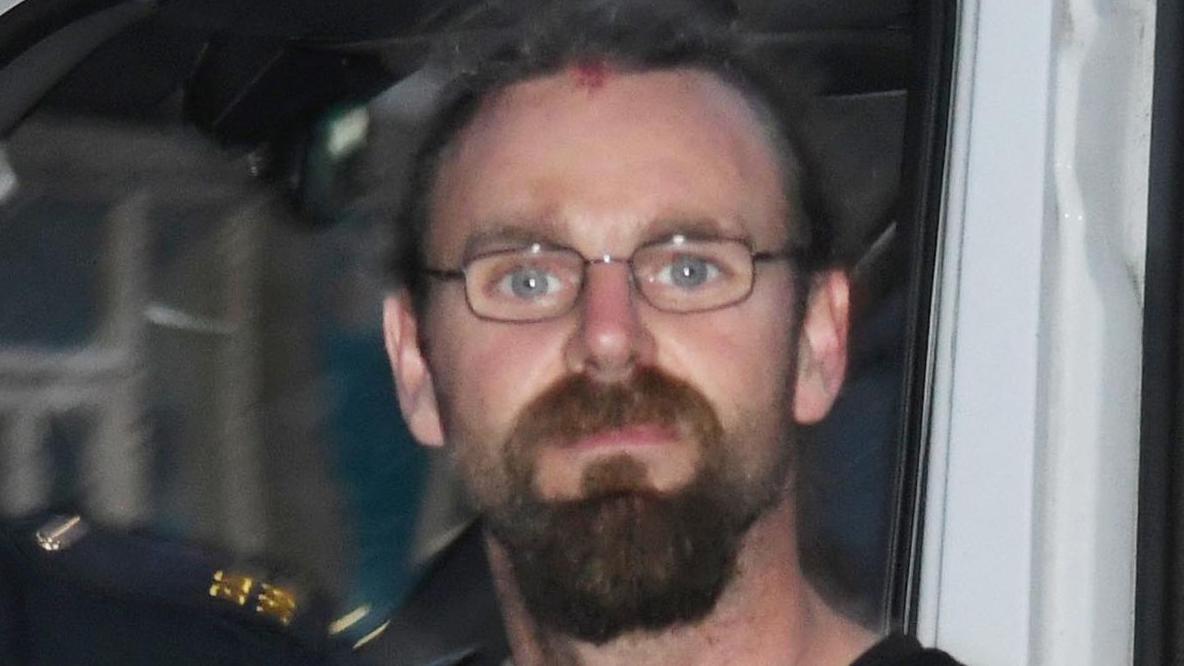
Stephen Silver: Will now face retrial. Picture: Michael McCormack/PA
A jury at the Central Criminal Court has failed to reach a verdict in the trial of Stephen Silver, who accepts that he shot Detective Garda Colm Horkan 11 times but denies his murder.
The jury were asked to consider whether Mr Silver was suffering from bipolar affective disorder at the time of the shooting and whether his condition substantially reduced his responsibility for the killing. Mr Silver's lawyers argued that he should be found not guilty of murder but guilty of manslaughter due to diminished responsibility.

The seven men and five women spent just under nine hours considering their verdicts over three days before revealing that they had a disagreement that they were not able to resolve. The case will now be listed again at the Central Criminal Court on 9 December next and Mr Silver will be sent forward for a retrial. He has been remanded in custody until that date.

Mr Justice Paul McDermott thanked the jury for what they had done over the last number of weeks.
“This was a very difficult case in detail and evidence and the nature of the case itself. It was very disturbing for everyone, especially for people such as yourselves who had to be judges,” said Mr Justice McDermott.
“I want to thank you for your application, attention, and dedication, and for the significant contribution you have given,” he said, excusing the panel from jury service for the next 10 years.
Mr Silver (46), a motorbike mechanic from Aughaward, Foxford, Co Mayo, had pleaded not guilty to the murder of Det Garda Horkan knowing or being reckless as to whether he was a member of An Garda SĂochána acting in accordance with his duty. He had pleaded guilty to manslaughter by reason of diminished responsibility, at Castlerea, Co Roscommon, on 17 June, 2020.
Mr Silver accepts that he shot and killed Garda Horkan using the detective's own gun. Garda Horkan suffered 11 gunshot wounds.
Dr Brenda Wright, a psychiatrist called by the defence, said that the accused was suffering at the time from bipolar affective disorder, a mental illness that diminished his responsibility. Professor Harry Kennedy, who was called by the prosecution, disagreed with Dr Wright and said that Mr Silver's mental capacity was intact at the time of the killing.
Mr Justice Paul McDermott told the jury that for the accused to be convicted of murder, the prosecution must prove that he unlawfully killed Garda Horkan and that at the time he intended to kill or to cause serious injury. If he is guilty of an unlawful killing but without the necessary intent, he said, they must find him not guilty of murder but guilty of manslaughter.
If they find that he had the necessary intent they must then consider whether the prosecution has proven beyond a reasonable doubt that Garda Horkan was a member of An Garda SĂochána acting in the course of his duty and that Mr Silver knew that or was reckless as to whether he was a garda acting in the course of his duty. If all those ingredients had been proven then the prosecution would have made out the case for "capital murder", he said.
The defence of diminished responsibility arises, he said, where a jury is satisfied that murder or capital murder has been proven. For the defence to succeed, he said, the accused must first establish that he was suffering from a mental disorder. He reminded the jury that there was evidence that Mr Silver has a diagnosis of bipolar affective disorder. He said the accused must also prove that he had relapsed or was relapsing into an acute phase of the illness at the time of the shooting such that it "substantially reduced his responsibility for the acts at the time".
If the jury had accepted that it is more likely that he was suffering from a mental disorder such that it substantially diminished his responsibility then that would reduce murder or capital murder to manslaughter, the judge said.
He asked the jury to come to their decision without emotion and by assessing the evidence and the inferences they were happy to draw using their common sense.
Mr Justice McDermott told the jurors they were not bound by the expert evidence and they were entitled to prefer one psychiatrist's evidence over another. This was not "trial by expert" but trial by jury, the judge reminded the panel.
He added: "You are not bound to accept the medical evidence, which is put forward as expert testimony, you give it such weight as you deem appropriate. If there is other evidence that conflicts or outweighs it or leads you to feel it is not reliable, you are entitled to act on that basis because you are the judges of fact and are entitled to consider the evidence as a whole."
He added: "You have to ask yourself, was his responsibility substantially diminished by an operative mental disorder? Was it a real mental disorder, a real contributing factor or cause of his acts at the time?" They must consider the extent of the mental disorder, the extent of its effect on the accused, his decision-making and "in particular his decision to shoot and kill the victim", the judge said.
"That is a question for you to assess on all the evidence, in a common sense way, taking into account the medical evidence but also the other evidence which you have heard."