Anonymous garda evidence will see 'cloak of secrecy' descend on Hutch case, lawyers say

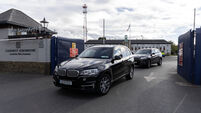
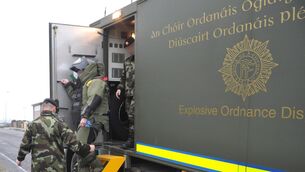
Armed gardaí on duty outside the Special Criminal Court in Dublin for the trial of Gerry "The Monk" Hutch. Mr Hutch's defence lawyer said: "An argument could be made by any of the gardaí in the country that they are entitled to anonymity but that isn't the rule that applies." File picture: Niall Carson/PA
Lawyers for Gerard ‘The Monk’ Hutch, who is accused of the murder of Kinahan Cartel member David Byrne at the Regency Hotel, have argued that "a cloak of secrecy" will descend over their client's case if gardaí from the National Surveillance Unit are allowed to give evidence anonymously.
Following lengthy legal applications on Wednesday by the prosecution and by defence counsel Brendan Grehan SC for Mr Hutch, the Special Criminal Court will rule on Thursday on whether 27 officers from the National Surveillance Unit (NSU) can give evidence anonymously and their names, which are handed in writing into the court, can be withheld from the defence and from the public.
Mr Hutch (59), last of The Paddocks, Clontarf, Dublin 3, denies the murder of Mr Byrne (33) during a boxing weigh-in at the Regency Hotel on February 5, 2016.
The prosecution made an application to the three-judge court on Wednesday that the public should be excluded from the court when members of the NSU give evidence and that each member should be "anonymised" according to an alphabetical letter, which is the same letter assigned to them in every case.
Mr Grehan, for Mr Hutch, objected to the application and said the Special Criminal Court did not have the jurisdiction to make the order. He said that the legal basis for the application should be established.
Fiona Murphy SC, prosecuting, called Detective Superintendent Eugene Lynch, the head of the Garda National Surveillance Unit, who outlined his concerns in connection to the reporting of the names, addresses and physical description of its members.
Det. Supt Lynch asked the court to prohibit the reporting of such details "to protect current covert operations and the integrity of future ones". He said if his officers' details were read aloud in court, it would curtail the ability of the State to prevent terrorist attacks and jeopardise investigations into serious crime.
Det. Supt Lynch agreed with Ms Murphy that 27 members of the NSU are in the book of evidence and that six of them have since retired.
Under cross-examination by Mr Grehan, defending, Det. Supt Lynch said that he had not sought to protect his own identity because he is now in a management role.
"But you are here asserting a general right that NSU personnel should not be identified?" pressed Mr Grehan. "Yes, as they are involved in operations currently," he replied.
Mr Grehan told the witness that there was obviously a premium in protecting those officers currently involved in the NSU as it could endanger the situation but asked the witness what protection he was seeking if someone had left their role in the NSU and had since retired. "Some of their families are not aware that they were involved in high-risk operations at a covert level,' replied Det. Supt Lynch.
Referring to the trial of Real IRA leader Michael McKevitt, Mr Grehan said members of the NSU who gave evidence had been identified. McKevitt was jailed for 20 years by the Special Criminal Court in 2003 after he was convicted of directing the activities of a terrorist organisation between August 1999 and October 2000.
Mr Grehan put it to the witness that if the Special Criminal Court decided it had the power to grant the application, would he be seeking it on a "blanket basis" whether his members were active or retired. Det. Supt Lynch said he was.
In her submissions to the three judges, Ms Murphy said Det. Supt Lynch had given particular reasons for the anonymity sought and that he had a genuine concern for the safety of the witnesses and their future engagement in such activities. The three-judge court had jurisdiction to make the order, she added.
In reply, Mr Grehan argued that nowhere is it stated that the Special Criminal Court "can make up rules" to provide for the anonymising of witnesses that appear before it. "The rule in this case that the prosecution seeks to rely on is ultra vires to the Offences Against the State Act 1939," he added.
Mr Grehan said it was not possible for witnesses in the Central Criminal Court to get anonymity as it was in the Special Criminal Court and asked the three judges not to depart from "the norm" and from what is done in every other case.
The lawyer asked the court to be "scrupulous" in ensuring that "a clear basis of necessity is made out" for the application and that there is no "overreaching".
"All of the CCTV civilian witnesses came up, gave their names and said where they were from; they didn't have any protection. Neither do any other gardaí who are in court day in and day out where they are identified," Mr Grehan continued.
A "blanket application" was being made, he said, without the necessary justification for why it should apply to people who are not on active NSU duty.
He said:
Presiding judge Ms Justice Tara Burns asked Mr Grehan how he said that his client's right to a fair trial was being interfered with. Counsel emphasised that he was not looking for the names and addresses of any NSU member for the benefit of his client and that he "had not instructed me to make any such enquiries".
The judge said she was specifically asking how Mr Grehan said his client's fair trial rights were being interfered with. Mr Grehan stressed: "Because he [Mr Hutch] should have a trial in public as far as possible and witnesses should give evidence in a public trial.
"He [Mr Hutch] has already gone to the Supreme Court because he was being tried before the Special Criminal Court and he sought to bring a Section 4E application but wasn't permitted under the legislation and now this is yet another layer where things can happen in his trial that would not happen if he was to be tried in an ordinary court".
Mr Grehan said he could not point to a specific fair trial right other than that "a cloak of secrecy" was being "put over" this part of the case. "It reflects on him in the general perception of his trial taking place before this court," he added.
He suggested to the court that if one of the NSU witnesses had been the subject of disciplinary proceedings for giving false evidence then the defence would be "shut out" from knowing this where otherwise one might have recourse if this process wasn't adopted.
Counsel for the two co-accused Jason Bonney and Paul Murphy adopted Mr Grehan's submissions.
In the opening speech, Sean Gillane SC, prosecuting, said the court would hear evidence that Jonathan Dowdall drove Mr Hutch north to a meeting in Strabane in Co. Tyrone on March 7, 2016.
Mr Byrne, from Crumlin, was shot dead at the Regency Hotel in Whitehall, Dublin 9, after five men, three disguised as armed gardaí in tactical clothing and carrying AK-47 assault rifles, stormed the building during the attack, which was hosting a boxing weigh-in at the time. The victim was shot by two of the tactical assailants and further rounds were delivered to his head and body.
Mr Byrne died after suffering catastrophic injuries from six gunshots fired from a high-velocity weapon to the head, face, stomach, hand and legs.
Mr Hutch's two co-accused - Mr Murphy (59), of Cherry Avenue, Swords, Co. Dublin, and Mr Bonney (50), of Drumnigh Wood, Portmarnock, Dublin 13, have pleaded not guilty to participating in or contributing to the murder of David Byrne by providing access to motor vehicles on February 5, 2016.
Ms Justice Burns, presiding, sitting with Judge Sarah Berkeley and Judge Grainne Malone will rule on the issue on Thursday afternoon.

CONNECT WITH US TODAY



Be the first to know the latest news and updates