Former Garda boss: Dwyer ruling 'tilts the balance in favour of the criminal'

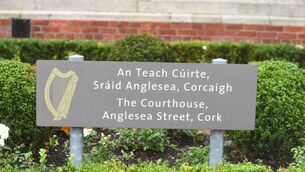
Graham Dwyer's phones were accessed 'at the end of 2013', months before a key ECJ ruling which found that 2011 Irish retention legislation violated EU laws. File picture: Collins Courts
The film has been referenced a couple of times in relation to Tuesday’s European court ruling.
In that sci-fi film, ‘pre-cogs’ — psychic people who can see the future — are able to predict crimes people will commit. Tom Cruise plays a police officer chasing down the “criminals” before they act.
“Some members of the grand chamber of the European Court of Justice seem to want you to anticipate crimes before they are going to happen,” said an experienced detective on Tuesday.
The European Court of Justice (ECJ) ruled conclusively that the blanket retention of traffic data from people’s mobile phones, so that they can be accessed at a later date if police are investigating a crime, contravenes EU rights to privacy.
So, in Graham Dwyer’s case, the system under Irish law which allowed data from his various mobile phones, and the locations of those phones, to be retained before he murdered Elaine O’Hara — and the Garda’s subsequent request to access that information — is not permitted under EU law.
Associate professor of law at Trinity College Dublin, David Kenny, said: “The problem is that data was retained before any intimation he was a suspect. The data has to be retained before it can be accessible.
He said this ruling does set out “targeted retention” as legal, but this is before the event.
“It is ‘pre-cog’ stuff, and that was the State’s argument — that this will make the investigation of ordinary crime very difficult — which I think is true,” said Mr Kenny.
He said “targeted retention” is really only useful for police investigating organised crime, where they have identified suspects they can target.
It may also be useful for people who have convictions and are suspected of continuing to engage in crime.
Tuesday’s ruling also says police can seek targeted retention of data based on a geographical area, such as a high-crime area or places attracting a high volume of people such as airports and stations.
Former assistant commissioner for Dublin, Pat Leahy, said it appears from the ruling that gardaí investigating serious crimes “up to and including murder” will no longer have access to telephone metadata.
“In my time as assistant commissioner for Dublin, we investigated several murders each year and almost every one of those investigations identified the use of mobile phones by criminals as a central element of the planning and execution of those crimes," said Mr Leahy.
"The loss of this key investigative element by the police will undoubtedly enhance the capacity of criminals.
"It significantly tilts the balance in favour of the criminal.
Former assistant commissioner Michael O’Sullivan said the ability of gardaí to access traffic data is “a vital part of an investigation” and said that if the ECJ ruling was made years ago “many serious criminals” would not now be in prison.
“The decision will be welcomed by criminals because they know that it places law enforcement at a distinct disadvantage and it is not good for safeguarding society because criminals will benefit,” said Mr O'Sullivan.
Advocacy group AdVIC, representing families of homicide victims, said the ruling will affect Garda investigations.
“It could result in some murders becoming unsolvable,” said Joan Deane of AdVIC. “There has to be some common sense as a person’s right to life has to be held in greater importance than an individual’s privacy rights.”
Associate professor of law at Aarhus University, Denmark, Graham Butler, said 12 member states supported Ireland’s position, adding this could represent a “groundswell of political support” to amend EU laws for the investigation of serious crime.
He said such member states could press the European Commission which in turn could amend EU law, but cautioned it would have to adhere to EU primary laws.
In the meantime, Ms Deane said: “It is very important that no one forgets Elaine O’Hara in all of this and that not only has her family been forced to suffer the terrible burden of losing her, but that they are being also forced to endure this ongoing legal process.”
The prospects for Dwyer, though significantly improved from his perspective, are not clear yet.
The ECJ’s ruling now goes back to the Supreme Court.
As legal experts have said elsewhere in this paper, there is a legal basis for the courts to admit evidence, even in cases where it was illegally obtained, particularly if that illegality was determined after the evidence was gathered.
As the ECJ ruling says, Dwyer's phones were accessed "at the end of 2013". This is months before a key ECJ ruling in April 2014, resulting from a case taken by Digital Rights Ireland, which found that 2011 Irish retention legislation violated EU laws.
Experts say the “state of mind” of gardaí who gathered the evidence will be key. If those gardaí can convince the Court of Appeal they did not know data accessing breached EU rights, the court has the discretion to admit the evidence.
“It is not a foregone conclusion that Graham Dwyer will win,” said Mr Kenny.
CONNECT WITH US TODAY



Be the first to know the latest news and updates