EU takes action against UK over 'international law breaches' on Northern Ireland
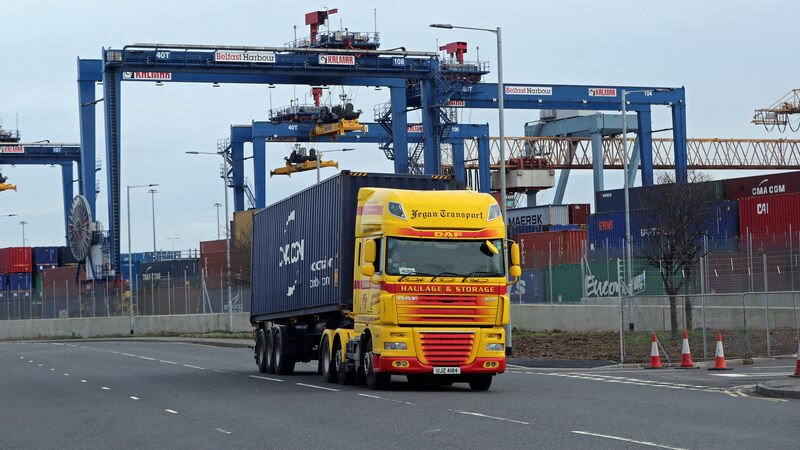
A freight lorry leaving Belfast Port. Picture: Niall Carson/PA
The European Union has accused the UK of breaching international law for a second time as it formally launched legal action against the Government for unilaterally extending the post-Brexit grace periods on trade in Northern Ireland.
In an escalation of tensions, the European Commission on Monday took the first step towards proceedings over the alleged breach of the Northern Ireland Protocol.
Commission vice president Maros Sefcovic accused the Government of breaching trust and said its actions had “once again set the UK on a path of a deliberate breach of its international law obligations”.
Officials in Brussels said the Government had effectively decided without agreement to impose an “open-ended extension” to the light-touch regulatory periods, which were due to end this month.
The grace periods cover areas such as supermarket supplies and parcel deliveries to Northern Ireland from Great Britain, and mean post-Brexit checks are not yet fully applied.
A “letter of formal notice” was sent to Westminster on Monday over the latest alleged breach, marking the beginning of the formal infringement process.
It requests that the UK carries out “swift remedial action to restore compliance with the terms of the protocol”.
After a call on Monday morning, Mr Sefcovic sent a separate “political” letter to Lord Frost, the Cabinet Office minister who negotiated the Brexit deal.
Mr Sefcovic told his counterpart on the EU-UK joint committee overseeing the Withdrawal Agreement that the UK had “acted in breach of the mutual trust and spirit of co-operation that we manage to rebuild” towards the end of last year.
He added that the “recent measures once again set the UK on a path of a deliberate breach of its international law obligations and the duty of good faith”.
Mr Sefcovic called on the Government to “rectify and refrain” from enacting the alleged breaches detailed on March 3 and to provide a “credible roadmap” to implementing the Protocol by the end of the month.
In a briefing in Brussels, an EU official told reporters that the UK had already committed the second breach and accused ministers of failing to send a timetable explaining how it would implement the protocol.
“Yet without going through the joint bodies, unilateral measures were announced on March 3 and now the European Union is confronted with an open-ended extension to certain grace periods, at least until October 1,” the official added.
“In other words, this is the second violation of international law on the same issue and we think it is an enormous problem because there are real-life issues behind all of this and the stakeholders need stability and predictability.”
The EU official was adamant that the second alleged breach of the protocol had already happened, arguing: “Let’s be clear about what the United Kingdom is doing with these unilateral announcements.
“They are actively telling stakeholders not to apply an international agreement so yes we believe that is a violation.”
Boris Johnson has previously said the extensions are “very sensible”, with the Government denying there has been a breach of the Protocol.
The Northern Ireland Protocol of the Withdrawal Agreement was designed by the UK and EU to avoid a hardening of the border on the island of Ireland when the post-Brexit transition period ended on December 31.
Northern Ireland remained part of the EU’s single market for goods, meaning products arriving from Great Britain face EU import regulations.
The first of the grace periods had been due to expire at the end of March but the UK has pledged to extend them until October in a move widely welcomed by businesses in Belfast.
If not resolved sooner, the legal action could end up in the European Court of Justice.
Boris Johnson's official spokesman said that the measures taken are “temporary operational steps intended to minimise disruption in Northern Ireland”.
He said the UK remains committed to the Protocol, “but there are issues that have emerged since the implementation of the Protocol” and that work is being addressed through the joint committee process bringing together both sides.