Jury shown past news reports that claim Gerry Adams was a member of the IRA’s army council
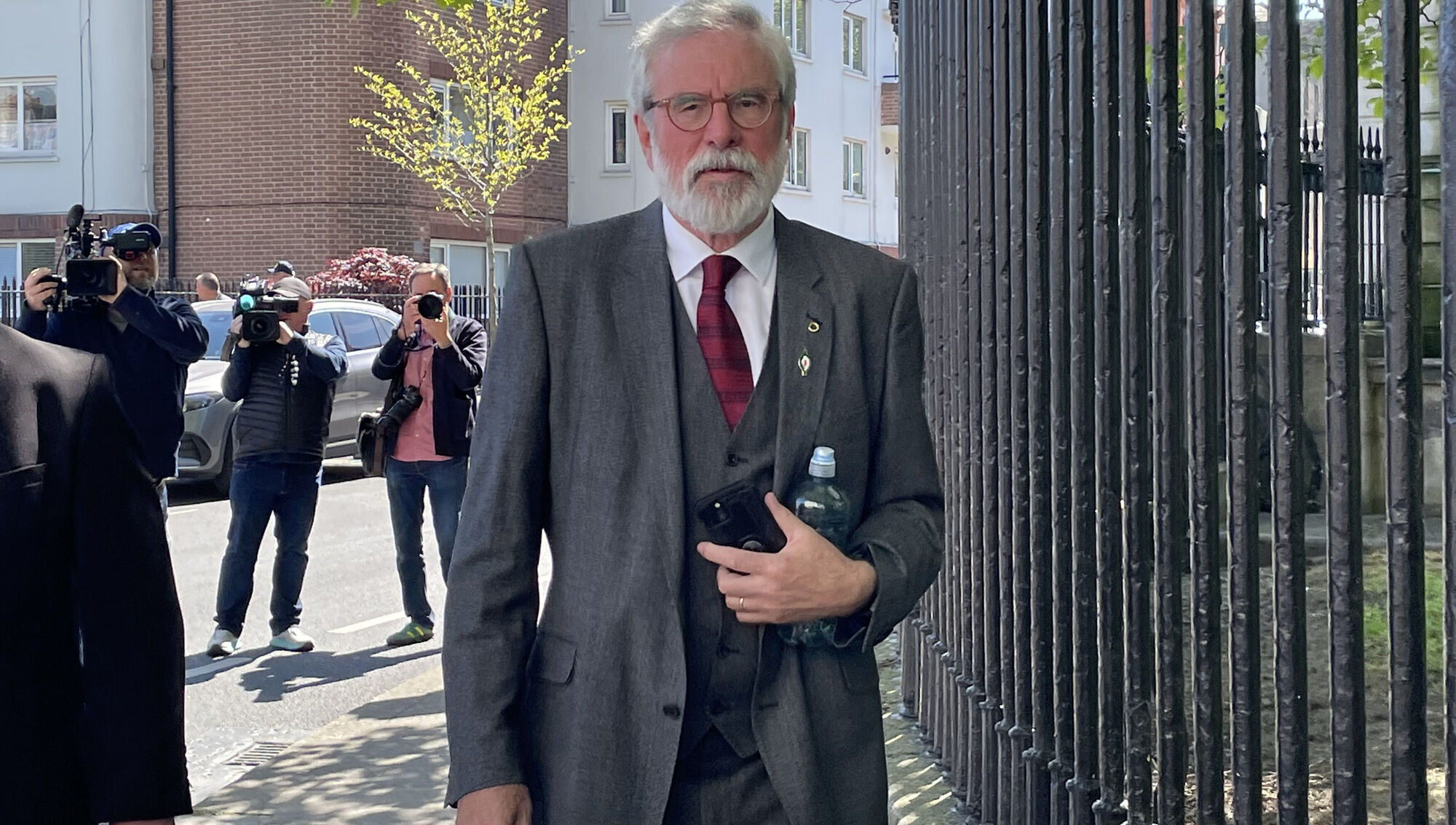
Gerry Adams claims a BBC Spotlight programme and a related article published in 2016 defamed him by falsely alleging he sanctioned the 2006 killing of MI5 agent Denis Donaldson. The BBC denies it defamed Mr Adams. Photo: Grainne Ni Aodha/PA
The jury in Gerry Adams’ defamation action against the BBC have been shown a montage of news reports and documentary clips that carry various allegations against the former Sinn Féin president, including that he was a long-time member of the IRA’s army council.
Mr Adams claims a BBC programme and a related article published in 2016 defamed him by falsely alleging he sanctioned the 2006 killing of MI5 agent Denis Donaldson. The BBC denies it defamed Mr Adams.

Included in the montage of news report and documentary clips shown to the jury on Tuesday was an extract from a programme made by broadcaster Vincent Browne. The documentary carried an allegation that Mr Adams authorised the death of Jean McConville, a mother of 10 who was shot and secretly buried by the IRA in 1972.
In a 2013 RTÉ radio interview, also played to the jury, Mr Adams said allegations made by IRA member Dolours Price that he was involved in Ms McConville’s killing was “wrong”. Asked by Paul Gallagher SC about the IRA’s killing and secret burial disappearance, Mr Adams said the practice was “wrong”.
Mr Adams said he was not aware of the practice of the “disappearance” during The Troubles. He said that following the cessation of violence in Northern Ireland, families came forward to speak about their lost loved ones.
Mr Adams said that he continues to work with the families of Columba McVeigh, Robert Nairac and Joe Lynsky, three men who were secretly buried by the IRA whose remains are yet to be recovered.
The jury was also shown a clip of Mr Adams stating at a press conference in 1987 that Charles McIllmurray, a man abducted and killed by the IRA for reportedly informing for British security services, “knows that the consequence for informing is death”.
Asked by Mr Gallagher about the remark, Mr Adams said it was a “harsh remark”. He said, however, that his comments should be interpreted in context – he said he commiserated with the family of Mr McIllmurray, and appealed at the time to anyone “caught in a trap” of informing to come forward.

In a BBC programme broadcast in 2019, shown to the jury, former IRA member Des Long alleges that Mr Adams was on the IRA’s army council, and at one point chaired Army Council meetings.
Asked about Mr Adams’ assertion that he wasn’t in the IRA, Mr Long says: “You can’t be on the army council unless you’re a volunteer, and you can’t be chairman of the army council unless you’re a member of the army council, and I sat opposite him in the meeting.” The army council was the IRA’s decision making body.
Other clips carried allegations that Mr Adams was a commander in the IRA’s Belfast Brigade, and that he held a leadership role in the brigade at the time of the Bloody Friday bombings in Belfast.
Prior to being shown the montage, Mr Justice Alexander Owens told the jury the material came with a “health warning”, noting that the fact people say certain things about someone doesn’t “begin to mean” something is true. “Rumour and speculation are never evidence,” he said.
He told the jury that if they get to a point when they have to consider awarding damages, they may have to consider the public reputation of Gerry Adams. He said that some may have a reputation that is based on rumours or speculation. However, the fact that “things are out there” – whether they’re true or not – may affect reputation.
Mr Adams last week stated in evidence that he was released from Long Kesh ahead of talks, under cross-examination, Mr Adams said he could not be expected to remember every death that occurred during the Troubles, after stating that he could not recall the death toll of several atrocities in the conflict.
Mr Adams and Mr Gallagher engaged in sometimes heated exchanges, in particular when Mr Gallagher asked the plaintiff of his memory of specific atrocities during the Troubles. The trial, before Mr Justice Alexander Owen, continues. It is expected to run for four weeks.
In his opening statement to the jury, Tom Hogan SC, for Mr Adams, said his client’s reputation was one of a “peacemaker”, and the BBC’s broadcast was an “unjustified attack” on that reputation.
The BBC denies it defamed Mr Adams, and claims the programme and publication were put out in good faith and during the course of discussion on a subject of public and vital interest. The BBC says the programme constituted responsible journalism that was the result of careful investigation.
Mr Adams has at all times denied any involvement in Mr Donaldson’s death, for which dissident republicans claimed responsibility in 2009. He claims all allegations connecting him or the IRA to the death are attempts to discredit republicans.