Care system for adult children with disabilities after parents die 'cruel and heartless', Dáil committee told
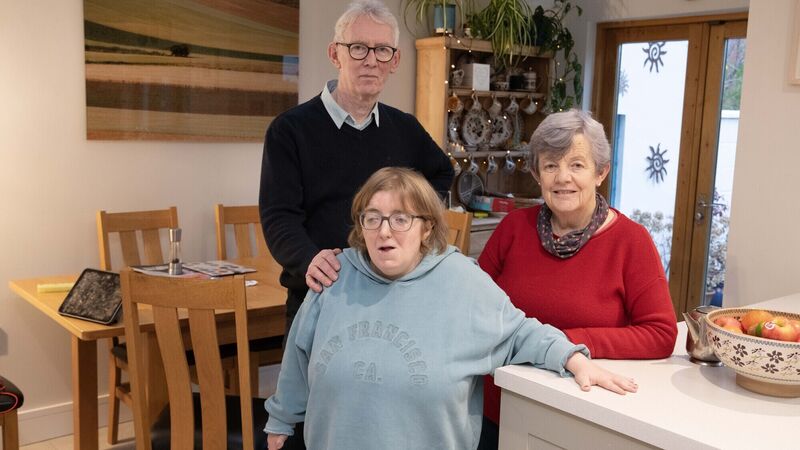
Tony Murray, with his wife Susan and their 42-year-old daughter Aoife, who has an intellectual disability and is cared for full-time by her parents. Picture: Moya Nolan
The uncertainty facing aging parents of children with disabilities “is not a dark cloud, it is a black hole”, an Oireachtas committee has heard.
A meeting of the Disabilities Committee heard from advocacy bodies and parents of adult children with disabilities, who described the current system of residential place allocation to those children as being “cruel” and “bonkers”.
Tony Murray — the 70-year-old founder of the advocacy group Before We Die and father of Aoife, who is 42 and living with an intellectual disability — said he had been moved to act upon turning 70 and realising “nothing is in place” for their children when parents in his position die.
He noted people had suggested his situation was like living under a dark cloud. “It’s not, it’s a black hole. Dark clouds move away. It’s a black hole and black holes don’t emit light. It’s nothingness,” he said.
The meeting heard from Leanne Matthews, a Monaghan mother who was moved to a nursing home for three years when no home care could be sourced in her area after suffering from a brain haemorrhage, and worried she would not be in a position to return home.
Many children with disabilities of parents who die end up in such situations, placed far from their homes and support networks, via ‘emergency’ placements by the HSE.
She described the difficulty of being visited by her children in the home.
“Being in a nursing home was debilitating. I lost my independence, my mental health suffered... I sometimes felt it wasn’t temporary at all, that I would living in a nursing home for the rest of my life,” Ms Matthews said.
Mr Murray said, in terms of the issues of parents applying for residential placements for their children to local authorities, there was “no evidence that local authorities are taking this on board at all”.
“There is no evidence of a plan whatsoever,” he said, adding the system as it stands “is bonkers”.
“Housing for adults with an intellectual disability can no longer be an afterthought,” he said.
He described the emergency protocol where a parent dies, of tendering for for-profit companies to provide care, as “cruel and heartless” and “the most expensive way of providing residential care”.
Nora Roban, founder of the group Remember Us, described the need to upgrade the current “cruel” system to properly allow for the wellbeing of disabled people who lose their principal carers, as a “no brainer”.
She said if her adult son went into care “all the hard work we’ve put in would be gone”.
“Our son would regress... Unless you’ve put the time into a disability you haven’t a clue. You’ve got to get out of your bubble and understand what’s going on out there,” she said.
Mr Murray said the current system of applying to social housing authorities was not fit for purpose, not least because adult children with disabilities often have the intellectual capacity of a child, a fact the system does not allow for, and the fact such an application is not integrated with the HSE.
He called for the creation of a "one stop shop" to streamline such applications in order of need.
His colleague at Before We Die Sarah Roarty, meanwhile, called for a “mandated authority”, to incorporate the HSE and disability services, charged with using “joined-up thinking so that people can come together and form a plan”.


CONNECT WITH US TODAY



Be the first to know the latest news and updates