Ireland must work 'seriously' to implement public health reforms, covid group concludes
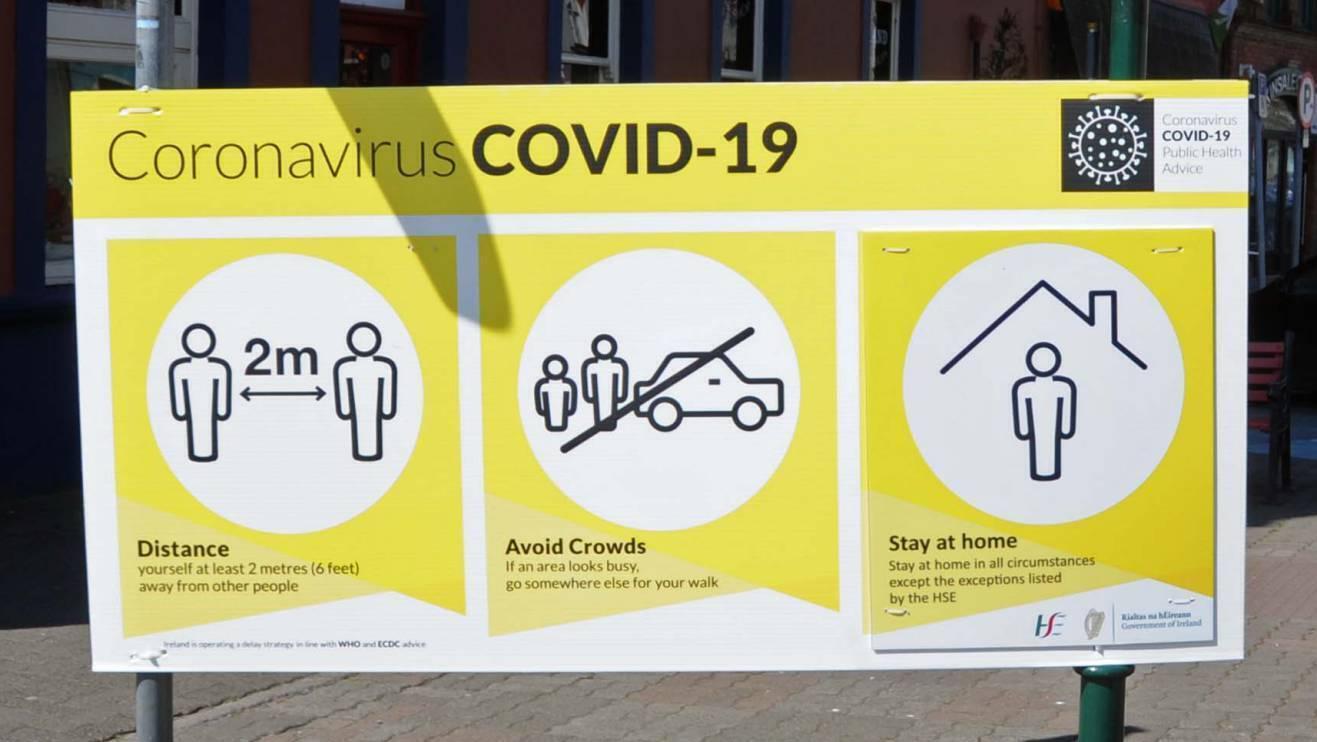
Covid-19 signage in Kinsale, Co. Cork, in April 2020. File picture: Denis Minihane
The covid-19 evaluation group heard from Irish and international experts on Tuesday.
Chairwoman professor Anne Scott summed up the morning by saying, “we are here six years down the line and probably no better prepared than we were in 2020”.
Governments opted for lockdowns “because of lack of understanding” around risks, according to Professor Mark Woolhouse, University of Edinburgh.
He recalled briefing the government there around reopening schools in 2020.
“Our best guess was that a chance of a child going to school in Scotland and dying from covid they caught in the school was roughly equivalent to the child being struck by lightning,” he said.
He described school closures as “unnecessary”, saying “we didn’t need to do that but we did it".
Professor Anthony Staines, Dublin City University, was a member of the Independent Scientific Advisory Group during the pandemic.
“We also knew that children got devastating illness from it (covid-19) but what we didn’t realise was that illness is exceedingly rare in proportion to the number of infections. We didn’t know that then, we know that now,” he said.
“That explains some of the fear around children.”
Students and parents of young children were among those “particularly impacted” by lockdowns according to Professor Sarah Burke, Trinity College Dublin.
Professor Patricia Leahy-Warren, School of Nursing and Midwifery at UCC, also noted “major service disruption” to school health services including vaccinations and child health checks.
Dr Mike Ryan, the Sligo man who led on the emergency response for the World Health Organisation, focused on trust.
Scientific communities can deal with rapidly changing advice based on new research.
However he said communications around new advice managed to “turn a trust pothole into a trust chasm”.
He said the pandemic “didn’t cause the lack of trust in the system”, but indicated it significantly increased since then.
“How do we communicate with the public, and how do we communicate uncertainty,” should be a key part of future pandemic preparation.
Professor David Heymann, London School of Hygiene & Tropical Medicine, is on the covid-19 evaluation panel.
He recalled an increase in “armchair experts” during the pandemic.
“There were bogus scientists who were promoting drugs that weren’t effective, and political leaders at the same time who were trying to show they were in charge rather than public health,” he said.
Dr Anders Tegnell, Sweden’s State Epidemiologist, said restaurants were regulated but not closed there.
They were asked to “reorganise their businesses to minimise social interactions" instead.
“That proved to work reasonably well, we didn’t see any outbreaks in restaurants in Sweden,” he said.
Sweden's government asked people also to work from home, and he said mobile phone data showed about 50% of the workforce did this.
“It was very important to close this down as much as possible,” he said, due to the high transmission rates in work-places.
Prof Woolhouse described how this was “a game changer” for monitoring in Scotland.
However, he said it was rolled out too slowly and could have been more useful than it was.
Irish experts did not focus on antigen testing, which was hugely controversial here also.
Mary Codd, Associate Professor of Epidemiology & Biostatistics at University College Dublin, said infection control training in nursing homes was “seriously missing or substandard” in 2020.
One survey she worked on then with 400 staff revealed “less than 50% of our long-term residential care facilities had training in infection prevention control prior to the pandemic.”
Other research she was involved with showed among over-70s cocooning at home “mortality was no different, no bigger, in that group than in general population”.
However, for nursing home residents: “Mortality in that group, age-matched to over-70s was 21 times higher.”
Some 60% of those who died in wave 1 were in nursing homes even though this group is equal to only 5% of the population, she added.
Now six years later, she said: “We have not addressed adequately the residential care facilities factors.
“We have not addressed occupancy, staffing, renumeration, rotation, training”.
She said infection prevention control is improved, but was also critical of lack of change for isolation facilities, oversight and regulation.
“Those are lessons that have been learned that we need to act on.”
Professor Ivan Perry, University College Cork, focused on how Northern Ireland and Ireland co-operated.
“We lacked political and institutional structures needed for a coordinated all-island pandemic response, something that must be prioritised before the next pandemic,” he urged.
He also pointed out how separate health structures still are, saying for example Cork city hosts five key units but they are all in separate locations.
Professor Anne Scott noted concerns around lack of readiness in many areas.
“I think at the heart of it is a clear acceptance that people were trying to do their best in quite difficult circumstances,” she said.
“We can certainly learn from the lack of preparation. I think there’s widespread agreement: ‘we were not prepared’.
"We should not find ourselves in that situation in the future.
“And given that a number of people are flagging 'we are here six years down the line and probably no better prepared than we were in 2020’ we’ve got to wake up and move fairly quickly on this, fairly seriously, to implement those recommendations including those around public health reform, public health structures in the country that we already have.”
She added: “We don’t have to wait for another report, we actually have the information and the recommendations here.”


CONNECT WITH US TODAY



Be the first to know the latest news and updates