Government warns 20,000 Irish citizens in Middle East against perilous land escape routes
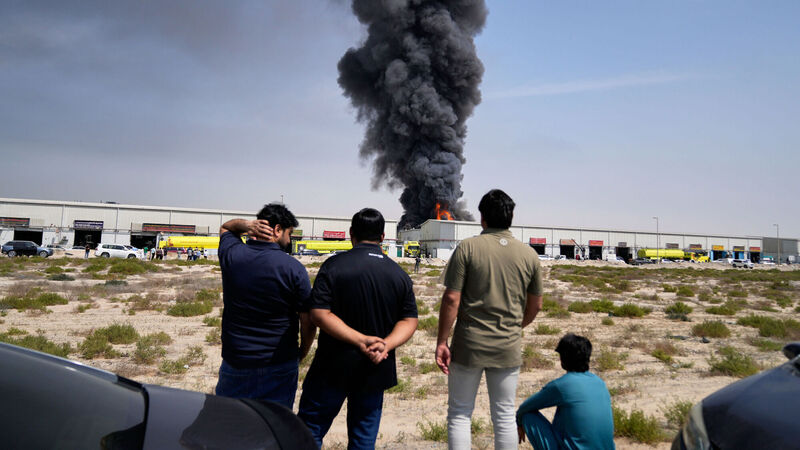
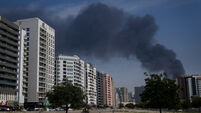
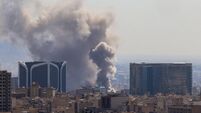
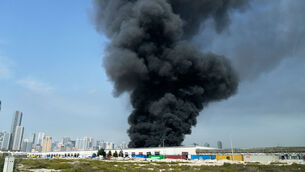
Residents watch as the flames and a black plume of smoke rises from a warehouse at the industrial area of Sharjah City in the United Arab Emirates following reports of Iranian strikes in Dubai on Sunday. Picture: Altaf Qadri/AP
The estimated 20,000 Irish people in the Middle East are being urged against taking perilous land journeys to escape the escalating conflict engulfing the region.
The Irish Government is urging citizens to take “shelter” and to register with local embassies, or on a special consular helpline, in the event of evacuations.
Foreign affairs minister Helen McEntee said she is very concerned at the spread of the conflict to the United Arab Emirates (UAE), where an estimated 12,000 Irish people live and work.
Fears of the violence spiralling grew after confirmation emerged of the death of Iran’s supreme leader, Ayatollah Ali Khamenei, in a joint US-Israeli bombing. His death sparked pledges of revenge by the Iranian Revolutionary Guard.
Ms McEntee said she is engaged in talks with her EU counterparts regarding how, if the situation arises, “we can evacuate people safely”.
Airports in the UAE are closed, and air traffic is heavily restricted across much of the region, although airports in Oman and Saudi Arabia remain open.
Investments in recent years mean the Defence Forces has three medium-range transport Airbus, capable of carrying 60 passengers each, and a long-range jet that can carry 14 people.
However, it is not clear how the thousands of Irish people in the UAE would get to Oman or Saudi Arabia.
Ms McEntee told RTÉ radio that embassies are hearing reports of Irish people in Dubai travelling to, or considering travelling to, Muscat in Oman.
She advised against such travel, which she said is “at least an eight-hour journey” with reports of “significant delays” at the border.
She said: “The advice at the moment, and this is the same for every country, is for citizens to remain where they are, to remain sheltered where they can.”
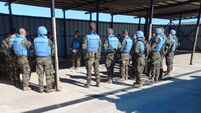
Military officials are keeping a close eye on the security situation in South Lebanon, where 360 Irish troops are based, with a UN mission.
Any decision by Hezbollah, the Iranian-backed militia, to launch missiles from South Lebanon at Israel is expected to spark a devastating reprisal, which could put UN troops in the crossfire.
Despite Israel firing missiles into Lebanon at the weekend, there is no indication, yet, Hezbollah is getting involved.
The Iranian community in Ireland is struggling to keep in contact with loved ones back home, not least because of restricted internet access.
Mastoureh Fathi, a lecturer in sociology at UCC, said she has spoken to family in Mashhad, in northeastern Iran, and that they are safe.
She said people across the country are “on the street celebrating” the death of Ali Khamenei.
She added that people protesting against the regime in Mashhad and Isfahan were shot dead, and she believes people are “waiting” to take to the streets en masse.
She said it is just “a matter of time” before the revolutionary guard “lose faith” and scatter, predicting it will take a few more weeks.
- Cormac O'Keeffe is the Security Correspondent for the

CONNECT WITH US TODAY



Be the first to know the latest news and updates