Up to 20,000 Irish citizens in Middle East as Defence Forces monitor worsening crisis
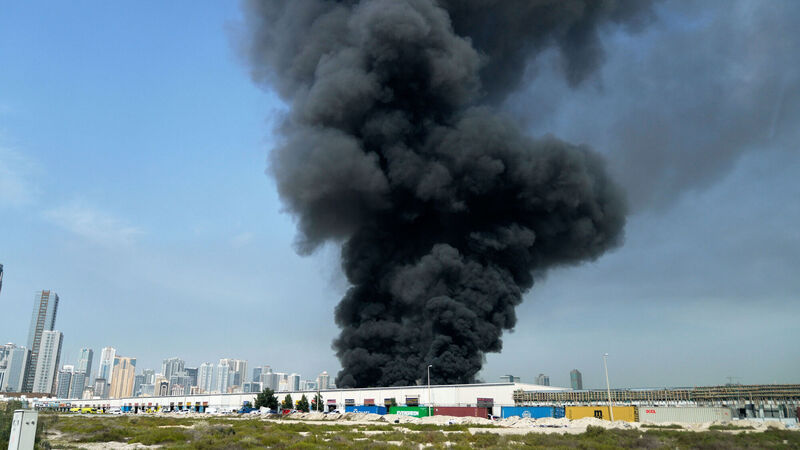
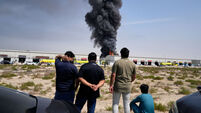
A black plume of smoke rises from a warehouse in the industrial area of Sharjah City, United Arab Emirates, on Sunday, following reports of Iranian strikes in Dubai. Picture: Altaf Qadri/AP
As conflict and uncertainty escalates in the Middle East, senior government officials and top brass in the Defence Forces are closely monitoring the security situation on the ground.
The potential repercussions for up to 20,000 Irish citizens and 370 or so Irish troops in the region are their key concerns as they draft security assessments and brief government ministers.
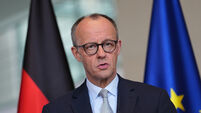
This led to calls on Sunday from foreign affairs minister Helen McEntee to the estimated 12,000 Irish citizens in the United Arab Emirates not to consider taking “land routes” to other neighbouring countries, and urging them to stay where they are and “shelter”.
An Irish teacher in Dubai told the that Irish people were “naturally panicking a bit” from hearing explosions in the city and watching videos of the blasts “flooding” their phones.
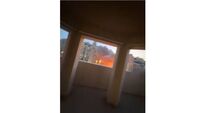
He said he was in his apartment on Saturday when he first heard an explosion: “There were massive bangs — the walls were shaking. I was in another person’s house after and missiles were being intercepted directly above our heads, multiple explosions at a time.”
He said they got news that a large area in Dubai called 'The Palm' had been evacuated. Local footage captured the moment when a drone or missile, or debris of an intercepted missile, struck the ground near large apartment blocks and a hotel.
“Videos are flooding in so, naturally, people are panicking a bit,” he said.
He said the Irish embassy in the UAE had posted messages on Instagram, stating: “The advice is to stay at home."
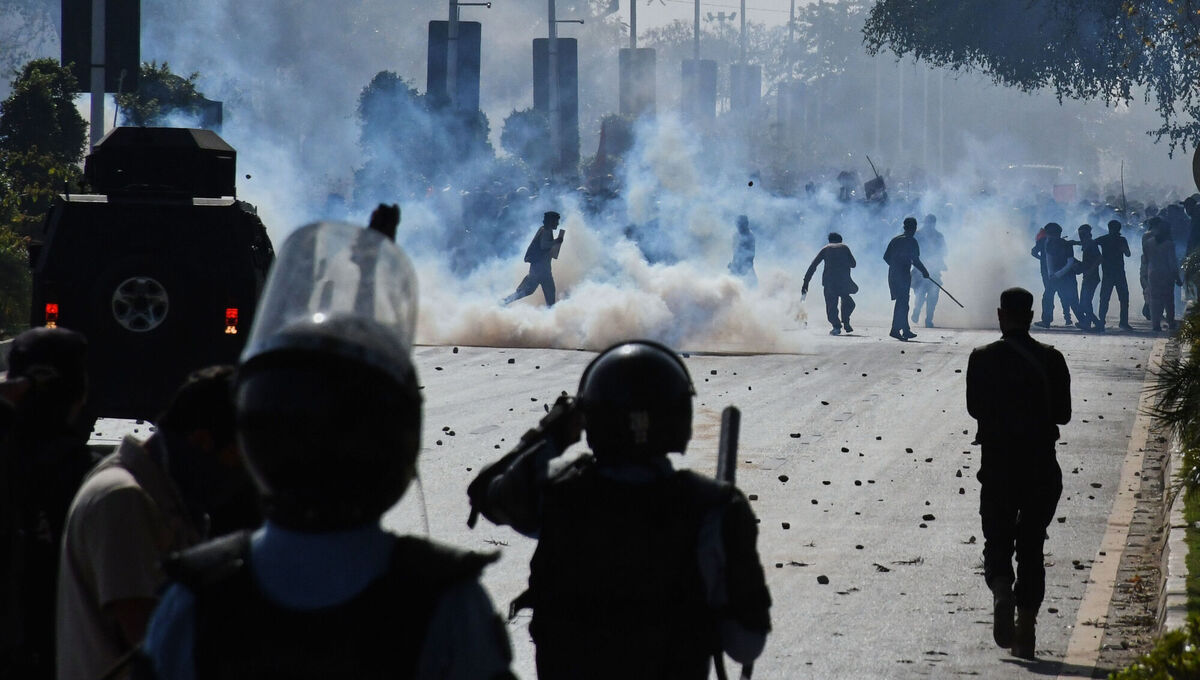
Analysts have noted that missiles or drones were hitting civilian and residential areas in the UAE and not just US military bases there.
Ms McEntee expressed concern that the conflict was spreading to areas, including to within the UAE, with such a large Irish population.
She appealed to Irish citizens in the Middle East to register with their local embassies to assist the authorities in identifying them, getting their contact details and addresses.
The minister told RTÉ radio that Ireland was in constant discussions with fellow EU member states, adding: "We're all engaged so when the situation arises and when the opportunity arises, we can evacuate people safely."
In recent years, the government has invested in medium-to-long-range aircraft, including for the purpose of evacuating Irish citizens and troops.
Ms McEntee, who is also the defence minister, said there were up to 20,000 Irish citizens in the Middle East, including people living and working there and people travelling.
She made this call to Irish in the UAE: “I am aware of suggestions of consideration of land routes to neighbouring countries such as Oman. However, I strongly urge citizens not to pursue anything other than a shelter in place strategy for now.”
Ms McEntee declined to condemn the US/Israeli attack, describing the situation as “extremely difficult”. However, shw said she was most concerned “by the escalation”.
She had a phone call on Sunday afternoon with UAE deputy prime minister/foreign minister Sheikh Abdullah Bin Zayed Al Nahyan to discuss the situation.
The potential reach of the conflict has already stretched to the fringes of the European Union, with reports that Iranian missiles were fired in the direction of Cyprus — where Britain has military bases.
Since Saturday, Iran has aimed missiles at US military bases in neighbouring Middle Eastern countries in response to the US/Israeli assault overnight.
The retaliation threatened to escalate on Sunday after the killing of Iran’s supreme leader, Ayatollah Ali Khamenei, in a joint US-Israeli bombing.
His death — confirmed by Iran’s official news agency — sparked pledges of revenge by the Iranian Revolutionary Guard, which security experts have said is now fighting for the survival of the regime.
There were explosions above Jerusalem and Tel Avi on Sunday as Israeli defence systems intercepted missiles and drones.
Some terrorism experts have also warned of the possibility that the Iranian regime could activate so-called “sleeper cells” in the West to conduct attacks in North America and Europe.
In terms of flights from Ireland to the Middle East, DAA said: "Due to ongoing airspace closures in the Middle East, airlines have confirmed further disruption to flight schedules.
"Emirates has cancelled its full schedule of flights between Dubai and Dublin Airport today [Sunday] — three inbound/ three outbound — as well as its early morning inbound and outbound flights tomorrow [Monday].
"Qatar has cancelled all flights to/from Doha today — two inbound/two outbound.”
It said Etihad had cancelled three of its four Abu Dhabi flights on Sunday — two inbound/one outbound — with a decision to the made about the last flight.
It said: "Further disruption over the coming days is possible. Passengers are advised to contact their airline directly for the latest updates."
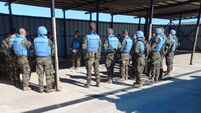
The bulk of Irish troops in the region are based in South Lebanon with the Unifil.
Security concerns are focused on the possibility of military action by the Iranian-backed Hezbollah militia against Israel, which is sure to result in a devastating Israeli response, potentially putting Unifil troops in the crossfire.
There is a total of 372 Irish troops serving in the Middle East: 358 with Unifil; 11 with UNTSO, and three with UNDOF. The 11 soldiers with UNTSO are spread across the Middle East, and the three with UNDOF are based in Syria.
It is understood there is at least one Defence Forces officer based in Jerusalem as part of UNTSO.
Senior leaders in the Defence Forces and senior officials in the Department of Defence were working over the weekend, gathering information from the ground and supplying briefings to Helen McEntee.
The chief of staff, Rossa Mulcahy, is understood to be in daily contact with the battalion commander in Unifil, while the operations and intelligences sections of the Defence Forces are constantly gathering information and providing security assessments.
Retired brigadier general David Dignam, who first served as a platoon commander in Unifil in 1987 and last served as battalion commander in 2013, said that the military strength of Hezbollah in its traditional base of South Lebanon has been “significantly reduced” in recent years.
The Israel-Hezbollah conflict ended in a ceasefire in November 2024, leaving the group in a depleted state. There were reports on Saturday of Israeli strikes in South Lebanon.
“The ability of Hezbollah to launch a sustained campaign is very significantly diminished, but that doesn’t mean they won’t try,” Mr Dignam said.
He told the that this would mean Unifil troops, like they did over a year ago, would “bunker down” in their three bases — two run by Irish troops and one by Polish.
He said: “There’s always the risk of collateral damage in the crossfire if Hezbollah launches rockets and Israel returns artillery fire. Unifil could be caught in the middle.”
However, he said the troops would be protected in their bunkers and have good supplies of food and water.
“Bar a direct hit, they should be fairly safe,” Mr Dignam said.
Mervyn O’Driscoll, attached to UCC's School of History, said: “Both president [Donald] Trump and prime minister [Benjamin] Netanyahu have been clear for a long time that Iran should never acquire nuclear weapons.
"While the US-Israeli airstrike is portrayed as targeting an imminent threat, public evidence suggests it's more of a preventive measure. It lacks UN or multilateral approval.
"The campaign aims to destroy Iran's military and regime, indicating a goal of replacing it with a compliant one, promising gains but risking escalation given recent Middle East history. It erodes international law, relies on airpower for regime change, and may destabilise the region and fuel radicalisation.”
Scott Lucas, a professor of international politics, said one question was what was Mr Trump's "plan B" if the conflict drags out and there is no regime change in Iran. He said the majority of Iranians oppose the regime, which he said had killed anywhere from "several thousand to tens of thousands" of its own people, who were conducting protests, last January.
- Cormac O'Keeffe is the Security Correspondent with the

CONNECT WITH US TODAY



Be the first to know the latest news and updates