SNA anger 'loud and clear', protesters warn Government
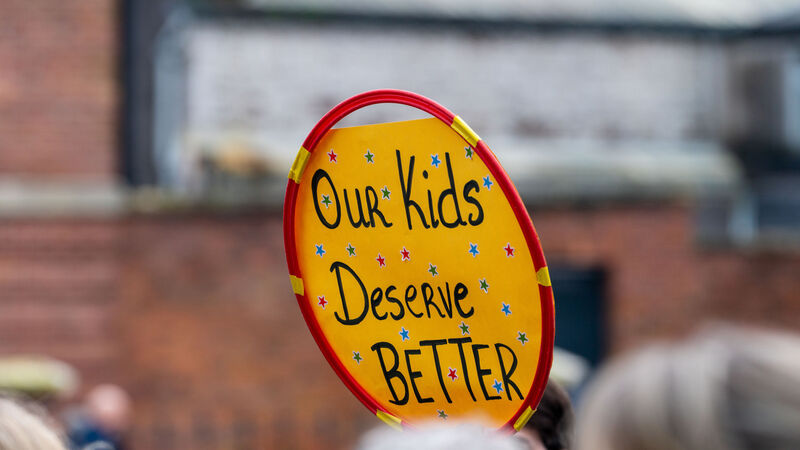
One of the many placards at the SNA protest outside Cork City Hall on Wednesday evening. Picture by Noel Sweeney
The Government's U-turn this week on cuts to special needs assistant (SNA) posts next year is just an "extended, year-long pause" leaving families, schools and SNAs in limbo, nationwide protests have heard.
Demonstrations in response to recent moves to cut SNA posts took place across the country this evening, including outside Leinster House, Cork City Hall, and at Merchant's Quay in Limerick City.
It follows continued anger among school communities despite a Government U-turn announced late on Monday over attempts to cut SNA posts for the 2026 school year.
Read More
Outside the Dáil, SNAs, parents, teachers and trade union representatives gathered with placards, reading 'Save Our SNAs'. Among those attending were several parents who have been waiting to secure school places for their children for this coming September.
The decision to halt the incoming changes this year is not a resolution, said Samantha O'Flanagan, an SNA, Fórsa member and parent to a child with additional needs.
"It is simply an extended, year-long pause. It brings no real certainty, no long-term security for SNAs and no clear answers for children, families or schools who remain in limbo."
The Government already knows what needs to be done, she added.
"The message has been loud and clear: The level of need in our schools has been well documented, and goes far beyond the narrow scope of primary care needs outlined in the circular."
Jesslyn Henry, a Dublin city councillor for the Social Democrats and an SNA currently ona career break, told the demonstration that the pause "kicked the can down the road until next year."
"SNAs should not be cut in any school in the country. SNAs are a vital part of every school community.
"The SNA cuts that were announced to 194 schools affect every one of us. We don't know whether it's our school next. That is deeply, deeply unfair.
"You're literally just kicking the can down the road until next year," Ms Henry added.
"Our children deserve the care and support that everyone of us offers in our schools, and they need answers. Their parents deserve answers."
Outside Cork City Hall, Anglesea Street heard chants of “a pause is not enough”, as SNAs, teachers, parents and students gathered.
Hand-painted signs reading “Hey Taoiseach, leave our kids alone” and “No ifs, no buts, no SNA cuts” were held high alongside banners for the Labour Party, Sinn Féin, the Green Party, the Social Democrats, People Before Profit, Fórsa, and Aontú.
Joanne Doherty, vice-principal of Scoil Barra in Ballincollig, said she had heard the initial news of a proposed reduction in SNAs and had not known “whether to curse or to cry”.
While the decision to pause the cuts was welcome, a focus on real solutions was needed, she added.
“We invite the Government and the National Council for Special Education (NCSE) to work with the people on the ground, with school leaders, teachers, SNAs, parents and never forget the voice of our incredible children,” Ms Doherty said.
“Come into our schools. See the complexity. See the care. See the effort. Let us create a framework where the word care is truly at the heart of supporting our children.”
In the Dáil on Wednesday, education minister Hildegarde Naughton said she knows "people are angry and frustrated at what is being portrayed as the removal of essential supports to young people."
Last week, the minister confirmed that approximately a third of 584 schools were to receive a reduction in their SNA posts from September.
More schools were expected to receive letters from the NCSE in the coming weeks advising them of the review outcomes.
This year, 1,000 reviews were carried out by the NCSE.
The Minister said she fully accepts that the process and outcomes of the reviews were not "properly communicated."
"That is the fault of Government. I will work to ensure this does not happen again.
"No cuts are proposed, or will be proposed, to the provision of SNA support to children and young people across our school system.
"I understand the anger and upset that arose this week, but I do not – as some have claimed - blame the NCSE for this situation," she said.
On Tuesday, Taoiseach Michael Martin told the Dáil the Government “never signed off on” the planned reductions.
Ms Naughton said: "The NCSE did the work it is mandated to do. I have full confidence in the NCSE. It fulfilled its role to ensure that special education resources are allocated to the schools with the greatest need."
On Wednesday, Tánaiste Simon Harris admitted the government "got this wrong" on a review of how SNAs are allocated at schools.
Mr Harris said that while there was a "strong logic" to review SNA allocations, "the buck stops with us" in how the review was handled.
"There's been a lot of hurt caused over the course of the last week, a lot of stress, a lot of anxiety. We got this wrong," he told Newstalk.
"The reality of the situation is when something goes wrong, you've got to put your hands up and you've got to fix it.
"What I heard from parents across the country, what I heard from SNAS and what I heard from teachers was that the sequencing here matters."
Up to 30 protests across the country took place across the country.
Parent Niamh McDonald said she does not see the announcement this week from Government as a “U-turn”.
“I see it as an extension of the pause. Nothing has changed realistically. To me, what they did, because they knew that anger was right across the country, and they were reactive. They tried to just clamp stuff down by saying, ‘Right we’re OK for another 12 months.
“It's an extension of the pause, and it's just another part of this cycle of chaos,” said Ms McDonald.
“That’s unfair. This is not a resolution.”
Ms McDonald’s son is autistic and has ADHD. He attends mainstream school with the support of an SNA. His school wasn’t sure if it was due to lose SNA posts for 2026 as its review was ongoing when the Government announced the pause last week.
“Without my son’s SNA, he would not be able to navigate mainstream education. He is flourishing right now, but that’s because of the supports he has right now, and his principal and his teacher.”
Ms McDonald added: “He has a constant SNA beside him to support him, and he is flourishing. He loves school but without that SNA, that would not be the situation.
“He needs a lot of help with emotional regulation, he needs help with transitions, and he can be a flight risk."
All of those situations are not recognised in the current SNA circular from 2014, said Ms McDonald.
“But if he didn’t have that support, how could his teacher manage that situation while also trying to teach 23 other children in the class? I don’t understand that at all.”
Ms McDonald called for action on the issue. “For me, I would like to see all the opposition parties, the trade unions, and the stakeholders to come together and sit down within the next 48 hours and plan a pathway of how we start to get security for SNAs in our classrooms, whether that’s special classes, mainstream or special schools.
“We have huge momentum now, we have a massive opportunity and we can see when communities, SNAs, parents, the opposition, and the trade unions come together we’ve got power to make changes.
“We want to make sure we’re not in the same situation next year.”
Fórsa, the trade union that represents SNAs, said it has been agreed this week that the SNA redeployment scheme, the SNA workforce development plan, and changes to a 2014 circular outlining the role of a SNA will be advanced before any further decisions are taken.
"The priority will be ensuring that the child-centred approach to the provision of special education is retained and enhanced in these policy developments," it said.
"The NCSE cannot therefore make recommendations on SNA numbers until these key documents are agreed and published."
It said the situation "should never have happened."
"The Government has failed to prioritise this issue for too long. While the additional €19m in funding that has been found is to be welcomed, it is a sticking plaster.
"What is needed is real engagement and resourcing and proper planning for the future of special education in mainstream classes."

CONNECT WITH US TODAY



Be the first to know the latest news and updates