Dos and Don’ts for your CAO 2026 applications

Don't delay if you're applying to the CAO for college courses starting next September; you must register with CAO before 5pm on February 1.
With the February 1 deadline fast approaching, now is a great time to consider the essential dos and don’ts of the CAO application process for 2026.
Do: Read the CAO handbook in its entirety before you start the process.
The 2026 CAO handbook, available from the CAO website, is vital reading for all students.
The 100-page document goes through each and every important step of the CAO application process in great detail.
It's easy to read, and online it's also easily searchable if you have any particular questions or aspects you need more information on.
Students should take the time to read this year’s handbook in its entirety and set reminders for important deadlines in the months ahead.
Don’t: Delay starting the application process.
If you are planning on starting college next September, you must register with CAO before 5pm on February 1, so there’s no reason to delay if you haven’t started the CAO application process yet.
Sometimes students can underestimate just how long it can take them to pull the relevant information and supporting documents required together.
If you are unsure about the application process, you can practice submitting an application before you register using the online demo application form, available on the CAO website.
Make sure you give yourself plenty of time and begin the process well in advance of February 1.
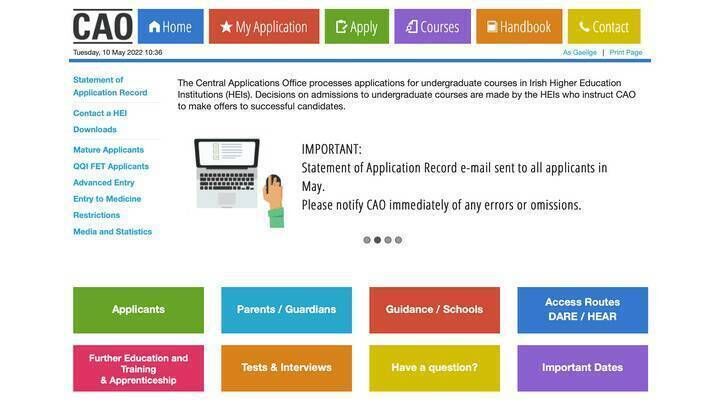
To register and receive your CAO application number, go to www.cao.ie and click on Apply.
Do: Take your time to make sure your personal details are correct and entered carefully Every year, small preventable mistakes happen during the CAO process that could have been avoided. When inputting names, you enter your name as it appears on your birth certificate or passport. Higher education institutions require proof of ID at registration if a candidate hopes to register under a different name.
Don’t: register with an inactive email address.
During the application process, you must make sure to use a valid email address, that you can access easily and frequently.
Failure to do so could have very serious consequences and could even result in a student not receiving an offer down the line.
The CAO contacts all applicants by email, and when it sends emails, it sends them to the address you registered on your CAO application.
For example, some students may be contacted via email by the CAO later in the year to ask for their examination number to be inputted manually into the CAO account.
With this in mind, you must be in a position to monitor this email inbox for messages from the CAO.
According to the CAO Handbook, the responsibility is on the applicant to ensure all relevant correspondence it sends is received and “dealt with appropriately”.
It's also a good idea to make a note of your passwords to avoid being locked out of your account ahead of crucial deadlines.
Do: List your courses in genuine preference.
Arguably the most important step of the process is remembering to place your course choices in genuine order of preference.
This is because at the offer stage, applicants will receive an offer of the course highest up on their list.
After logging into the ‘‘My Application’ facility, you will have the option to list ten course choices from Level 8 degrees, and ten course choices for Level 7/6 courses.
Choices made on one list will not affect the choices on another, but it is vital to make sure the courses are listed in order of your genuine preferences.
Do not list your courses based on assumptions about examination performance or what you think the points will be for a course.
Offers will be made based on the course highest up on your list that you are deemed eligible for. If you receive your first preference Level 8 course in Round One, you will not receive an offer for a lower preference on your list in later rounds.
Don’t: ditch the research.
You should make sure to take the time to research prospective courses carefully. This can be done in many ways, and most courses have dedicated pages online that provide further details on different modules and areas of study.
You must also check very carefully for matriculation and minimum entry requirements.
Keep in mind that even if you receive the required cut-off points for a course, you will not receive an offer of a place if you do not meet the minimum entry requirements.
Do: Let the CAO know if you are applying for a student grant.
If you have, or intend to, apply for to the student grant authority SUSI for a grant to help cover your costs while studying, you should indicate this on your CAO online application.
The CAO will then provide your identification, contact and offer/acceptance details to SUSI when relevant.
However, keep in mind that the application process for SUSI is completely separate, and ticking this box on your application does not mean that you have applied for a grant.
Do apply, you can visit www.studentfinance.ie or www.susi.ie to complete the necessary steps.
Don’t: forget key dates.
Make sure to set a few reminders for important deadlines over the coming months.
The closing date for applications is February 1 at 5pm, and the online facility to amend course choices becomes available again on February 5 at noon, with a €10 fee.
This can be used to add any restricted courses not already listed on an application.
Restricted courses include those with additional assessment procedures, for example, the submission of a portfolio, an oral assessment or interview, or a written assessment.
Most tests and interviews for restricted courses are held in March and April.
You will also have some opportunities later in the year to update your course preferences should you change your mind, although there are a few limitations to this.
The CAO online Change of Mind facility opens in early May and closes on July 1.
You can use the online facility to introduce, remove or reorder your courses free of charge until July 1 at 5pm.
Closing date for 2026 CAO applications.
Online facility to amend course choices becomes available.
Closing date for amending course choices.
Late application facility opens.
Latest date for HEAR/DARE supporting documentation to arrive in CAO.
Closing date for late applications.
Free online Change of Mind facility becomes available.
Statement of Application Record sent to all applicants.
The 2026 State Exams begin.
Change of Mind closes.
Expected issuing of Leaving Cert 2026 results and the first round of offers.
CONNECT WITH US TODAY



Be the first to know the latest news and updates