HSE expands 'virtual ward' service to all of its seven regions
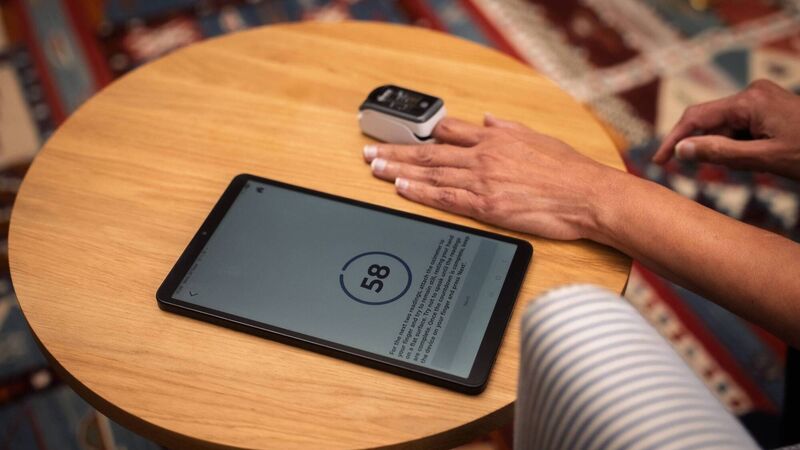
Technology kit now used by public patients on virtual wards delivered by Doccla in partnership with the HSE. The kit allows nurses to monitor the patients even though the patients are in their own homes. File picture
All HSE regions from this week can offer some patients the option of a 'virtual ward' or hospital-at-home care in a bid to reduce unnecessary hospital stays.
One patient was so closely monitored that nurses phoned when his blood pressure shot up while watching the crucial Ireland v Hungary soccer match.
St Vincent’s University Hospital and University Hospital Limerick have been running these wards as a pilot since last year.
Patients are given a technology kit, delivered by UK health tech firm Doccla in partnership with the HSE. This allows nurses and the patient’s doctors to monitor them remotely. They stay on the books as an inpatient.
Helmut Sundermann, aged 66, was a patient at St Vincent’s for about 12 days. He potentially faced a longer stay, but was offered this option instead.
“I was on the virtual ward from the end of September to November this year,” he said. “I gladly accepted it. It was a new thing for me, but it was a nice thing, so I could be at home with my family.”
The German teacher was being treated for a serious suspected infection. “Many different scans were arranged for me during my time on the virtual ward, such as CT, PET and MRI scans,” he said.
He measured his blood pressure and other markers twice a day, and reported this to the medical team. However, he had to do it three times when Ireland made the World Cup play-offs.
He said:
“It was quite funny. St Vincent’s rang me, and they said ‘can you repeat that, it’s very high’. It was just from the excitement.”
Professor Donal O’Shea, clinical director for medicine at St Vincent's, said: “It’s now gone live in seven different hospitals, so there’s one in each region now as of this week.”
The system works well for patients who are improving and near the end of treatment.
“They go home with a kit that has blood pressure, temperature, oxygen saturations, an ECG monitor, and an iPad they use to phone in, or FaceTime to the nursing staff twice a day. It’s staffed 24/7,” he said.
The kit is collected when the treatment is over and readied for re-use. Nurses work together from a base in the hospital. About 30 patients can be admitted, their names recorded on whiteboards in the usual way, as well as in the system.
He described it as more “hospital at home” than virtual care.
“Patients’ faces light up when you mention it as a possibility,” he said. “We’ve had over 1,000 patients through it and would estimate maybe 12,000 bed-days saved. So with the pressure we’re under, that’s significant.”
He estimated St Vincent’s is at 120% capacity now, as are other Irish hospitals. The recommended level is 85%.
“I’m really hoping Anne O’Connor (incoming HSE CEO), as an occupational therapist by her background, will say ‘we need to build beds and we need to build capacity’,” he said.
He stressed: “This ward is not the solution, instead of bricks and mortar and beds, it’s part of the solution. And a very positive one from a healthcare perspective and patient perspective.”