Martin: Slow trickle of humanitarian aid in Gaza is 'a sick joke'
Martin: Slow trickle of humanitarian aid in Gaza is 'a sick joke'

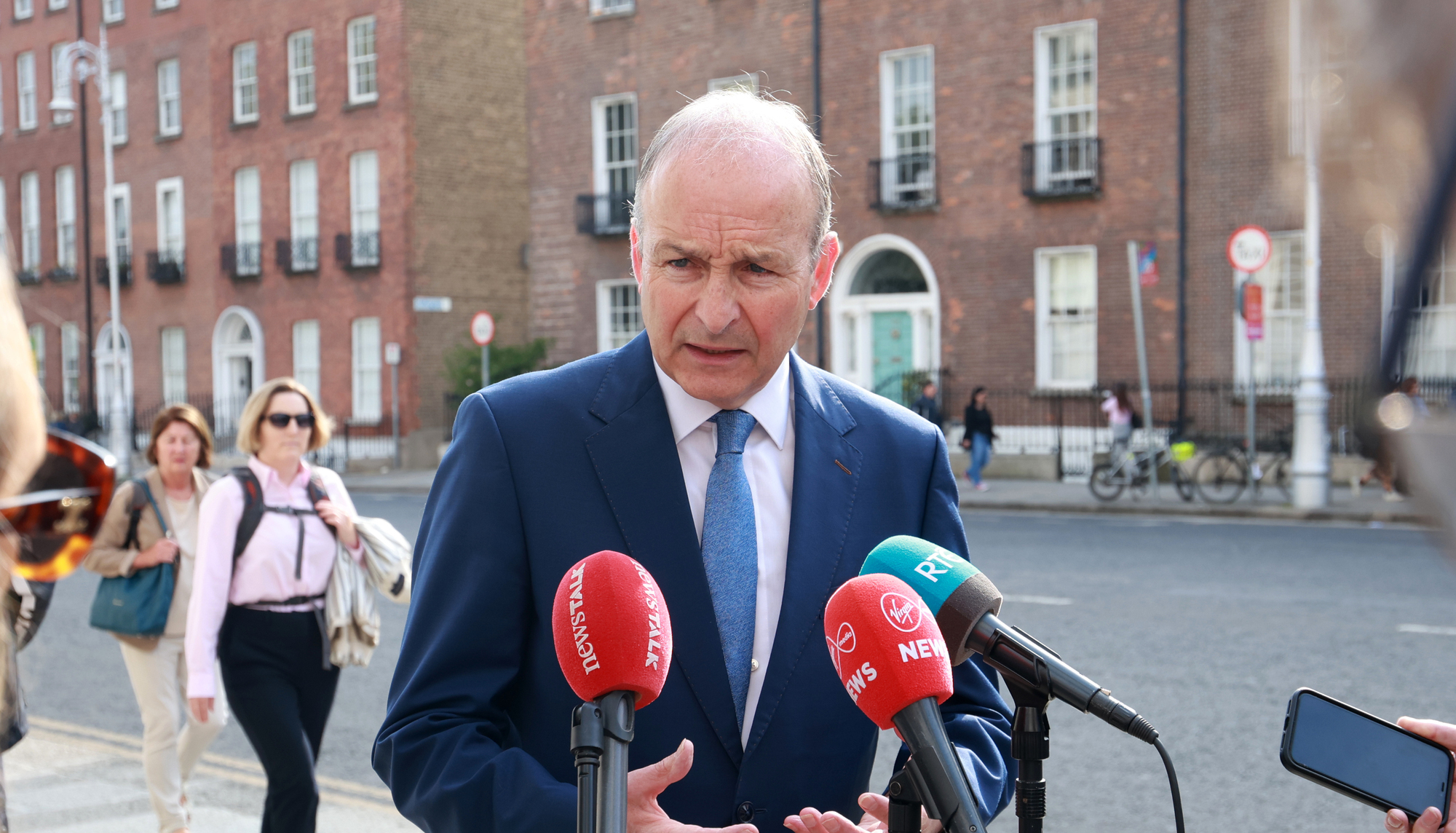
Taoiseach Micheál Martin said the people of the world are “sickened and absolutely disgusted” by the level of bombing and starvation of civilians in Gaza. Picture: Leah Farrell/RollingNews.ie

Taoiseach Micheál Martin has condemned the slow trickle of aid into Gaza as a “sick joke”, as the UN warned that as many as 14,000 babies could die in the days ahead without urgent humanitarian assistance.

EU ministers agreed to review the EU-Israel Association Agreement, amid backlash against the Israeli Government’s continued bombardment of Gaza and slow release of aid into the enclave.

The UN’s humanitarian chief Tom Fletcher said that 14,000 babies could die within days if more aid, such as baby food, does not reach Gazan civilians.

I want to save as many as these 14,000 babies as we can in the next 48 hours,” Mr Fletcher told the BBC.

Asked how the UN arrived at this figure, he said: “We have strong teams on the ground — and of course many of them have been killed… we he still have lots of people on the ground — they’re at the medical centres, they’re at the schools...trying to assess needs.”

The Taoiseach said the people of the world are “sickened and absolutely disgusted” by the level of bombing and starvation of civilians in Gaza.

“This slaughter of the innocents must stop and there’s an onus on the world at large to very significantly pressurise Israel now to cease all hostilities in Gaza,” Mr Martin said.

Asked about the levels of aid allowed in by Israel, with just five trucks permitted on Sunday, Mr Martin said that it is nowhere near the levels required.

I think five trucks instead of the 500 plus that we desperately need a day is a sick joke.

"We know we need hundreds of hundreds of trucks. I mean, people are starving."

Meanwhile, EU High Representative on Foreign Affairs Kaja Kallas confirmed the EU-Israel Association Agreement would be reviewed, following a decision by EU ministers at the Foreign Affairs Council on Tuesday.

It is understood that Ireland backed the proposal to review the agreement, alongside 16 other states.

Nine EU member states rejected the proposal, it is understood.

Ms Kallas said there had been “intensive” discussions on Gaza at the meeting.

“It is clear from today’s discussion that there is a strong majority in favour of review of Article 2 of our association agreement with Israel. So we will launch this exercise,” Ms Kallas said.

Ms Kallas said the ongoing situation in Gaza is “catastrophic”.

Palestinians struggle to get donated food at a community kitchen in Jabalia, Northern Gaza Strip, on Monday. Picture: Jehad Alshrafi/AP

The review of the association agreement has been welcomed by the Government, with Tánaiste Simon Harris describing it as a “strong signal to Israel to reverse course”, resume aid to Gaza and halt their military operations.

We need an immediate cessation of hostilities, the release of all remaining hostages, and a surge in vital humanitarian aid into and throughout Gaza. I call on all parties to support this,” Mr Harris said.

The EU decision comes as the UK suspended trade talks with Israel, while confirming sanctions on settlers in the West Bank.

Criticism grew within Israel, too, where Yair Golan, the leader of the opposition Democrats who served as deputy chief of staff for Israel’s military before entering politics, said: “A sane country doesn’t engage in fighting against civilians, doesn’t kill babies as a hobby and doesn’t set the expulsion of a population as a goal".

In Gaza, local medics said Israeli forces killed at least 55 Palestinians in airstrikes on Tuesday.

It comes as the UN said no humanitarian aid has been distributed in Gaza as of yet.

UN spokesperson, Stephane Dujarric, said that one team “waited several hours for the Israeli green light to access the Kerem Shalom area and collect the nutrition supplies”.

Unfortunately, they were not able to bring those supplies into our warehouse.

Separately, indirect ceasefire talks between Israel and Hamas militants in Qatar appeared to falter again, with Israeli Prime Minister Benjamin Netanyahu saying he had decided to bring back the senior negotiating team from Doha for consultations.

More than 150 academics and lawyers have signed an open letter to the Government criticising its “continued failure” to take steps to comply with international law on Palestine.

In particular, it called for the Government to “act urgently” to introduce the Occupied Territories Bill, saying there are no “insurmountable legal obstacles” in Irish, European or international law to its passage.

Dr Andrew Forde, an assistant professor in international law at DCU, said: “Progressing the occupied territories bill is now both an unconditional international legal obligation and an urgent moral necessity. It is the very least we can do. There is no justification for further delay.”

See the full text of the letter below.

Academics demand action over Gaza atrocities

The observable facts are that at least 53,000 deaths have been confirmed in Gaza so far. 

The numbers injured, many in life-altering ways, is well over 120k. 100% of people in Gaza (2.1m people) are facing acute food insecurity with half a million people (i.e. one in five) are facing actual starvation (i.e. IPC Phase 5/catastrophic food insecurity) whilst aid trucks are lined up at the border ready to enter and relieve some immediate suffering. 

The UN has said that 14,000 babies could die in the next 48 hours without meaningful access to aid. The UN also has reported that more than 70% of buildings in Gaza have been damaged/destroyed. 

(Key Source: https://www.ochaopt.org/content/reported-impact-snapshot-gaza-strip-14-may-2025) 

The damage to civilian infrastructure is currently unquantifiable, but extensive, and in some regions, total.

Israel is bound, under international law to limit the effects of armed conflicts, especially on non-combatants like children. 

This includes the principle of humanity, the principle of distinction between civilians and combatants, and between civilian objects and military objectives; the principle of proportionality, and the principle of military necessity (from which flows the prohibition of superfluous injury and unnecessary suffering).

There is little doubt that war crimes have been committed by the IDF in Gaza, despite the media blackout and persistent objection of the Israeli authorities. 

These range from targeting civilians, destruction of civilian infrastructure, blockade of essentials (medicine/food/water), etc. 

Israel has targeted almost 40 hospitals in Gaza since the war began. 

Under international humanitarian law, some of these may have become legitimate targets (i.e. if they were doubled up as weapons caches) but it is implausible that Israel could argue that it fulfilled the requirements of necessity, proportionality and distinction in all of these cases unless of course Israel has lowered its threshold to the point whereby International Humanitarian Law is rendered effectively meaningless.

A process of ethnic cleansing is also now obvious and observable. 

Though ethnic cleansing is not defined per se in international law it is strongly related to the Genocide Convention which prohibits "deliberately inflicting on the group conditions of life calculated to bring about its physical destruction in whole or in part." 

Israeli authorities have repeatedly and unashamedly said that they wish to take control of Gaza, implying without Palestinians being present anymore. This has been described as the only sustainable outcome for Israel. 

In some cases, Israeli authorities at the highest level have called for Palestinians to be moved en masse to neighbouring countries.

Israel is also creating conditions which are incompatible with life through forced population movements, the imposition of weeks long blockade including prohibiting free and meaningful access by humanitarian organisations in flagrant contravention with well established humanitarian principles.

The actions of the IDF bear many of the hallmarks of genocide, though the threshold to prove genocide is extraordinarily high and requires a demonstration of "intent". 

There are two major cases before the International Court of Justice at present which will consider some of these issues: 1) the South Africa v Israel inter-state case and 2) the Advisory Opinion on the Obligations of Israel in relation to the Presence and Activities of the United Nations, Other International Organizations and Third States in and in relation to the Occupied Palestinian Territory.

What can Ireland / EU do?

The Irish Government has shown admirable political leadership by finally recognising the State of Palestine in 2024 and consistently speaking out about the deteriorating situation in Gaza. 

It has also provided humanitarian aid, facilitated medical evacuations, and allocated Dáil speaking time to the issue. 

It has absorbed incredulous criticism by Israeli politicians, maintained a steadfast position in favour of humanitarian access and championed efforts for UN Security Council reform.

However, in July last year the International Court of Justice declared Israel’s presence in the Occupied Palestinian Territories to be unlawful and obliged all states not to “render aid or assistance in maintaining the situation”. 

It is patently obvious that enabling trade with those businesses present in occupied territories is directly contributing to a continuing illegal situation. 

Progressing the Occupied Territories bill is now both an unconditional international legal obligation and an urgent moral necessity. It is the very least we can do. There is no justification for further delay.

The EU must urgently consider sanctions against Israel. The double-standard in terms of its approach to Russia versus its approach to Israel is striking. 

Ireland, of course, must make these sanctions effective in whatever way is required.


  • Additional reporting by Reuters and The Guardian.

More in this section

Lunchtime News

Newsletter

Keep up with stories of the day with our lunchtime news wrap and important breaking news alerts.

Cookie Policy Privacy Policy Brand Safety FAQ Help Contact Us Terms and Conditions

© Examiner Echo Group Limited