Coolock chaos: Gardaí to investigate if attacks could lead to terrorism charges
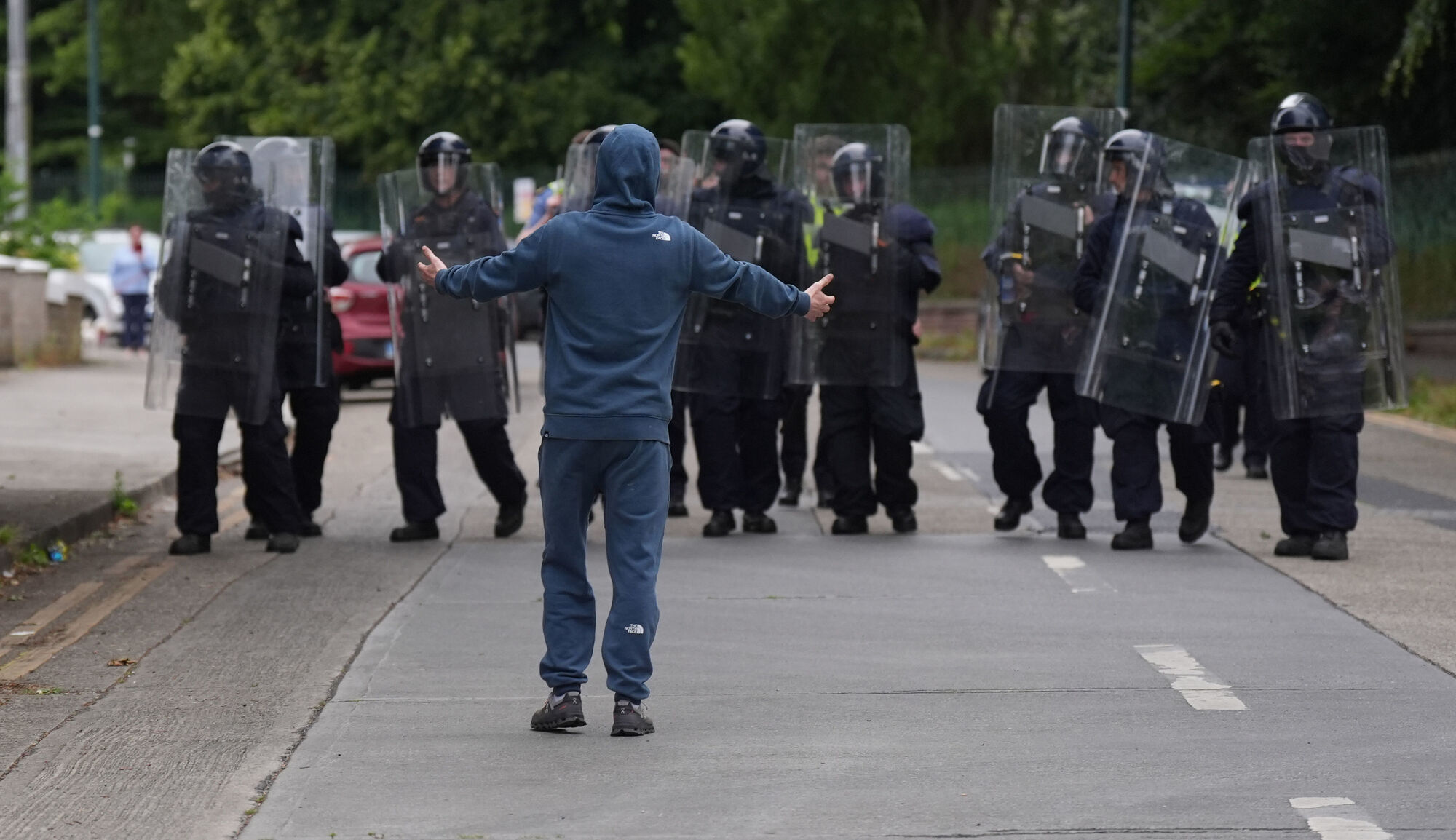
A protester stands in front of a line of gardaí after a number of fires have been started at the former site of the Crown Paints factory in Coolock, North Dublin, on Monday. Picture: Niall Carson/PA
Senior gardaí are trying to identify those behind Monday's arson attack at a planned asylum centre in North Dublin and investigate whether or not there is evidence to support terrorism charges.
The criminal damage – including the firebombing of a digger and the theft and destruction of mattresses – sparked a day-long spree of public disorder, which saw gardaí deploying public order units in full riot gear.
Some 15 people appeared before a special sitting at Dublin's Criminal Courts of Justice on Monday night, charged with public order offences in relation to the day's trouble.
Outside the courts, Garda Commissioner Drew Harris said: “This has been a difficult policing day for us in terms of dealing with serious public disorder. What we saw today was unacceptable.”
Mr Harris indicated more people would be charged overnight in relation to the incidents, and praised the actions of members of An Garda Síochána for dealing with a “very volatile and difficult situation”.
A detailed investigation will follow into all aspects of the events in Coolock, according to Mr Harris.
Earlier, one person, thought to be a man working at the planned centre on Malahide Rd, Coolock, was taken by stretcher by emergency services to hospital, his face covered in a blanket.
Sections of the crowd jeered at him, and some people shouted, “get them out”.
Several people were arrested during the day and, at stages, rocks and stones and other missiles were thrown at riot squad officers. Some protestors were pepper sprayed and wrestled to the ground during chaotic scenes. Several people were arrested.
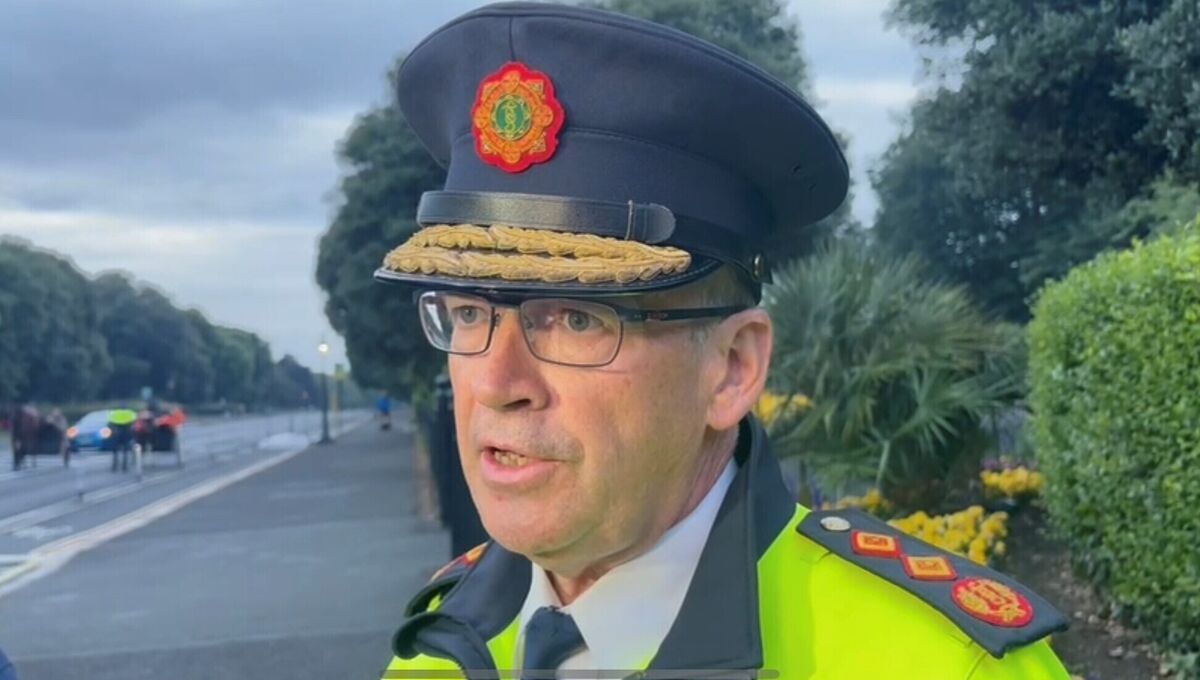
It is understood that Mr Harris travelled to Coolock Garda Station in the early afternoon where he met senior officers.
Earlier, Justice Minister Helen McEntee said: “I have spoken to the Garda Commissioner, and he has assured me that everything will be done to bring those responsible to justice.” She said the people engaged in such acts “will face the full rigours of the law”.
It is understood that the Special Detective Unit — which investigates terrorism and political violence — is assisting local gardaí in their investigation.
Gardaí are trying to identify suspects who started the incident, including those involved in entering the site and setting the digger and mattresses on fire.
A number of videos circulated online of people abusing and threatening staff, mainly foreign nationals, before the criminal damage.
There were also subsequent videos of people inside the site and taking the mattresses. In one video a man’s voice is heard shouting: “Burn the digger. We need petrol.” A second voice says: “Yeah, the digger is lighted."
Security and legal sources have explained that the arson attacks could be prosecuted under the Terrorism Offences Act 2005 — if suspects can be identified and evidence gathered as to their motivation.
One security source said the “use of violence in the furtherance of an ideology” that is hostile to democracy and brings the behaviour “beyond that of protest activity and public disorder” could be considered a terrorist offence.
Alan Greene, reader in constitutional law and human rights at Birmingham Law School, said the 2005 Act requires two elements: That a specified offence has been committed, and that a specific motive is involved.
He said criminal damage, including arson, is one of the specified offences.
He said the second requirement of motive states the offence is committed with the intention of “seriously intimidating a population” or “unduly compelling a government…to perform or abstain from performing an act”.
Mr Greene, an expert on Irish security laws, said: “Certainly, one can see that the arson attacks on the asylum centres would legally meet both requirements.”
But he said the requirement to “prove motive” creates an additional burden for prosecution, pointing out that the simple charge of criminal damage can carry a maximum life sentence.
In addition, the DPP may feel that a terrorism prosecution “potentially aggrandises the attacker and gives oxygen to their cause”.
On the other hand, he said the DPP may wish for the State to “send the signal” that this form of political violence against asylum seekers is “exceptionally pernicious and should be condemned”.
Taoiseach Simon Harris described scenes in Coolock as “reprehensible and despicable”, and he rejected assertions there was not enough community engagement on plans for new asylum seeker accommodation.
“Just to be very clear, when you decide to use a petrol bomb, you lose your right to be called a protestor," he said.
“I’m not quite sure why we have decided, in any manner or means, to legitimise in any way shape or form the actions of people who engaged in sheer thuggery."
Justice Minister Helen McEntee said she anticipated more arrests would take place while adding that bodycam footage from Gardaí would be used to help prosecute individuals.
Mr Harris said that “everybody knew” the Crown Paints site had been earmarked for use as international protection accommodation.
“People can agree or disagree but no amount of community engagement is required to tell somebody not to throw a brick, not to set a digger on fire, not to harm a security guard, not to put the men and women of An Garda Síochána in danger.
“I’ve had it up to here with this whataboutery.
“This is not protest. This is not an issue of community engagement. This is an issue of a relatively small number of people who think that they have a right to do whatever the hell they like in this country, who show absolute disdain for the laws, disdain for the men and women of An Garda Síochána, disdain and disrespect for people going out to do a day's work, like the security guard.”
Speaking in Kenya on Tuesday, Tánaiste Micheal Martin also condemned the “criminality” in Coolock, saying: “An attack on An Garda Síochána is an attack on our State and our democracy. There is no justification for the thuggery and criminality that occurred yesterday.”
Asked about potential terrorism charges being brought against the ringleaders of the attacks, Mr Martin said: “As I said, the full rigours of the law, whatever it takes within the law, and if we have to strengthen our laws, we should, because we’ve got to stamp this out. We cannot have premeditated, wilful attacks on An Garda Síochána.
“In the context of what is happening globally, in the context of what is happening in the United States, and the shocking assassination attempt on President Trump, which I condemn utterly, there’s a real need to assert the primacy of democracy, of dialogue, of civilised discussion as opposed to aggression, violence and use of the gun,” he said.


CONNECT WITH US TODAY



Be the first to know the latest news and updates