Tori Towey: I called my mother because I was hysterical. I was like, ‘I'm in a police station and I don't know why’
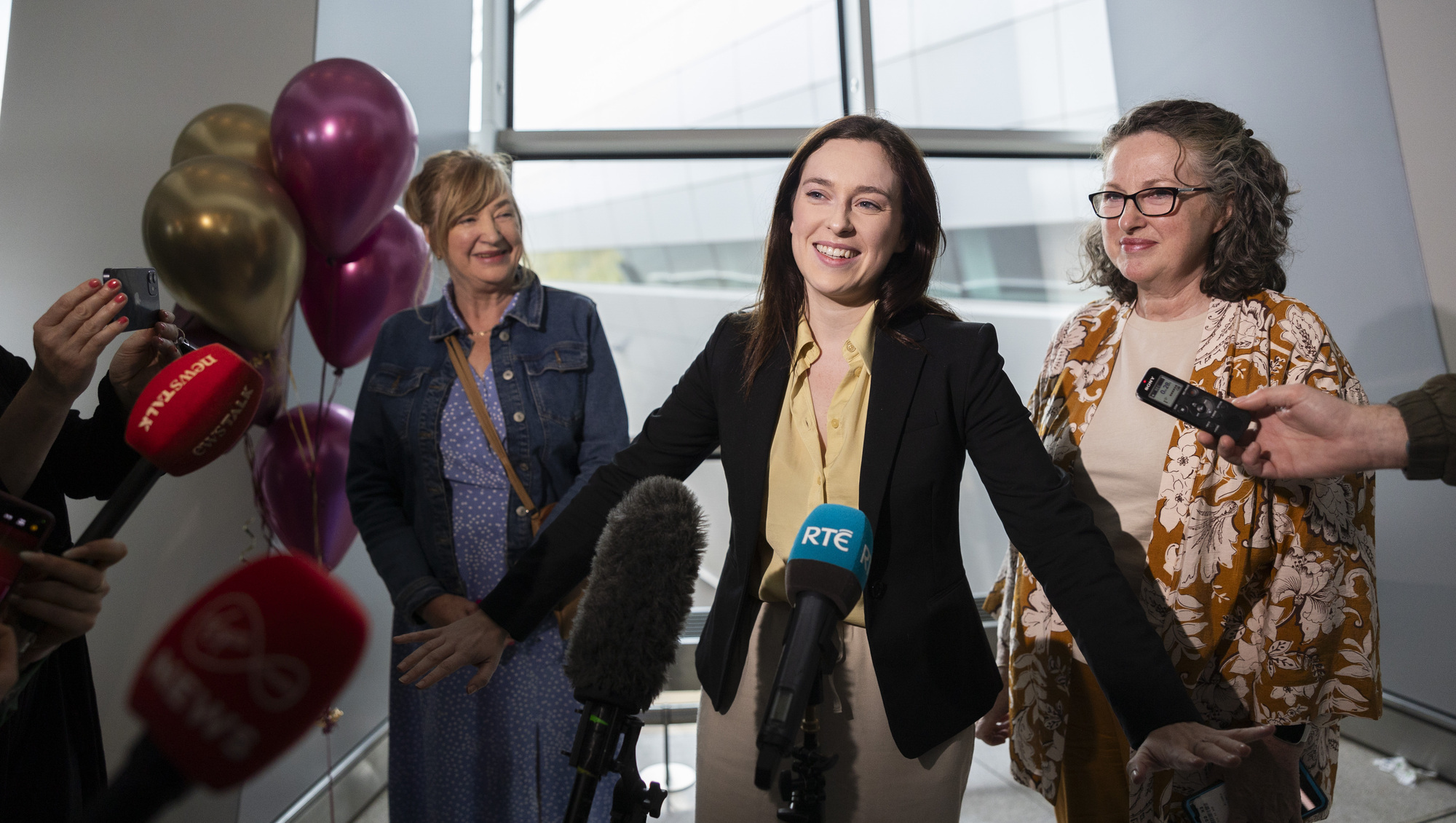
Tori Towey with her aunt, Ann Flynn, and her mother, Caroline, at Dublin Airport. Picture: Sam Boal
Tori Towey woke up in a haze in her bathroom, surrounded by police speaking Arabic and paramedics giving her oxygen.
Earlier that night, after being the victim of domestic violence and terrified she was going to be killed, she escaped to the bathroom and at her lowest ebb, tried to take her own life and lost consciousness.
But instead of being rushed to hospital, she was taken by police straight to a police station.
“I didn't know what was going on,” Ms Towey said, speaking on an X live broadcast organised by Radha Sterling, CEO of Detained in Dubai, who was instrumental in ensuring that Ms Towey would eventually get safely home to Ireland.
“They made me blow into this thing and took my fingerprints. I called my mother because I was hysterical. I was like, ‘I'm in a police station and I don't know why.’
“And then they just took me. They strip searched me. They took all my jewellery off.”
She was taken upstairs to the detention centre, “a tiny corridor” with individual cells and mattresses on the floor.
One Filipino woman ordered another woman off a mattress so that Ms Towey could sit down.
“She brought me coffee, offered me food. She's been there 10 years. She's a lovely person. I was obviously very anxious. I was very worried. She kind of calmed me down and told me everything was going to be OK.
“There were a lot of people from Nigeria and a lot of people from the Philippines.
“The ones from the Philippines, they'd been there a very long time. And I think that's just due to the fact of just having no one on the outside that can help them and not having any financial help to help get them out. So they just ended up staying there for years.”
Ms Towey said the girls she met were lovely but added: “They never got outside. They've never been told what's happening to them.
“And they're there for very ‘wrong place, wrong time’, very minor things.
“That's when I started to panic. I was thinking. ‘I could be here for a month'. I remember saying to the girls that were there ‘how do you do it? I don't know how I'm going to get through this.’
“Because even the lights in there, it's like a surgical room. They're so bright. And they don't turn the lights off when you try to sleep.
“You don't have toothbrushes. They don't give you clothes. You need money in there to pay for everything."
She said there were a lot of children in the cells.

Making that one call to her mother before her mobile phone was seized is what saved her from being detained for longer, she believes.
“It would have just looked like I completely disappeared off the face of the earth.
“Because I managed to call my mother before I got in there, she was phoning people, phoning the embassy. She was calling the police.”
Ms Towey was brought into custody at 4am and released at 11am.
She had been charged with attempted suicide and alcohol consumption.
But she had gone to police before having been allegedly severely beaten by her South African husband.
During that earlier alleged assault, she managed to escape the house, neighbours were outside and they called the police and the ambulance.
The police then took both Ms Towey and her husband to the police station.
At the station, Ms Towey’s husband made a vexatious complaint against her of assault.
Ms Towey said that she never felt discriminated against as a woman in Dubai until she went to the police station badly injured that night.
“My forehead was completely swollen, my shirt was ripped, I had blood and bruises everywhere.
“He [one police officer] started pointing and laughing at me and he was like ‘what happened to you did you hit your head on the ground when you were praying?!’”
Ms Towey was sent to a hospital to make a medical report.
“The day after that I received calls from his family begging me to drop the case, that he was in jail.
"He was calling me from jail, crying, begging me.
“I spoke to the prosecutor and then that's when they told me, ‘he has a case against you’.”
A case against her meant she would have a travel ban on her passport so she could not work as an airline attendant or return home.
The travel bans on both her and her husband’s passports would only be lifted if the cases were dropped, she was told.
She told the criminal investigator that she may not be safe if she dropped the case and he returned to their home.

She was told that he would most likely be kept in detention for a few days and this “might be a wake up call for him".
But when she got home, he had already been released and he arrived with men to change the locks on their home.
She “got him to calm down” and they later went to the police and dropped the charges against each other.
Ms Towey said she felt that she had no choice because with a charge against her she could not work on airplanes and she could not afford a legal battle.
Ms Stirling said that police often encourage people to drop cases of domestic abuse.
“That's why abusers always take a case against their victim, because it gives them that leverage to push for those cases to be dropped,” she said.
People can easily manipulate and weaponise the system against victims, she said.
Speaking on Friday, Ms Towey said that she was “just so relieved” to get home.
“There was a time where I didn't think it was even possible that I was going to be able to come back at all,” she said.
Ms Towey’s mother first got in contact with the Irish embassy when her daughter was detained in Dubai, where she had been working as an airline stewardess.
But the embassy initially just gave her a list of lawyers she could contact and said there was not much they could do, Ms Towey said.
But once the Irish Government pushed for the case to be resolved, the embassy worked “night and day”, keeping Ms Towey regularly updated and informed at all times.
Embassy officials even drove from Abu Dhabi early in the morning to escort her onto her flight home.
They later told her that they had been working behind the scenes before pressure arrived from Government on her case.
“In the end, you know, they did their best,” Ms Towey said.
But things had only really started to move once she contacted Ms Stirling, she said.
Ms Stirling contacted Ms Towey's local Roscommon TD, Sinn Féin's Claire Kerrane, who quickly told Mary Lou McDonald, who immediately contacted Ms Towey and raised the hugely emotive case in the Dáil.
Taoiseach Simon Harris immediately pledged his support and Tánaiste Micheál Martin pushed for the case to be resolved.
“They worked as a team. They were amazing. I am so grateful to all of them,” she said.
Foreigners are viewed as “cash cows” by many lawyers in Dubai who charge extortionate fees for legal representation, sometimes $50,000 to $100,000.
Fighting the case legally would have been left Ms Towey stuck in Dubai unable to work as a flight attendant with the travel ban imposed on her passport, while racking up huge legal fees that may get her into debt which could in turn incur further civil and criminal charges.

“So if I went the legal route and had a lawyer I think the situation might have ended up even worse because I would have been stuck over there for a longer time, being in more debt.”
Civil debt cases can be difficult to resolve diplomatically because they are taken by an institution like a bank, Ms Stirling said.
But debt can also be misrepresented as fraud and become a criminal case.
“And people go to jail for their debt.”
Ms Stirling called for upgraded warnings about the dangers in the UAE and the judicial system there which can jail you for being raped, issuing a bounced cheque, getting into debt, insulting someone online, or having a CBD product.
She believes that travel warnings should be increased on the Irish embassy website. The warnings that are there “are insufficient,” she said.
“I haven't seen a single country that has been sufficient in explaining to citizens what is actually illegal," she said.
And people from countries that do not have strong ambassadorial or government support or without money can be left trapped in appalling conditions in Dubai police stations and prisons on minor alleged offences indefinitely, Ms Stirling said.
Ms Stirling is aware of one person who has been in jail for more than 10 years for owing money to a bank. And it’s at the bank’s discretion to extend that sentence, she said.
TV star Selina Waterman-Smith was abducted on the street by three men, bundled into a car, taken to the desert, and gang raped.
“The embassy told her to leave the country in case she gets charged with sex outside marriage,” Ms Stirling said.
“But she did push, and she pushed extremely hard and eventually had those men convicted and jailed.
"So that was probably the first example of progress in that department that I've seen. But it's disturbing."
Since Ms Towey was freed, Ms Stirling has already been contacted by another Irish citizen detained in Dubai under similar circumstances to the 28-year-old Roscommon woman who arrived safely back in Ireland on Thursday.
Plainclothes police officers can intimidate tourists, “grabbing them” without identifying themselves as police, Ms Stirling said.
“They think they’re being assaulted and attacked and suddenly they’ve got charges for disrespecting a police officer.
“It’s really difficult to protect yourself,” she said.