Jacques Delors was architect of modern, inclusive Europe, says President Higgins
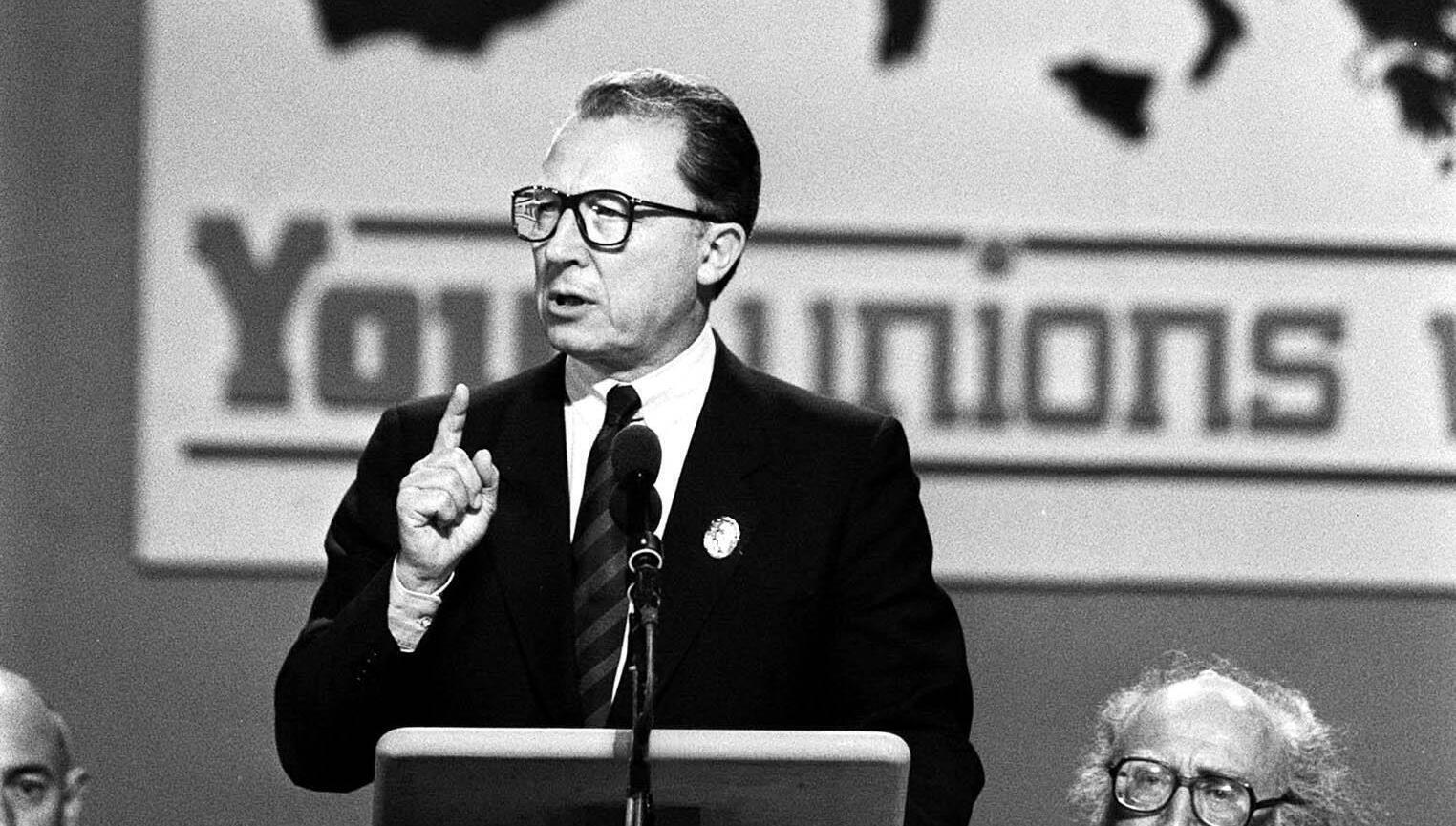
Jacques Delors has died (PA)
President Michael D Higgins has described Jacques Delors as one of architects of a modern, inclusive Europe.
Delors, former European Commission president, who played a key role in the design of the euro and creation of the single market, died on Wednesday, aged 98.
"He represented a visionary moment in the evolution of Europe," President Higgins said.
"This was reflected for example in activities such as his organisation of his discussion on the soul of Europe, to which he invited those of all faiths and ethical dispositions to participate. An open, generous vision of a Europe which should respect all traditions and cultures, and be built around a future of peace, mutual respect and dignity.
"In his decade as President of the European Commission, Jacques Delors oversaw the introduction of a wide range of key initiatives, including the Erasmus programme for student exchange and the Schengen travel area. He also understood the importance of cultural policy as President of the Commission and gave it priority as part of his leadership.
"Importantly, Delors recognised that economic needs must be balanced with the needs of society and that the new market demanded equal, if not greater, forms of protection for the citizen and the development of a Social Europe.
"He was among those who continued to advocate for that balance and to developing a Europe of a global and inclusive vision for its citizens, including through the work of the Jacques Delors Institute.
"As he put it: 'Europe does not just need fire-fighters, it needs architects too'. Jacques Delors was one of those foremost architects."
Mr Delors was hailed as a “statesman of French destiny” by French president Emmanuel Macron after news of his death was confirmed.
He served as European Commission president from 1985 to 1995, a period that saw him involved in several skirmishes between Brussels and Britain.
In 1990, then British prime minister Margaret Thatcher said “no, no, no” as she issued a Commons rebuke to Mr Delors as he sought greater Brussels control.
In November 1990, a front page of The Sun – under the headline “Up Yours Delors” – urged readers to face France and shout the insult in a bid to protect the British pound.
UK Labour former leader Neil Kinnock said Mr Delors sought to emphasise common interest and shared sovereignty.
Recalling the exchanges with Mrs Thatcher, Mr Kinnock told BBC Radio 4’s PM programme: “To represent him as some kind of fanatical federalist who wanted to create some country called Europe with all the trappings of that was extremely misleading, but it suited her political purpose at that time.
“And of course the caricature stuck. That wasn’t Jacques at all.”
He described Mr Delors as a “very polite, calm, highly intelligent man, a problem-solver”, noting: “He wouldn’t let his judgment of what was possible, what was practical, what was doable be clouded by personal reservation or dislike.”
Conservative former chancellor Kenneth Clarke said Europe had its “most powerful and reforming leadership” during the era of Helmut Kohl as German chancellor, Francois Mitterrand as French president, Mrs Thatcher and Mr Delors.

He told the same programme: “Jacques Delors was one of the most reforming and creative of the four and when they worked together, or when one of them managed to prevail to get an idea, Europe developed as never before.
“Margaret’s own contribution was the single market because Margaret was in favour of economic Europe, she was in favour of a total free trade Europe, she never talked about leaving the European Union, she saw it as an economic thing to make us more prosperous by giving us a big free trade bloc.
“She suspected Jacques, as she revealed in that extraordinary outburst in the House of Commons, of going beyond that and being in favour of a political Europe, which she was against, which was going to be a sort of united states of Europe, a superstate and all the rest of it, which I agree with Neil – I don’t think Jacques was interested in that at all.”
Pro-European Mr Clarke said he thought Mr Delors’ views on common employment laws were “too social democrat and left-wing”, adding he was “impressed” by the “highly intelligent man” when they discussed finance matters.
He went on: “The truth was that Jacques Delors and Margaret Thatcher deeply disliked each other personally, they hated each other for personal and political reasons.
“If you saw them together it was painful. He thought she was a silly right-wing woman and she thought he was an irritating French intellectual obsessed with creating a united states of Europe.”
Mr Clarke said this caused Mrs Thatcher’s “final explosion” in Parliament.
Former MEP Nigel Farage, who led Ukip and the Brexit Party, told the PA news agency: “Jacques Delors had a vision that turned the EC (European Community) into the EU.
“For Eurosceptics like me he was an important figure who helped propel me into a political career.
“My only regret is not doing battle with him on the floor of the European Parliament.”
CONNECT WITH US TODAY



Be the first to know the latest news and updates