Indigenous knowledge, bravery, and vigilance ensured siblings' survival in Colombian jungle
As more details emerge about the children’s incredible feat of survival, it has become clear that the ancestral knowledge of the eldest child played a vital role in keeping her younger siblings, including a baby who turned one during the ordeal, alive for 40 days.
Lesly Mukutuy, aged 13, was able to identify edible fruits, find suitable water, and avoid dangerous plants and animals, thanks in part to knowledge handed down to her by Valencia.
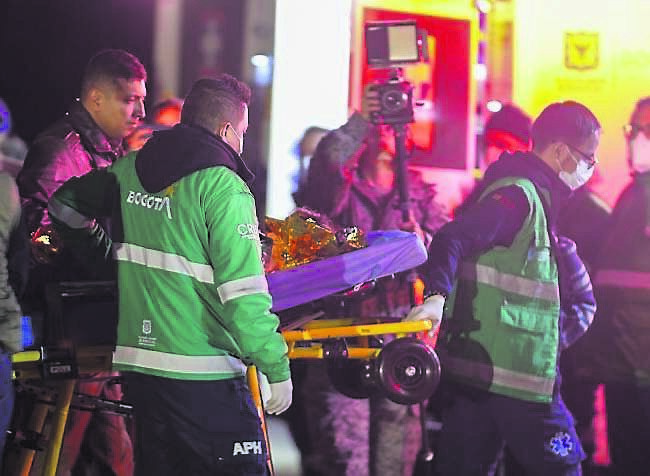
“We have to recognise not only her bravery but also her leadership,” the minister of defence, Iván Velásquez, said after a visit to Bogotá’s
military hospital, where the children were being treated for malnutrition and minor injuries.
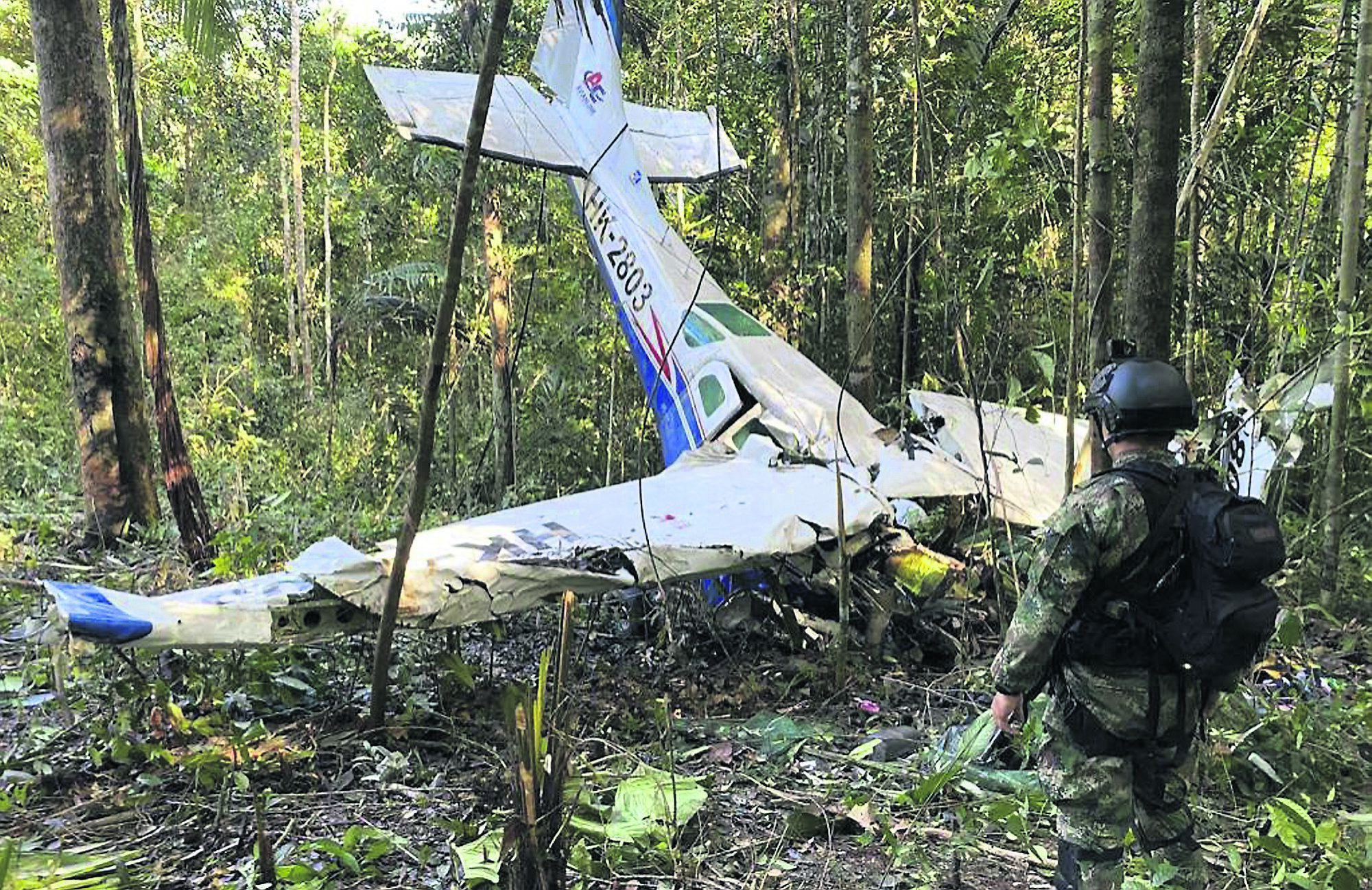
A Cessna carrying the four children, their mother, and two other adults, including the pilot, crashed in one of Colombia’s most remote and dangerous regions on May 1.
A search team found the plane on May 16 in a thick patch of the rainforest and recovered the bodies of the adults but the children were nowhere to be found.
Last week the four children, members of the Huitoto Indigenous community, were found in a small jungle clearing 5km from the wreckage, in an area where snakes, mosquitoes, and other animals abound.
Several times search teams had passed within 50 metres of the clearing. They were finally able to pin the children’s location down thanks to a cry from Cristin, the youngest of the siblings.
He was just 11 months old when the plane came down, while the children were travelling with their mother from the Amazonian village of Araracuara to San José del Guaviare.
The children’s great-uncle, Fidencio Valencia, said the siblings had survived by eating fariña, or cassava flour, and by using their knowledge of the rainforest’s fruits.
So far the children have given few details of their ordeal, but conversations with family members suggest they have may have hidden from the search team out of fear.
“They were afraid out there, with the dogs barking,” said Fidencio Valencia, having spoken to the children. “They hid among the trees… they ran.”
Valencia told the media outlet Noticias Caracol that the children were starting to talk and one of them said they hid in tree trunks to protect themselves.
Alicia Méndez, journalist with newspaper El Tiempo, said that at one point the children had heard a message in their native language recorded by Fatima Valencia and transmitted from a helicopter, but they were scared to respond.
Henry Guerrero, an Indigenous man who was part of the search group, told reporters that the children were found with two small bags containing clothes, a towel, a torch, two mobile phones, a music box, and a drink bottle.
He said they used the bottle to collect water in the jungle, adding that after they were rescued the youngsters complained of being hungry. “They wanted to eat rice pudding, they wanted to eat bread,” he said.
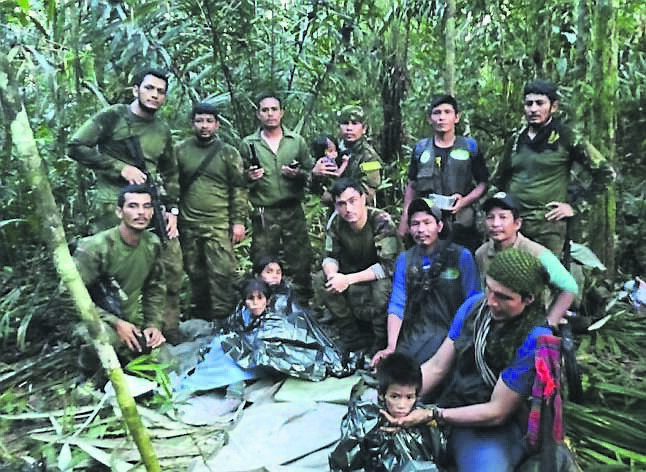
Aside from the shock and trauma of the crash and their mother’s death, the children may have had reason to fear the olive uniforms of the search party.
Manuel Ranoque, father of the two younger children, claims that members of the Carolina Ramiréz Front, an ex-Farc dissident group active in the region, had a history of threatening him and his family.
Ranoque, who served as governor of a Huitoto community, said the threats had forced him to leave the region to Araracuara, in Caquetá in Colombia’s southern Amazon region.
The family had visited Ranoque there in April and were returning to San José de Guaviare in a chartered Cessna when the engine failed and it crashed into a region where the rebel group operates.
On May 20 the army confirmed it had found an abandoned Farc dissident camp 2.8km from the crash site but quickly ruled out speculation that the children had been kidnapped by the group.
Ranoque said the children would tell their own stories in time.
No one can accuse the military of not doing enough to find the siblings. They used 11 aircraft, distributed 10,000 flyers, and launched 100 food kits into the search area of 323 sq km, even at distances further than the children could have been expected to reach on foot.
More than 150 soldiers and 200 volunteers from local Indigenous communities and a team of 10 Belgian shepherd dogs took part in the search.
At first the troops from the Colombian special forces acted silently, accustomed to tracking down rebel groups in the jungle.
“We realised we had to modify the procedure, to make noise and call Lesly’s name, to make them see us,” a soldier involved in the rescue told on condition of anonymity.
Of the Indigenous volunteers, he said: “They taught us about the jungle, their traditions, and their deep spirituality.”
It was perhaps telling that the first people to find the children were members of the Indigenous search team, who had been calling out in native languages. On the morning of the rescue they partook in a ritual with yagé (ayahuasca), a traditional jungle medicine with psychedelic properties.
“They were found by an Indigenous guardian who took yagé, and with the support of the army’s technology,” said Luis Acosta, coordinator of the Guardia Indígena. “Those who take yagé see far beyond what we see. He becomes a doctor, a panther, a tiger, a puma. He sees beyond because it’s a holistic medicine. He had the capacity to look.”
Fatima Valencia also credited the spiritual and natural worlds for her grandchildren’s survival. “I give thanks to Mother Earth, because she released them.”
- Guardian

CONNECT WITH US TODAY



Be the first to know the latest news and updates