Sprechen sie Deutsch? Could you pass a 'lovely' German JC exam or a challenging Business Leaving Cert?
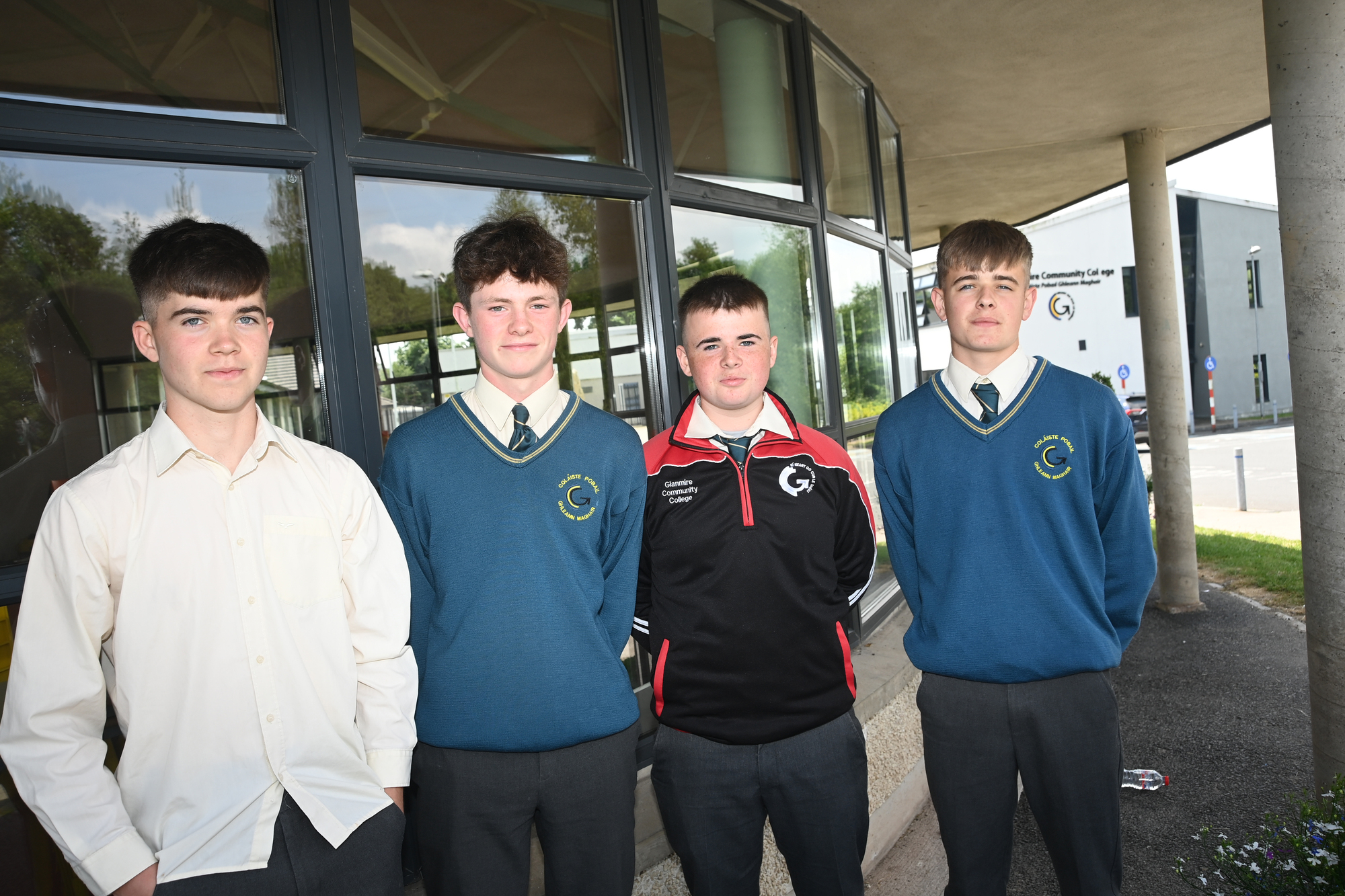
Students Joseph McMahon, JJ Foley, Nathan Cronin, and Harry Browne who were sitting the Wood Technology Junior Cert exam at Glanmire Community College on Thursday. Picture: Larry Cummins
Familiar topics with teenagers meant business was a paper set in the real world, although one compulsory question would have challenged even the best students, while German was a “lovely” paper for some to finish their State exams with.
The 2023 State exams continued this Thursday morning with Leaving Cert Business and Junior Cycle German.
Every section of the 2023 higher-level business paper had something that was “absolutely lovely”, according to Keith Hannigan, teacher with the Institute of Education.
“Those familiar with past papers will have seen familiar questions reappear and nothing that would disconcert them.”
“While in the past some papers had been spoiled by awkward, abstract, or curveball questions, this paper was pure syllabus and thus very fair to those who put in the work to revise.”
“Issues relevant to the modern teenager like minimum wage, GDPR, calculations of pay, and the EU meant that many students will have found themselves growing in confidence as they progressed,” he added.
Applied Business may have caused a “few moments of pause”, but it was also very fair in how it presented its surprises, Mr. Hannigan believed.
Students also would have found contemporary talking points throughout the long question section, including topics like environmentalism and flexible work.
However, this year’s applied business question (ABQ) on the higher-level paper would have challenged even the most capable student, according to Ruairi Farrell, a teacher at Greystones Community College in Co. Wicklow and subject spokesperson for the Teachers Union of Ireland (TUI).
The ABQ is a compulsory part of the paper and students cannot avoid answering it.
Students were asked to contrast the use of issued share capital with the use of debentures and grants as sources of long-term finance for a construction company.
Students also had to discuss the impact of economic variables on the company along with the benefits and challenges of entering international markets.
Mr. Farrell said: “There is no doubt the ABQ was challenging and needed careful consideration and a well-structured answering approach to be specific to identify the key areas of learning required from the areas of the course that students find more difficult to grasp.”
The short answer questions would have been received more positively with a mix of topics covered and good student choice available, he added.
“Students would have needed to be well prepared to do well but the choice would have enabled them to avoid some of the tougher questions.”
This year's ordinary-level paper, which had no compulsory applied business question, presented a wide variety of choices, he believed.
“This was very much welcomed by students across the board but would have provided an additional challenge in question selection as students had to reflect on many questions before finalising those they are best placed to answer.”
Reference was made throughout the exam to companies that students would be familiar with such as Apple, TikTok, Insomnia, and SweetKing.
“These well-known brands would have made the students feel at ease.”
However, the ordinary level paper also had its share of challenging questions on areas such as inflation, balance of payments, and the role of assessors and actuaries in insurance.
Meanwhile, the 2023 common-level Junior Cycle German paper was a curveball-free exam, representative of all topics and suitable for students of every ability, according to teacher Clodagh Mackle, subject spokesperson with the Association of Secondary Teachers Ireland (ASTI).
The majority of students Ms. Mackle spoke with coming out of the exam on Thursday morning were very happy with the paper.
“One girl just finished her State exams and she said it was a lovely way to finish her Junior Cycle.”
Ms. Mackle listened to this year’s listening comprehension from outside the door of an exam hall.
“Thankfully, like French, it only had eight questions. Last year there were 10.”
“They have put the two languages the same. It's something we were always looking for because the learning outcomes are the same for all modern foreign languages."
“The papers looked very different to each other last year, but not so much this year.”
There were no surprises on this year's Junior Cycle paper, she added.
“It was very much based on the sample paper that the State Examinations Commission (SEC) published in 2019.”
“Last year’s wasn’t, there were a few curve balls last year but not this year. It was an extremely fair paper.”
“It was very doable and suitable to all students regardless of their actual level.”
However, there was one reading comprehension towards the end that was a bit tricky.
“It was all about wanting something different, would you like to go to the farm? The vocabulary was very specific.”
Examples of this specific vocabulary included milking cows, ‘kühe melken’, cleaning horses, ‘pferde putzen’,collect and sort eggs, ‘hühnereier einsammeln und sortieren’ and help in the orchard 'obstgarten mithelfen’.
“That was a little bit tricker for some of them but all the topics were represented on the paper,” Ms Mackle said.
“Be it from clothes, to pocket money to part-time jobs, there was a range of topics and vocabulary which we were very happy to see. It was a student-friendly paper I thought.”
Leaving Cert German is due to be examined on Friday morning.
“My fingers are crossed and I’m blessing myself for tomorrow because it's going to be a trickier one I think,” she added.