Curveballs for Leaving cert Biology students; Some challenges for Junior cert French
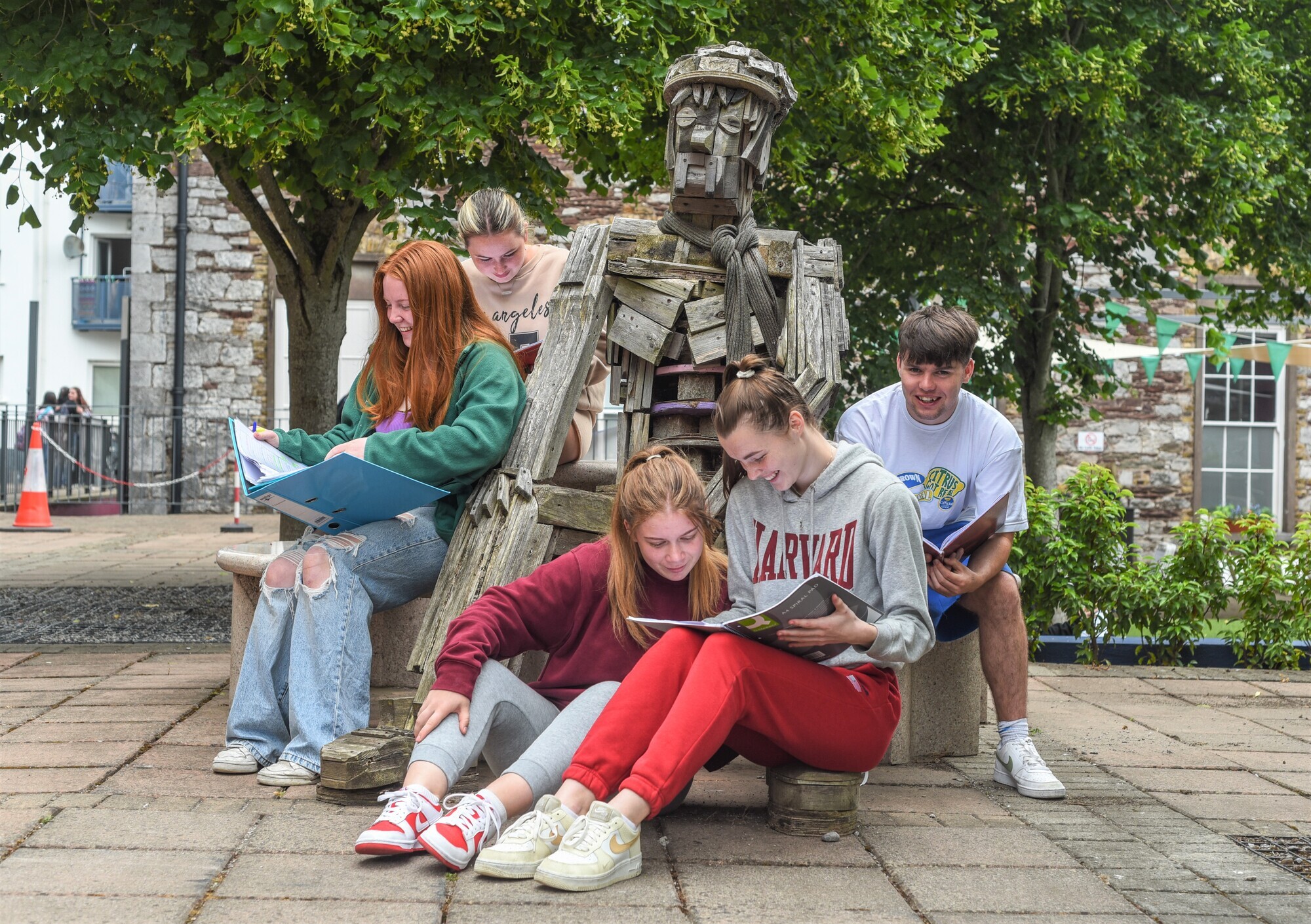
Sixth year students Aoife Cripps, Cáit Ní Chonnaill, Alicia Ní Bhuacáin, Leah Ní Chonnaill, and Fionn Mac Philip getting some fresh air while making final preparations for the Leaving Cert Biology exam on Tuesday afternoon. Picture: Cian O'Regan.
A reference to ‘innominate’ bones has stumped even a biology teacher of more than 20 years, while Junior Cycle students’ French vocabulary was put to the test as the State exams continued Tuesday afternoon.
Leaving Cert students sat the 2023 biology exam, while Junior Cycle French was also examined this afternoon.
Overall, the 2023 higher-level Biology paper was very straightforward, according to Margaret McGagh, subject spokesperson with the Association of Secondary Teachers’ Ireland (ASTI), and teacher at Dunmore Community School, Co Galway.
While the paper's opening question on food was fairly typical, the question on the scientific method included a graph, which can tend to throw students, she added.
“They are not so happy usually seeing graphs and there were a few graphs on the paper but there was nothing very difficult about them.”
This year's question about the skeleton might have jarred some students, Ms McGagh believed, as it asked about the ‘innominate’ bones, which are part of the appendicular skeleton.
“That word ‘innominate’; I have never seen that word and I am teaching biology for twenty-something years. I haven’t seen that on any syllabus. The word innominate would have thrown them.”
However, the rest of the question was very straightforward, and students should know the appendicular skeleton so could have made a good guess at it, she believed.
While students would have been happy to see a question about fermentation, hotly tipped to appear this year, the photosynthesis question was unusual as it included the spectrum of light.
“That will throw a lot of students. They should know it, and I have seen a similar type of question back in 2004 but a lot of students would have said ‘oh my god, what’s this?’”
There was also a question on the 2023 paper about bacteria where students were asked to complete the growth curve, similar to one seen last year.
“I do know from last year’s marking scheme that question was not answered well so I’d say that why its there again but it was easy enough.”
This year's section C questions included a question on Ash dieback.
“That is very topical right now as Ash dieback is decimating the country’s Ash, and that question was quite straightforward as well.”
The paper also included questions on genetics and reproduction, both of which would have been expected.
“Overall, it was a very fair paper.”
The ordinary level paper was also fine, she added.
“There was a nice question on using a microscope and a question on DNA which was fairly straightforward.”
“The same topics came up on the ordinary level paper as the higher, which included the ecology experiment.”
“The choice in section C was quite good. Overall, there were no big surprises in it.”
Meanwhile, the 2023 French Junior Cycle exam was fair overall, but with some challenging sections, according to the executive committee of l'Association Irlandaise des Professeurs de Langue Française (AIPLF).
The teachers’ subject association is the largest in the country, with more than 500 members.
The group is due to meet with its members online tomorrow evening to discuss their views on the 2023 exams before sending its feedback to the State Examinations Commission (SEC), according to AIPLF president Valérie David-McGonnell.
“The committee felt that the paper was fair overall, but with some challenging sections.”
The reading comprehensions included a text about a boy from Polynesia, a female soccer player from Martinique, a text conservation about a party, and an advert for a holiday camp.
“That was fair overall,” Ms. David-McGonnell said.
“The only thing is that we were a little bit surprised to see a poem in the reading comprehension. We were a little bit surprised by that, the fact that there was a poem is a little bit unusual.”
“That said, the questions focused mostly on parts of the body so it didn’t matter too much that it was in the shape of a poem.”
The committee also found the grammar section “doable”, she added.
“It included questions in the past tense, about adjective agreements and prepositions. There was no big surprises.”
“The only thing is that it is a pity that there was a grammar mistake in one of the sentences, but I would stress there was no impact on the ability of candidates to answer the question.”
“It was no big deal but it was just a pity to see a grammar mistake in the paper.”
The writing section was also quite fair and asked students to fill out a form and write a blog entry.
“Students had to mention their age, date of birth, talk about their family, their favourite food, and their hobbies. That’s quite normal, that was a fair section.”
The blog was about an exchange programme which included questions about the present, past, and future, as expected.
“But there were two surprises. They specified that candidates had to write about 200 words which they didn’t do last year. The other surprise is that there was only five points to write about.”
The listening test assessed students on their knowledge of numbers, countries, weather and school subjects, parts of the body, family, food and colours.
“These were all as expected.”
CONNECT WITH US TODAY



Be the first to know the latest news and updates