Residents seeking to take legal action over Dublin Airport flight routes

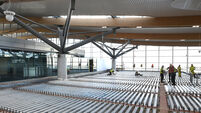
The second runway opened last August. Picture: Brian Lawless/PA Wire
Residents in Ballyboughal, just north of Dublin Airport, are raising funds for a legal action to challenge planning permission granted for flying routes.
They claim the Dublin Airport operator Daa amended certain routes which contravened the planning permission originally granted for the construction of the second runway which opened last August.
The residents said the airplanes are creating massive noise and interruption.
David Walton, of Ballyboughal Community Council, said the details approved in the planning application for the runway are not being adhered to.
"The planning that has been granted, it says that the planes should fly west in a straight line from the north runway for five nautical miles or reach 3,000 feet before they turn," said Mr Walton.
"From August 24, the planes were taking a 75-degree turn at 650 feet and the latest new flightpaths from the DAA are for a 30-degree turn at 850 feet, neither of which comply to the current planning permission."
When the issue arose following the opening of the north runway, the daa undertook a review that proposed updates to Instrumental Flight Procedures (IFP), specifically the Standard Instrument Departures (SIDs).
It was said that these updates were required to align flight paths more closely with the information that had been previously communicated by the daa.
The revised SIDs came into effect on Thursday, February 23.
Planes departing from the north runway must now turn by a minimum of 30 degrees northwest.
"This means that from February 23 some areas like St. Margaret’s, Shallon and The Ward Cross will continue to be overflown as anticipated, whilst other areas like Oldtown and Ballyboughal will also continue to be overflown but at higher altitudes," the daa said.
"Areas such as Skephubble, Kilsallaghan and Rolestown will no longer be directly overflown by jet aircraft but will still be exposed to a certain amount of aviation noise, albeit less than currently."
These changes mean that homes that had been on the edge of the boundary for mitigation from the noise generated will now have to undergo some soundproofing.
"It is expected that the overall number of houses in the various noise contours will be similar to that previously communicated," an airport spokesperson said.
"However, a small number of dwellings that were previously on the verge of eligibility for mitigation measures may become eligible as a result of these revised SIDs.
"We intend to engage with these dwellings regarding the required mitigations as soon as possible."

CONNECT WITH US TODAY



Be the first to know the latest news and updates