Gardaí fear members could be killed when called out to manage anti-social behaviour
Gardaí fear members could be killed when called out to manage anti-social behaviour

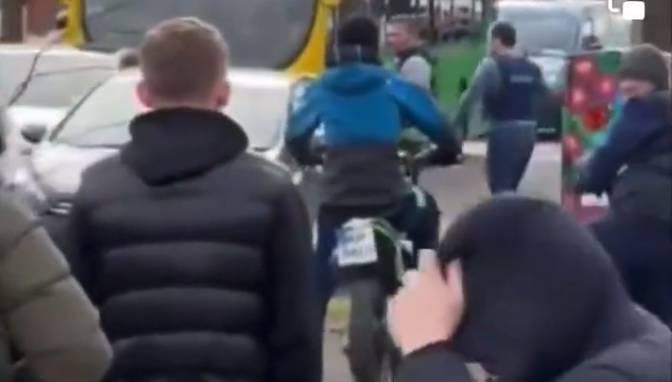
A screengrab of an incident in Ballyfermot in which a Garda was hit in the side of the head by a missile and two Garda vehicles were damaged. Picture: Twitter

Gardaí increasingly fear that a fatality could occur within their members when they are called out to manage anti social behaviour amongst large groups of people.

That is according to the Association of Garda Sergeants and Inspectors (AGSI) general secretary Antoinette Cunningham, who was speaking after an incident in Ballyfermot on Monday in which a Garda was hit in the side of the head by a missile and two Garda vehicles were damaged.

Ms Cunningham said attacks on gardaí are becoming an almost everyday occurrence.

"At the back of this are individual gardaí who receive injuries, some of them life-threatening and we are fast building into a society where this is going to become normalised. We do not want to find ourselves in a situation where a member is fatally injured whilst carrying out their duties."

She said that "almost everyday" assaults on gardaí are leading members to develop conditions such as PTSD.

However, she indicated in relation to the establishment of a taskforce that there is a need for a more clear understanding of what is hoped to be achieved from it.

"What will be the purpose of it? If it is to do with violence against gardaí it is something that we would absolutely look at. I am just not sure what a taskforce would actually achieve," Ms Cunningham told RTÉ radio's Today with Claire Byrne.

"I think there is a lot of issues in An Garda Síochána. I think we need a greater political response to what is going on. And I think we do have continued concerns around recruitment and retention that have been flagged for some time."

Recruitment issues

Ms Cunningham said that the Government promised to recruit 800 gardaí last year. However, they "achieved just 120."

"This year they have set out a target to recruit 1,000 gardaí. The first cohort of 200 were to start in Templemore yesterday. Sadly, only 136 of the promised 200 started in the Garda college.

"We would have to say that recruitment and retention has the potential to become a political failure. Government are setting out targets for recruitment and they are not being achieved. Government need to take hold of that."

She said that young people look at videos of events such as what occurred in Ballyfermot yesterday and decide to choose a different career.

"I think people look at videos like that and they say 'why would I put myself in a situation like that?'

"We had an 107 resignations last year. Unprecedented in the organisation. I think Government are failing to address the issues with staff associations.

"We haven't even in An Garda Síochána started the process yet of conducting exit interviews with those who are leaving to find out why the job is no longer attractive to them. That is a failure by Garda management to examine as expeditiously as they can the issues why people are leaving in numbers we have never seen."

Antoinette Cunningham of the AGSI. Picture: Don MacMonagle

Ms Cunningham's comments were echoed by Garda Representative Association (GRA) President Brendan O'Connor, who said incidents like the one in Ballyfermot mean people do not see joining the gardaí as an "attractive career".

"Recruitment hasn't materialised. We believe as an association that, unfortunately, policing is not an attractive career and the events of yesterday perhaps feed in to that," he told RTÉ's Morning Ireland.

Ms Cunningham also stressed the myth that gardaí receive "golden pensions" is very frustrating.

She said a guard will not be able to live solely on a garda pension when they retire.

Ms Cunningham added that gardaí are concerned about "more than just pay and pensions".

"It is about the conditions that you work under, it is about the mandatory sentencing for people who assault gardaí in the course of their duty, it is about a review of the Public Order Act which was brought in in 1994 to see if there are new offences that need to be introduced by way of legislation such as the filming of gardaí, such as the uploading of content."

More in this section

Lunchtime News

Newsletter

Keep up with stories of the day with our lunchtime news wrap and important breaking news alerts.

Cookie Policy Privacy Policy Brand Safety FAQ Help Contact Us Terms and Conditions

© Examiner Echo Group Limited