State papers: Tension between government and Mary Robinson over her efforts to expand presidency role
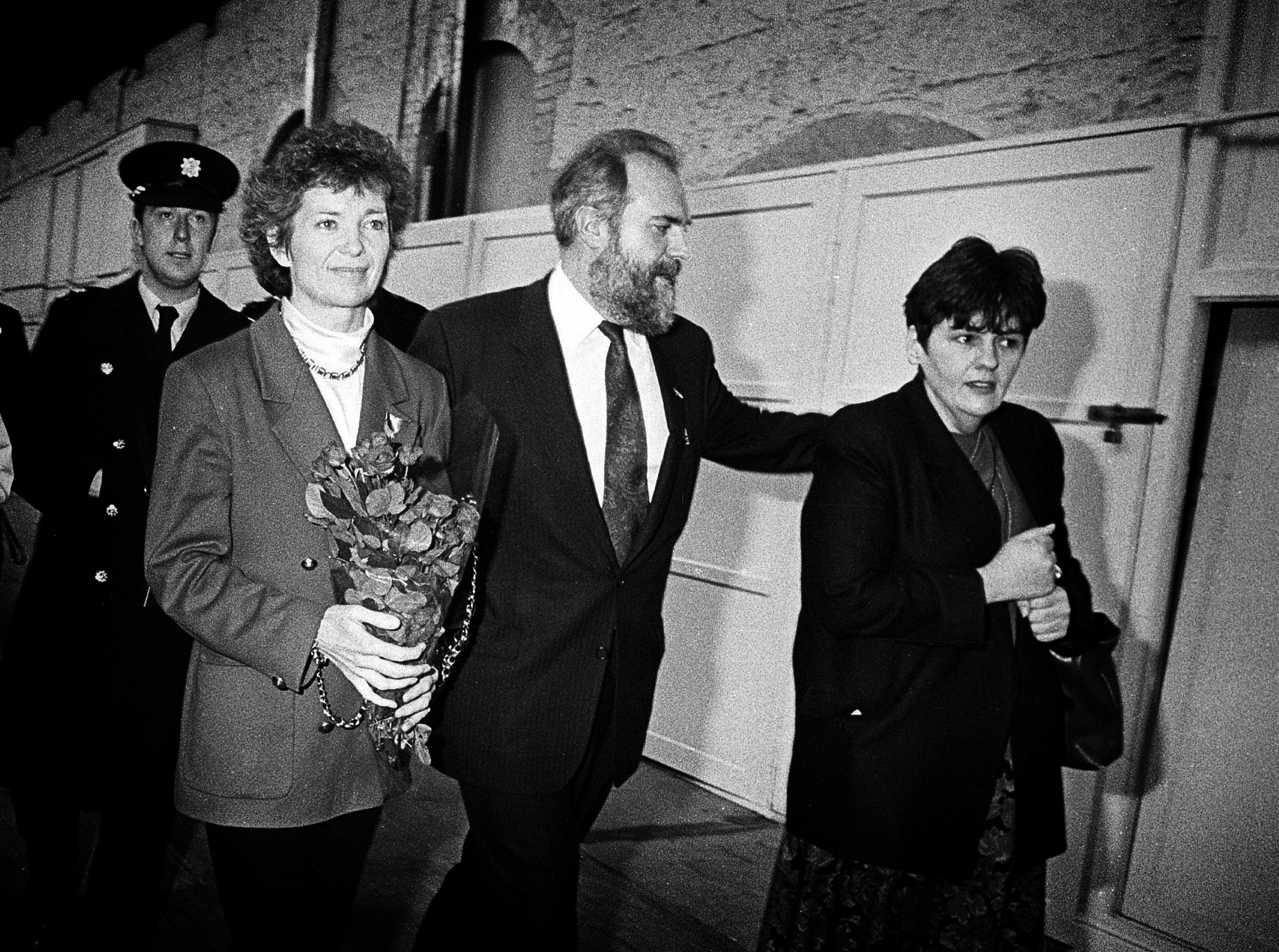
Mary Robinson with her husband Nick and media adviser Bride Rosney after winning the presidential election in 1990. Picture: Eamonn Farrell/RollingNews.ie
Serious tension erupted between Mary Robinson and the Charles Haughey-led government, including senior officials, over her role and independence following her historic election as the countryâs first female president in 1990.
Newly-released State papers show senior civil servants believed Ms Robinson and her advisers were seeking a confrontation with the Government over the limits of her office.
In April 1991, the attorney general, John Murray, advised the Cabinet that the President was prevented from expressing views in conflict with government policy under the terms of the Constitution.
Two months later, another senior barrister, Dermot Gleeson, who would subsequently serve as AG, wrote a legal paper for Mr Murray in which he argued that the President had no right to say anything in public without first securing the permission of the Government.
Mr Gleeson claimed that the Government even had power to dictate which events the President should attend.
HISTORY HUB
If you are interested in this article then no doubt you will enjoy exploring the various history collections and content in our history hub. Check it out HERE and happy reading
âThe constitutional scheme does not envisage conflict, and clearly envisages that the final word on presidential pronouncements should rest with the Government,â Mr Gleeson advised.
His proposed interpretation of the Constitution was adopted by Mr Murray who offered it to the Cabinet as his formal legal advice on the issue.

However, Ms Robinson challenged such advice and informed the Taoiseach, Charles Haughey that she had âextreme difficulty in accepting such a narrow and restrictive interpretation of the role of the Presidentâ.Â
While the President accepted that she should not get involved in matters of Government policy and acknowledged that she would always take care to avoid any public conflict with the Government, she pointed out that she had sought and obtained âa mandate for developing the representational role of the Officeâ.Â
Internal records from the Department of the Taoiseach, show officials were expressing concern about media interviews given by Ms Robinson without having first notified the Government.
They took particular issue with quotes from the Presidentâs special adviser who had stated that âas long as it is not Government business or the Constitution, there is no limit on what she may discuss in interviewsâ.Â
Such remarks were branded âinjudiciousâ and âcapable of being interpreted in a confrontational wayâ by officials who argued that such a position would inevitably lead to conflict with the Government.
The issue also came into focus after Ms Robinson commented on the X case which became a major public story in early 1992 when the then Attorney General, Harry Whelehan, sought a High Court order to prevent a pregnant 14-year-old rape victim from leaving the jurisdiction to have an abortion.
She told a meeting of a womenâs group in Wexford that it had been âa very difficult week for women and girls here in Irelandâ.Â
âI hope we have the courage which we have not always had to face up to and look squarely and to see this is a problem we have got to resolve,â Ms Robinson added.
While the spokesman for the then taoiseach, Albert Reynolds, claimed Ms Robinson had been âechoingâ the Governmentâs own concerns on the issue, the assistant secretary to the Government, Frank Murray, claimed she had created âa situation of controversy.âÂ

The following month, Ms Robinson stirred up further concern within the Reynolds administration when she was reported to have invited Queen Elizabeth II to visit Ireland.
It resulted in Mr Reynolds phoning the President to convey his concern at such reports and his wish to underscore âthe seriousness of what had happenedâ.Â
He even raised the prospect that her speeches and statements might need to be vetted by his officials in future.
However, Ms Robinson claimed the media reports had not reflected what she had stated and she stressed that she had âno wish whatsoever to interfere in political mattersâ.Â
There was also unease in Government circles over Ms Robinsonâs meeting with a deputation from the âUnemployed Organisationâ with the government secretary, Dermot Nally questioning why it was taking place, while a Fianna FĂĄil backbencher had described the group as âmilitant leftâ.Â