Calls to expand heel prick test to allow for earlier intervention
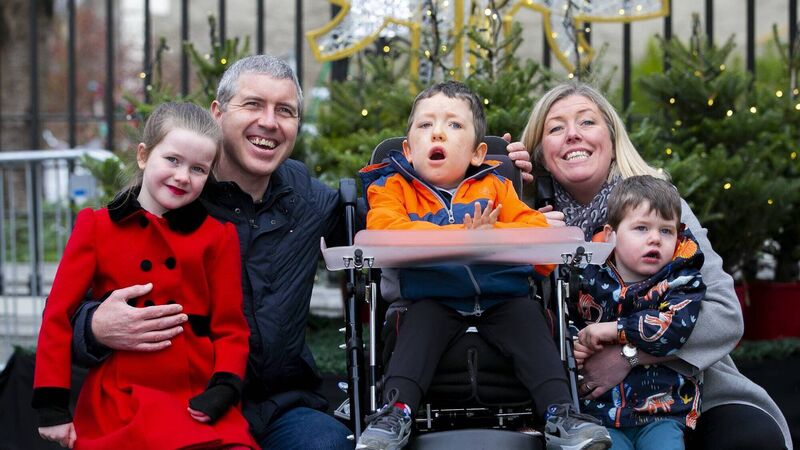
Vivienne, David, Luke, Liz, and Sean Ryan from Meath. Luke and Sean have spinal muscular atrophy, however, Sean was diagnosed earlier, allowing for more effective treatment.
The Irish newborn screening programme needs to expand to keep pace with Europe as even war-stricken Ukraine recently updated its programme, advocates have urged.
Newborn babies are screened here for nine conditions, allowing for early treatment of life-changing rare diseases. However, this puts Ireland in 20th position across Europe, an event calling for expansion heard.
Speakers said it is “criminal” that Irish babies are not screened for conditions including spinal muscular atrophy (SMA). SMA Ireland called on the Government to launch a pilot screening programme to include this condition in the heel prick test.
Addressing the event, Dave Ryan spoke of the difference in his young sons’ lives due to when they were diagnosed with SMA.
Luke, now four, spent 10 months in ICU as a baby, having been diagnosed at around seven weeks.
“He would just be floppy in our arms. Nobody knew what the problem was,” he said. “He has a lot going on. He has round-the-clock care, night nurses seven nights a week.”
In contrast, Sean, two, was diagnosed and treated earlier. Videos were shared of Sean climbing a slide and carefully pushing his older brother in a wheeled support.
Laois GAA star Aisling Donoher also attended with her son Dan who has SMA.

Speaking from the floor, Kacper Rucinski, SMA Europe, said Ukraine is among 10 countries which added SMA to screening in the last year.
He said: “A country in the midst of a war that seven weeks ago expanded their newborn screening programme to 21 diseases including SMA.”
Data presented by global consulting firm Charles River Associates showed, over 18 months, Ireland added one condition to screening while on average European countries added or planned to add three.
Milan Ferguson warned: “Out of 32 countries included in the research, Ireland currently ranks 20th in the number of diseases screened for. Based on recent policy developments, Ireland is expected to be in the bottom 10 countries by December 2023.”
Irish hospitals have access to ground-breaking treatments for SMA, but the earlier the drug is given the better the outcome, said paediatric neurologist at CHI Temple Street, Professor Declan O’Rourke.
However, they still see babies coming for the first time at six months old. He warned “without any treatment, the natural history is that this condition is ultimately fatal in children”.
SMA Ireland director Jonathan O’Grady said: “We must be grateful that the Irish Government made this drug available. It seems criminal that it should be available but yet its optimal treatment is to be given early.”
Rare Disease Ireland CEO Vicky McGrath said 58.6% of children who die before they reach 15 have an underlying rare disease.
She suggested the Government could expand screening on economic grounds, saying children with a rare disease use 25 times more hospital bed days than children without these conditions.
A Department of Health spokesman said SMA and a number of conditions are “undergoing active consideration” by the National Screening Advisory Committee.
“A recommendation regarding further expansion before the end of 2022 is expected,” he said.
“The minister is fully committed to supporting our population screening programmes which are a valuable part of our health service, enabling early treatment and care for many people, and improving the overall health of our population.”
CONNECT WITH US TODAY



Be the first to know the latest news and updates