800-year-old teeth may hold secret to origins of Black Death
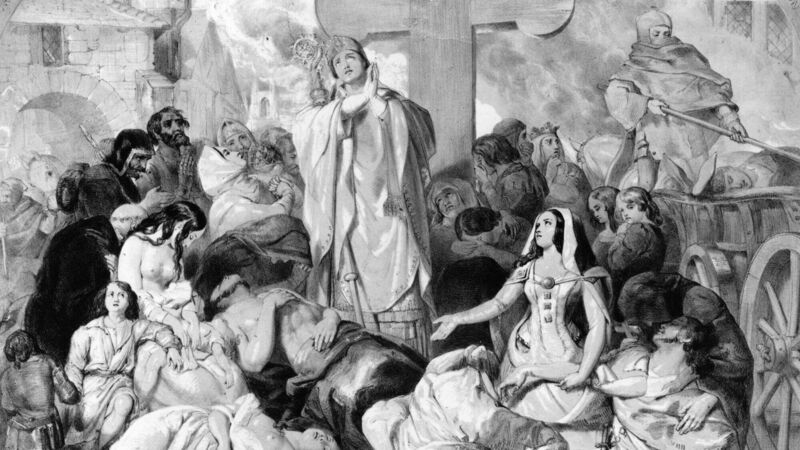
People praying for relief from the bubonic plague known as the Black Death. Picture: Hulton Archive.
Teeth from seven people who died around 1338 hold the secret to the mysterious origins of the Black Death which killed millions of people, researchers have claimed.
The plague pandemic is estimated to have caused the deaths of up to 60% of the western Eurasian population between 1346 and 1353 with smaller epidemics continuing into the 1800s.
Its precise origin has been disputed for centuries, however, an international study focused on two graveyards near Lake Issyk-Kul in modern-day Kyrgyzstan to try and solve the mystery.
Up until now, it has been speculated the Black Death appeared from a sort of explosion of a variety of plague types, which the study describes as “a massive diversification of plague strains”.
An international team of researchers analysed historical data and also ancient DNA from the teeth of seven people who had been buried in the graveyards at that time. They had been exhumed and preserved during the late 1800s.
Lead author and researcher at the University of Tübingen Dr Maria Spryou said: “We found that the ancient strains from Kyrgyzstan are positioned exactly at the node of this massive diversification event.”
Genetic studies showed this strain of the plague was a direct ancestor of the strain which spread so catastrophically throughout Europe just eight years later.
Senior author and historian at the University of Stirling Dr Phil Slavin said: “We could finally show that the epidemic mentioned on the tombstones was indeed caused by plague.”
One of those inscriptions read: “In the Year 1649 [= 1338 CE], and it was the Year of the tiger, in Turkic Bars. This is the tomb of the believer Sanmaq. [He] died of pestilence.”
Published in the journal , the study notes the plague can survive in the wild in so-called plague reservoirs among rat populations or marmots.
Professor Johannes Krause, senior author and director at the Max Planck Institute for Evolutionary Anthropology, said there are links between this ancient form and modern-day strains.
He said modern strains of the bubonic plague most closely related to that ancient strain can be found among rats in the Tian Shan mountains in that same region.
The study states it is not known what caused the plague to emerge at that time, saying natural disasters or sudden changes in temperature or rainfall can lead to outbreaks.
Now that the date and site of the first outbreak are confirmed, the team expects environmental, archaeological or historical research could pinpoint why it happened.
The start of the Black Death has traditionally been linked to outbreaks in 1346 around the Black Sea, and they expect investigations could now examine how the disease travelled to such devastating impact.
The study is available here.
40898501/[#embed4]

CONNECT WITH US TODAY



Be the first to know the latest news and updates