French heatwave: 'Painfully clear' that global heating happening faster than predicted
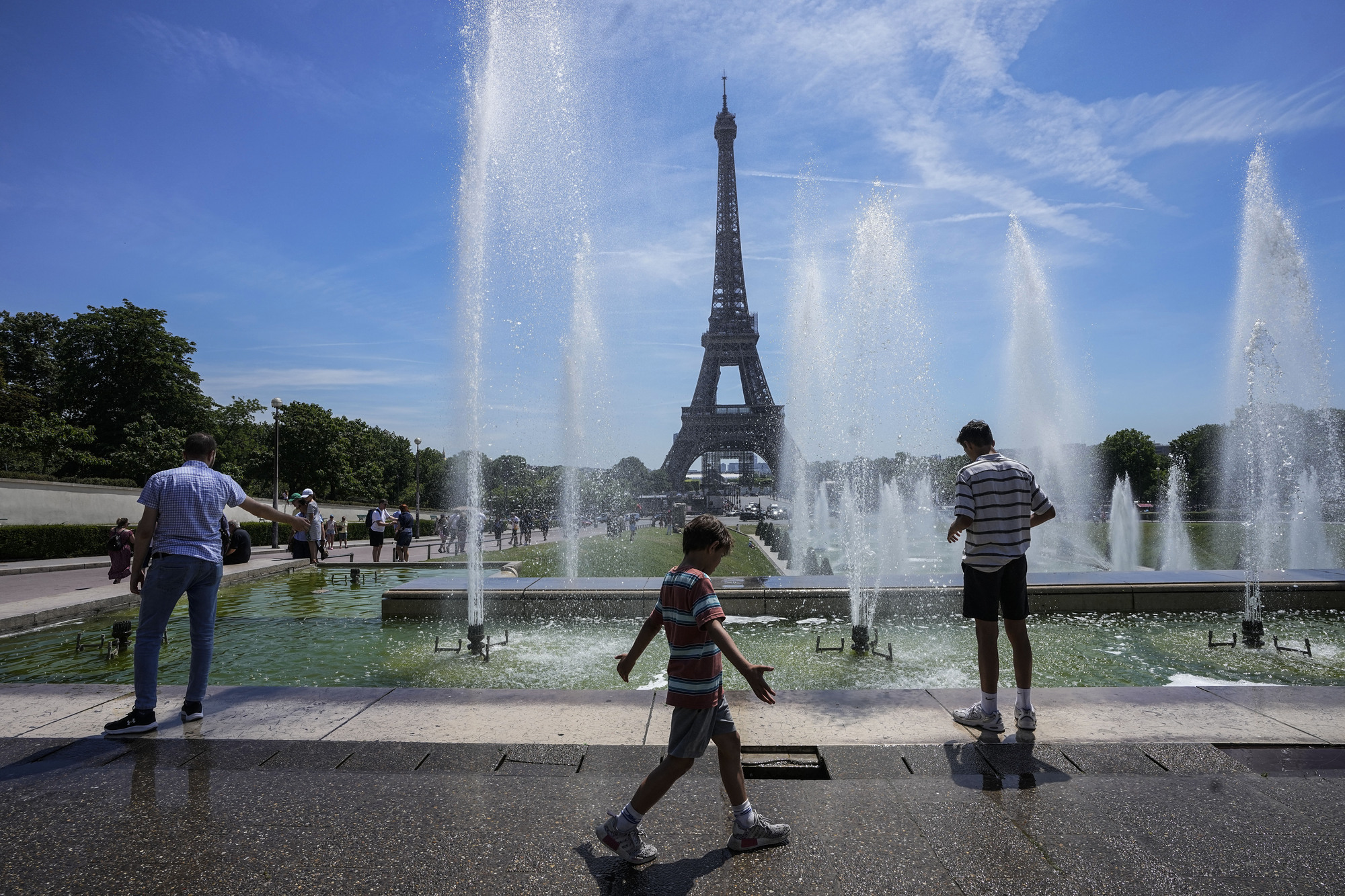
People cool off at the fountain of the Trocadero garden next to the Eiffel Tower in Paris. Hot weather is expected to last for several days across the country. Picture: Michel Euler/AP
A leading Irish environmental campaigner witnessing the brutal heatwave engulfing France and Spain in person has said it is “easy to grasp just how dangerous they are” as the countries bake in temperatures over 40°C.
Veteran environmental campaigner and journalist John Gibbons went on a family holiday to Spain and France on June 8, and told the it is “frightening to consider how much has already changed at just 1.2°C of global warming”.

Coming into the weekend, 14 departments in southwest France were under red warnings for heat, while a further 56 were on orange warnings.
Mr Gibbons, who took the ferry to Spain before driving the family’s electric vehicle (EV) to France as they are mindful of their aviation emissions footprint, said the current heatwave had echoes of another killer event in France three years ago.
“The last time we travelled for a family holiday to France — in June 2019 — we ran into a severe heatwave, with temperatures reaching 41°C," Mr Gibbons said.
"This year, we decided to head early, taking the ferry to Spain on June 8 and travelling by EV into southwest France shortly afterwards.
“We are due to stay in the medieval town of Carcassone, but temperatures there have once again breached 40°C.
“It's becoming painfully clear that global heating is happening even faster than predicted — temperatures exceeding 40°C in France were not projected to occur until closer to mid-century,” he said.
The situation in neighbouring Spain is equally serious, Mr Gibbons added, with temperatures hitting 43°C in recent days.

“Rather than being once-off extreme weather events, these are part of a clear pattern of temperatures ratcheting up dangerously in response to rising CO2 emissions, as scientists have been warning about for years,” he said.
The southern part of continental Europe could already be heading towards becoming largely uninhabitable due to recurring deadly heatwaves, Mr Gibbons added.
“It's frightening to consider how much has already changed at just 1.2°C of global warming. If we allow global average temperatures to breach 1.5 or even 2°C, the consequences are almost unimaginable both for people and for wildlife.
“Extreme temperatures also devastate food production, so left unchecked, we are facing into growing food shortages, or worse, in the decade ahead.
"When you're here in France, with the sweltering temperatures pressing down on you, it's easy to grasp just how dangerous these heatwaves really are,” he said.
Heatwaves like the one engulfing parts of Europe and the US will start earlier, become more frequent, and will be longer and hotter because of climate change, the World Meteorological Organisation (WMO) warned last week.
As well as heatwaves in Spain and France in rare patterns for this early in the year, nearly a third of the American population is under some form of heat advisory, it said.
The drought-blighted Horn of Africa has now experienced four successive failed rainy seasons, with this year’s March-May season predicted to be the driest on record, according to Irish humanitarian umbrella organisation Dóchas.

Dóchas, which collectively represents Irish development and humanitarian organisations, said last week that the world had to wake up to the African drought in Kenya, Somalia, and Ethiopia.
Dóchas chief executive Jane-Ann McKenna said: “The failure to address the deadly combination of climate change, conflict and the economic consequences of the Covid-19 pandemic has left the region in extreme crisis."