Relatives urged to provide DNA in bid to unlock mysteries of the missing
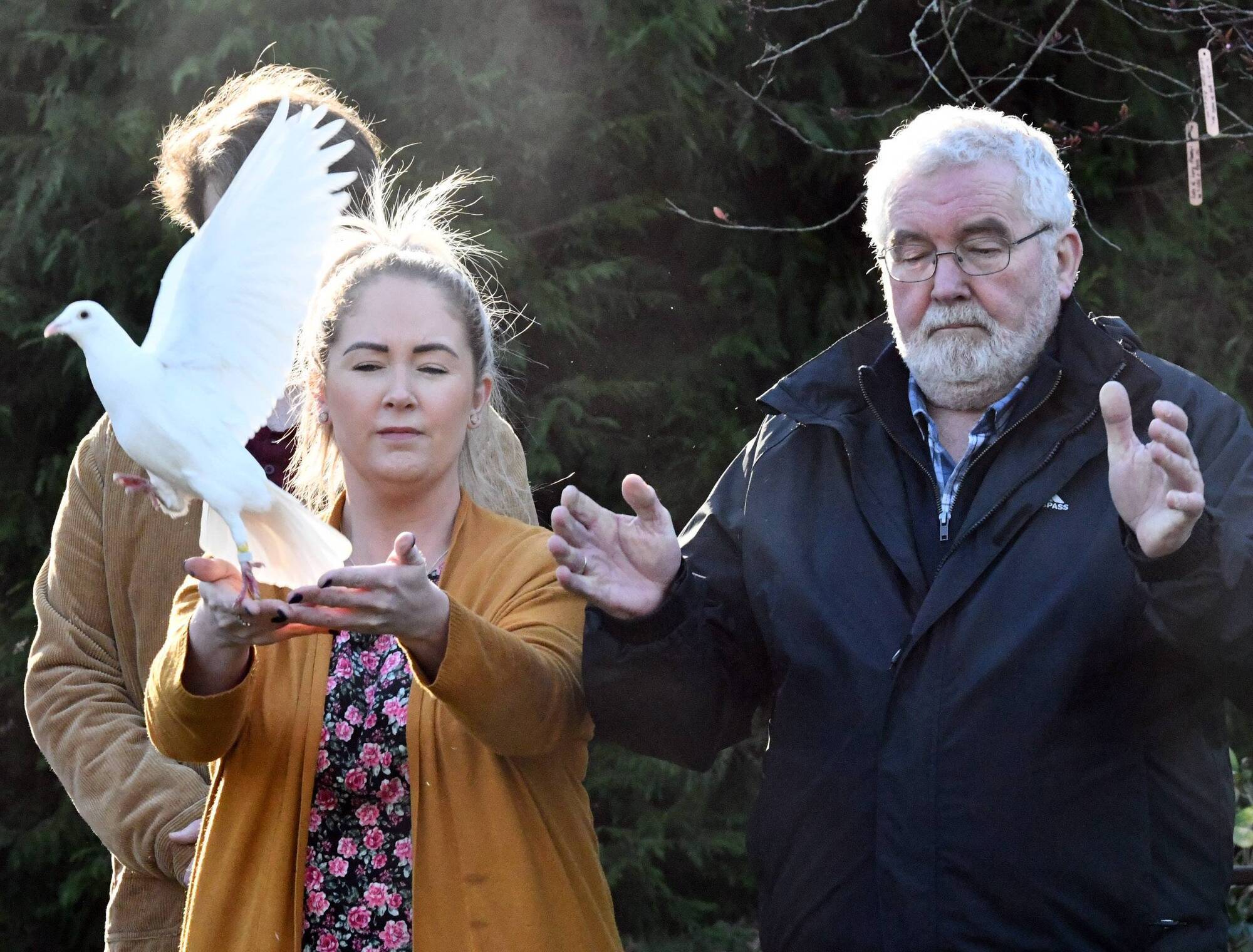
Murdered Bangor woman Lisa Dorrian’s sister Joanne and dad John release two white doves on the 16th anniversary of her disappearance. Photo: Alan Lewis
Justice Minister Helen McEntee has urged more people to come forward with information about missing people, while also urging relatives of the missing to provide gardaí with DNA samples.
Speaking at Wednesday's National Missing Persons Day event in Dublin, she said: “I would like to encourage people who may have information to come forward any information even if it appears insignificant or irrelevant.
“It has the potential to be important and valuable to both those investigating the disappearance of our missing persons and the families and friends of missing persons.
“I'd also like to take this opportunity to encourage close family relatives of missing people who have not done so to provide a DNA sample for uploading to our national DNA database.
“New laws which were passed in recent years, provided for the establishment of a DNA database system for use by gardaí and this assists them in identifying missing and unknown persons.
“The collection and subsequent matching of DNA samples from this database represents a key turning point in the identification of human remains in Ireland.
“And already it has provided much-needed closure for an increasing number of families.”
The event heard that there are currently 815 long-term missing people from the Republic of Ireland, down from 823 last year, and 876 on the island of Ireland.

The sister of murdered Lisa Dorrian, from Bangor, was one of the relatives of a missing person who spoke at the event.
The 25-year-old shop assistant was murdered in a Co. Down caravan park on or around February 28, 2005, and then buried but her remains have never been found.
Joanne said: “We're almost 17 years now. She had her whole life ahead of her. She was a funny, beautiful, very maternal person.
"Lisa went missing on the 28th of February 2005. She had gone to a caravan site with some new friends that evening and something happened that night which caused her to be disappeared and we have never seen her since."
She added: “We're in a very unique position of having a missing person, but also knowing that they have been murdered without ever find in their body.
Addressing families of missing people on behalf of coroners in Ireland, Dr Ciaran MacLoughlin, said at the event: “We empathise with you who have a loved one missing.
“Pain is a physiological, noxious stimulus experienced by all of us from early childhood. “Pain also has a psychological and emotional component.
“We who have not experienced your loss can only contemplate what such pain feels like - sleepless nights, broken, restless sleep, daily flashbacks, (and) silent birthdays.”
He added: “A vacant chair at Christmas, no exchange of gifts or phone calls, a tearful moment and emptiness at family occasions, such as weddings, and sporting events.”
He pointed out that from now on, an inventory of all human remains in the State will be kept by the coroners, the forensic science laboratory, and gardaí.

This inventory has been given statutory approval, and it is now obligatory for coroners to file a return on the number of unidentified remains in their districts annually.
Precise mapping of unidentified remains in charge will be recorded in order that they will be easily located if an exhumation is necessary or requested in the future.
Dr MacLoughlin backed Ms McEntee’s DNA appeal, saying: “The success of DNA analysis is dependent on the sample being compared with a sample of a very close relative.
“And I ask that first degree relatives, a parent or sibling of missing persons to provide your DNA sample in order that immediate comparison can be undertaken.”
Also speaking at the event in a pre-recorded video was Carol Morris who was 16 when her father Albert Timmins went missing on December 23, 1980, from his home in Swords, Co. Dublin.
“Every day you're sitting waiting for the guards to come and tell you they found the body, or the car and it just eats away at you."
She added: “I just wish we knew. Even if we got a finger or a nail we would be happy with that.
“That sounds terrible. We just want to bring him home.”
Ms McEntee spoke of how important National Missing Persons' Day is for ensuring family members are not forgotten.
"The routines of everyday life can bring back memories of our loved ones that can bring them to the forefront of our minds and music plays such an important role in that," she said.
"So often music and sound remind us of the ones we love but who are not by our side, where they belong.
"A memory of someone humming a tune in the kitchen, singing their party piece at a wedding or a family gathering or simply holding your hand at a concert when your favourite group plays your favourite song."
“I just wish we knew. Even if we got a finger or a nail we would be happy with that.”
These were the anguished words of the daughter of a Dublin man who has been missing for more than 40 years.
Carol Morris was 16 when Dubliner Albert Timmins went missing on December 23, 1980, from his home at 7 St Cronans Avenue, Swords, Co. Dublin. He is believed to have travelled in his car, a White Wolseley, which had a registration number YZU-896.
Neither the widower and father-of-three or his car have ever been seen since.
The motor vehicle has never been located.
“Every day you're sitting waiting for the guards to come and tell you they found the body or the car and it just eats away at you,” Carol said.
“He was good fun.
“We always had fun times in the house and he was a very quiet, happy-go-lucky person. Anyone that met him said he was a lovely man and he had time for everybody to always do a good turn for anybody.
“He was just one in a million.”

She says that on the day he went missing, he decided to go meet a friend who lived in Gaeltacht Park, Santry.
“His friend was sick and he ended up going to the Viscount for a drink,” Carol said.
“And that was the last that was ever seen of him.”
Of how she has felt since she said: “It's a very painful experience.
“And you have to go through it to know. People think that the longer it goes on, you just forget about (them) but you never forget about them.
“You feel bitter, you feel angry. It was very hard because I thought, like at one stage, if he came home, I was going to kill him for the hurt.
“I couldn't understand why he walked out, left three of us.”
She added that she even asked herself had he never loved her.
“Loads of emotions come from your head,” she said.
And she added: “I just wish we knew. Even if we got a finger or a nail we would be happy with that. That sounds terrible.
“We just want to bring him home.”
Aideen Walsh and her family know somebody did "something" to her grandmother Barbara Walsh.
But what the 25-year-old and the rest of the family don't know is - what did they do and how can the family bring her back. Barbara was last seen in the early hours of June 22, 1985.
The 33-year-old mother of seven had attended a party in her home at Rusheenamanagh, near Carna, Co. Galway, and was reported missing a week later.
Speaking in a pre-recorded video played during today's virtual National Missing Persons Day event, she said that at four o'clock in the morning, Aideen's mother noticed her mother had fallen asleep on a couch. She put the pillow under her head and put the blanket on her and she went back to sleep.

"That was the last time anyone had seen her," Aideen said.
"They had had a little family gathering at the house.
"There were two guards, there was a priest, there was (my father's) brother and sister Patrick and Catherine and (there) were a few local neighbours at the party as well.
"The party went on till about maybe one or two and then everyone left. We know she didn't leave. She (had) kids ranging from nine months to 18 years old.
"She wouldn't leave her kids. She loved her kids. I know someone did do something to her. We just want to know what."