Nphet recommends twice weekly antigen tests and extending use of Covid cert
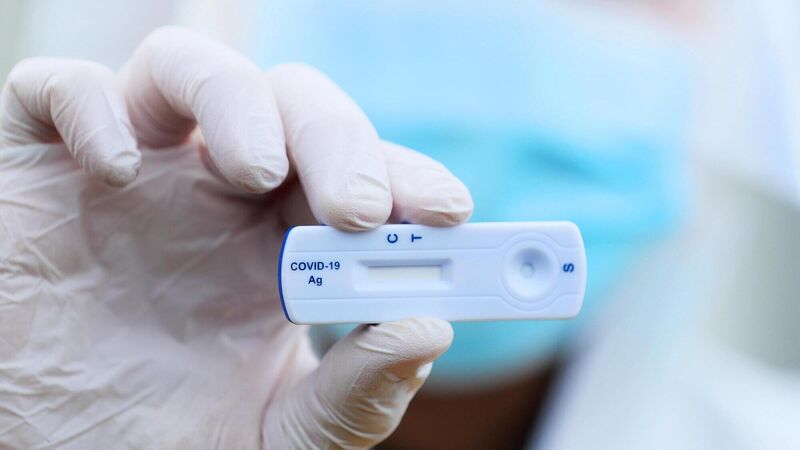
Infectious diseases consultant Dr Eoghan de Barra has said he does not understand why antigen tests are not being used. Picture: Brian Lawless
Nphet is urging the Government to consider extending the use of Covid-19 certs beyond the hospitality industry.
In his letter to the Health Minister, the Chief Medical Officer recommends wider use of Covid-19 certificates but does not specify where they could be used.
Nphet has also recommended that those who engage in what are considered to be high-risk activities, such as attending nightclubs, pubs and restaurants, should consider taking frequent antigen tests.
It recommends self-testing a minimum of twice a week.
The HSE’s National Clinical Lead Infection Prevention and Control, Professor Martin Cormican has warned anyone considering going out this weekend to assess their health first.
“Are you feeling well? If you have any symptoms you shouldn’t be going anywhere, it could be Covid or flu or any number of viruses,” he told RTÉ radio’s News at One.
Doing an antigen test before going out would not protect someone from getting infected, he warned. But it could tell them if they were infected.
The vaccine was important as a flood wall, acknowledged Prof. Cormican. “But we need to do other things to manage the flood.”
Being vaccinated meant that a person was less likely to end up in hospital or in ICU, but they could still get the virus.
Dr Denis McCauley, from the Irish Medical Organisation, says it is important we do all we can to keep the numbers down.
"I think we all have to observe closely what is happening in the hospitals and particularly in intensive care units," Dr McCauley said.
"These have remained quite stable over the last number of weeks and we are hoping that pattern will continue even with higher numbers in the community.
"If that is the case then that is some reasonably good news."
As of 8am this morning, there are 549 patients with Covid in hospital today - an increase of nearly 20% on this day last week.
The latest figures show 76 admissions since yesterday and 49 people have been discharged.
Carndonagh Local Electoral Area in Donegal has the highest rate of Covid-19 in the country.
Almost one in every 50 people tested positive in the space of two weeks.
On Monday, the country's 14-day incidence rate was 924 cases per 100,000 people but Carndonagh's was over twice that, at 1,993.
The second highest incidence was in Manorhamilton LEA in Co Leitrim, at 1,811.
Five other LEAs also have rates of over 1,500.
They are Drogheda Urban in Co Louth, Cahir in Co Tipperary, Lismore in Co Waterford, Arklow in Co Wicklow and Drogheda Rural.
The area with the lowest incidence rate is, once again, Belmullet in Co Mayo, at 198.
In Cork, 10 LEAs have an incidence rate above the national average with Mallow recording the highest rate at 1,320 per 100,000.
Donegal GP Ciaran Ó Fearraigh is urging people to act as the virus spreads widely.
"As a GP, the one thing that I could see making a significant difference is that those with respiratory symptoms would isolate and get a Covid test so we can identify those that have Covid and to isolate them," said Dr Ó Fearraigh.
"The thing that I am seeing a lot of is that many people are not doing that they are just doing antigen tests at home and then carrying about their daily activities without going and getting a formal PCR test."
Dr Ó Fearraigh said that since September doctor's surgeries have been very busy with respiratory illness.
The levels of respiratory illness among adults and children has returned to pre-pandemic levels.
Picking out Covid among these illnesses is the difficult part, he said.

Infectious diseases consultant Dr Eoghan de Barra has said he does not understand why antigen tests are not being used.
It would be pragmatic to use any means that can detect the virus, he told Newstalk Breakfast.
Dr de Barra pointed out that antigen testing was being used elsewhere in the world and there had been two reports recommending their use.
“I’m at a bit of a loss why they (the reports) weren’t implemented.” Having a third of ICU beds occupied by Covid patients was a burden on the system and staff were exhausted, he said.
Workers in other sectors could “turn it off” but healthcare workers were “living and breathing Covid every day”.
Dr de Barra said he understood the recommendations to work from home if possible even though nightclubs were open.
Going to a nightclub was an occasional event while going to work entailed being in an office day in, day out with other people which is a bigger risk.
A final decision on whether people will be told to work from home will not be made until next Tuesday.
Human behaviour was going to be a major factor in the fight against Covid, he said. Boosters were coming which would help.
When asked if the health system was close to breakdown, Dr de Barra said that he did not think the system was at that point, it was still functioning.
He acknowledged that elective work was being cancelled, but some was going ahead.
Israel had already “come out the other side” following their booster campaign, he said.
“There is a way through this.”

People visiting nursing homes will need to show a digital Covid cert from Monday.
New HSE guidance will require proof of vaccination or immunity at the entrance.
Visitors may also be asked to show photo ID to make sure the cert is theirs.
There will be some exemptions allowed to the new requirement on compassionate grounds.
Responding to the new guidance, Sage Advocacy, which provides support and advocacy services to older people, vulnerable adults, and healthcare patients, said new regulations must be enacted.
"If because of Covid-19, there will be no return to the previous open door visiting policy at many nursing homes then Sage Advocacy believes the Government must move legally to protect the right of nursing home residents to have visitors," said Sarah Lennon, Executive Director of Sage Advocacy.
"If new regulations can be enacted at speed when it comes to nightclubs then why can new regulations not also be employed to protect the rights of this country’s 32,000 nursing home residents."