Ambassador: Ireland and Britain should work together on renewables and agri-tech
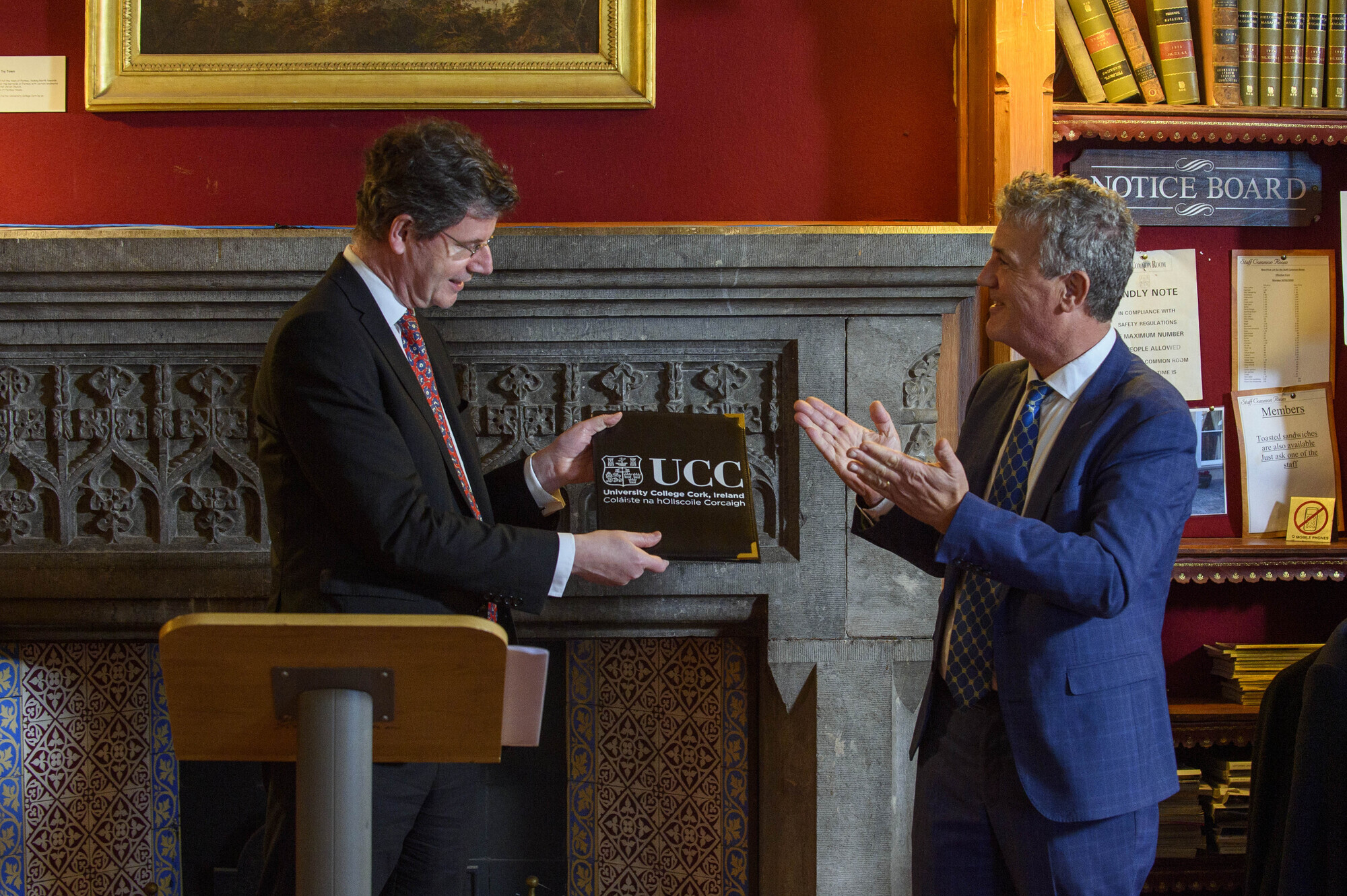
British ambassador to Ireland, Paul Johnston, with UCC president, Professor John O'Halloran.
Ireland and Britain have huge potential to work together in fields such as renewable energy and agricultural technology as the nations tackle climate change obligations post-Cop26.
That is according to British ambassador to Ireland, Paul Johnston, who was visiting University College Cork (UCC) to meet its delegation, whose members have returned from the UN two-week climate change summit in Glasgow.
Mr Johnston acknowledged tensions between London and Dublin over Article 16 of the Northern Ireland protocol agreed between Britain and the EU regarding Brexit, and the North's position regarding the single market.
"If you look at the emphasis on the Irish Government's national development plan, so much of it overlaps with what our government is trying to do in its levelling-up agenda" he told the
CLIMATE & SUSTAINABILITY HUB
It is vitally important that Ireland and Britain work closely together in the fight to combat climate change, and preserving democracies across the world, he said.
Renewable energy, digital health, and other areas of cooperation have "tremendous potential", Mr Johnston added.
The ambassador said he followed closely UCC's engagement at Cop26, and was shown its mural, at the College Rd entrance, by Cork-based artist Kevin O’Brien.
"The conference is a crucial moment to the future of our planet, to make critical changes and keep 1.5C alive.
"Cop26 offers an opportunity for communities to engage with each other on an issue that confronts us all and it was wonderful to see the UCC delegation taking part," he said.
“I can see first-hand the university’s strong climate action agenda and its commitment to tackling the climate crisis.
"I look forward to exploring further how UCC and the British embassy can work together beyond Cop26 to support the achievement of our climate targets.”
UCC was the only Irish university with official observer status at Cop26, sending a delegation of nine researchers and students to Glasgow, making their way to the Scottish Event Campus venue by rail and boat, instead of using planes and cars.
The UCC delegation consisted of experts in carbon emissions and budgets, transport, societal change, sustainable cities, air and water pollution, and energy efficiency.
More than 400 researchers work on climate change at UCC’s Environmental Research Institute.
Prof John O'Halloran, UCC's president, said: "We share the same objective in securing our future and we can only secure our future by winning hearts and minds though research and collaboration.
"As a research intensive university, we commit to use the knowledge emanating from research to address the welfare of humankind and the global environment, taking into account our responsibility not only to present but also to future generations."
CLIMATE & SUSTAINABILITY HUB